
American Goldfinch arrive in Canby, Oregon.
Franklin is the Sector Bullish Percent Portfolio scheduled for a review this morning. This is one of three portfolio using the Sector BPI investing model. New readers to the ITA blog may find this management style of interest as it is showing to be an effective investing model.
The basic idea behind the Sector BPI model is based on Bullish Percent Indicator data. Graphing data this way (BPI) is not common to all investors. The stock market is divided into eleven (11) sectors as is standard procedure. We then follow the movement of the BPI data for each sector. When a sector drops to 30% bullish or lower we purchase the Exchange Traded Fund (ETF) that mirrors that sector. When a sector moves up to 70% bullish or higher, we place a 3% Trailing Stop Loss Order (TSLO) under the overbought ETF. This management style relies on reversion-to-the-mean movement where we purchase low and sell high. The Sector BPI investing model does require patience as most sector spend most of their time moving somewhere in the middle between the 30% and 70% BPI limits.
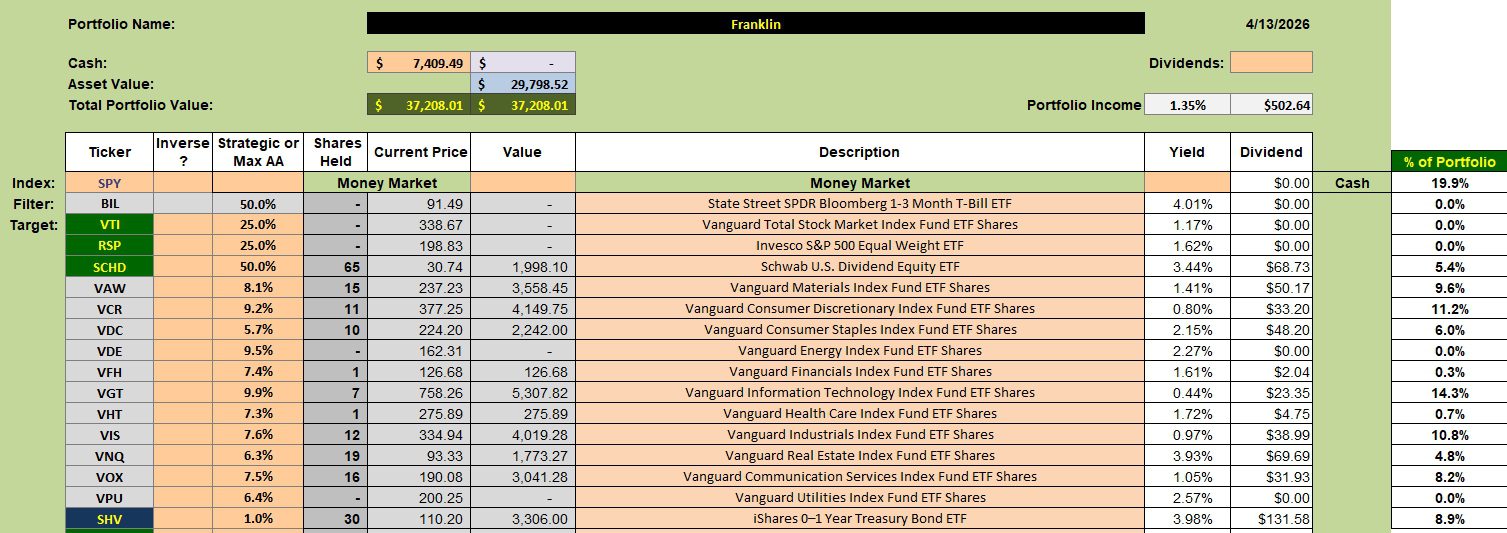
Franklin Sector BPI Holdings
Recent market dips has our Sector BPI portfolios holding more sector ETFs than normal.
One important point. How does one determine how many shares of an ETF to purchase to fill a particular sector when a Buy is called for? I use a three-year volatility average. Therefore, the higher the volatility the more shares one will purchase to fill the sector. Technology, Energy, and Consumer Discretionary are the most volatile so I will hold around 9% of the portfolio in each when the particular sector is oversold. The exact percentage is update and calculated based on price changes over the three-year time frame.
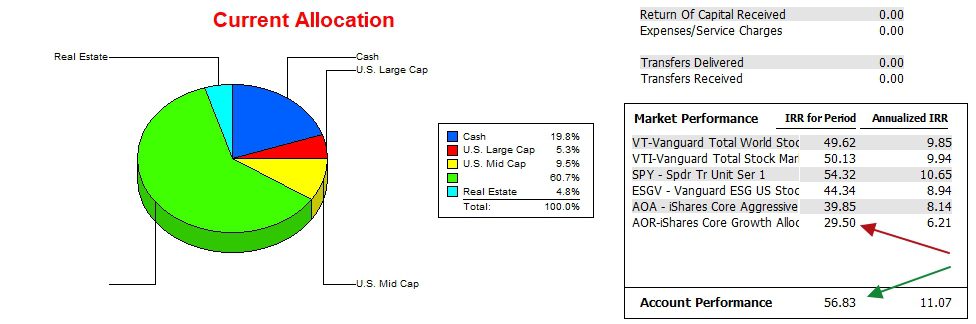
Franklin Performance Data
The following data goes back to 12/31/2021 or before the Franklin was using the Sector BPI investing model. Over this period the portfolio managed to outperform all six benchmarks I track. The goal is to do better than AOR and the Franklin demolishes that benchmark.
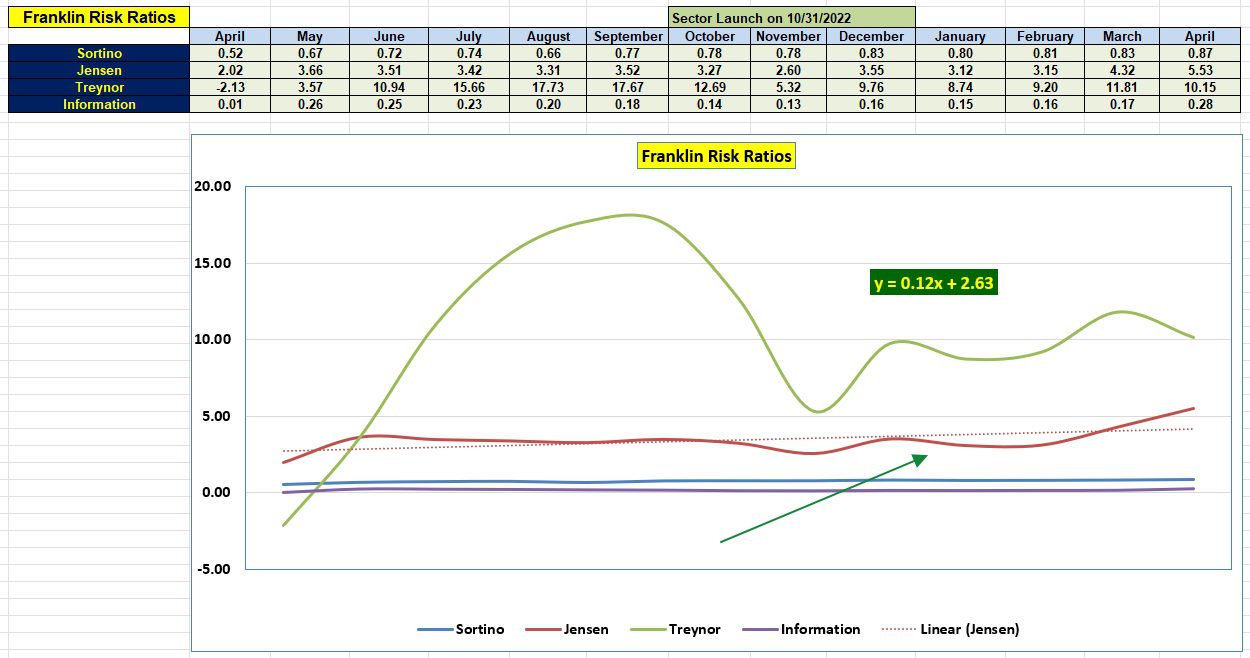
Franklin Risk Ratios
The following table lays out four risk factors. Is the Franklin portfolio doing well because we are taking on undo risk? The Jensen Performance Index is the most useful of the four measurements. Here are the four measurements that go into making up the Jensen PI or many times known as the Jensen Alpha. When the Jensen is positive we say the portfolio is adding alpha to the portfolio. Now here are the four factors.
- The Internal Rate of Return (IRR) of the portfolio.
- The IRR of the benchmark. I use AOR for my benchmark.
- The beta of the portfolio. The current beta for the Franklin is 0.7 so it is approximately 70% as volatile as the S&P 500. This is a conservative portfolio.
- A risk-free rate of return. I use the interest rate for SHV which is currently 3.98%. A few months ago the rate was above 5.0%.
All four risk measurements are well above where they were a year ago. The slope of the Jensen did drop slightly from where it was in the last review.
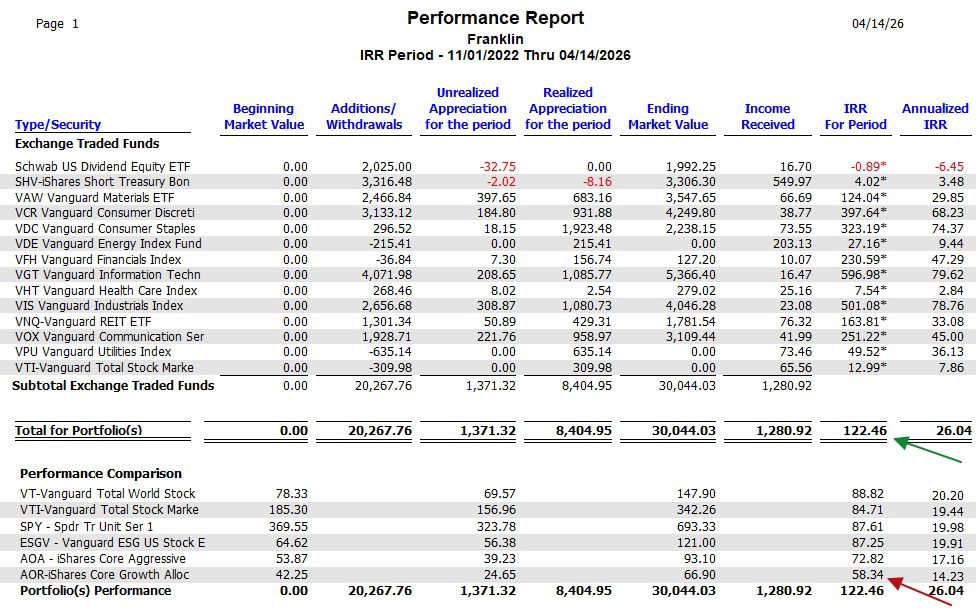
Franklin Sector Performance
Now we come to a very important data table as this table shows how well the Franklin is performance using the Sector BPI investing model since inception on 11/01/2022. This is at the tail end of a poor investing period.
Note how well the Franklin performed vs all benchmarks over this period. The asterisk (*) adjacent to most securities indicate they were not held over the entire period. That is to be expected as most of the ETFs will not be part of the portfolio for the entire duration of the data.
The follow data comes from the commercial program, Investment Account Manager, and I match all transactions to the penny with the broker statement. All ITA portfolios are real money. The portfolios are owned by several individuals.
Comments and Questions are always welcome. If you find this information useful, share with friends and family.
Ask ChatGPT (or other AI source) about the Sector BPI investing model and see what you uncover. Let me know what you find.
Discover more from ITA Wealth Management
Subscribe to get the latest posts sent to your email.
Check the Forum for Sector information. I purchased shares of VDE for all three Sector BPI portfolios and set TSLOs for other ETFs.
Lowell