
“Kingdom of the Sun”, Vidanta World, Nuevo Vallarta, Mexico
On 24 March I added the following comment to my Portfolio Hedging Post of 20 March (https://itawealth.com/portfolio-hedging/):
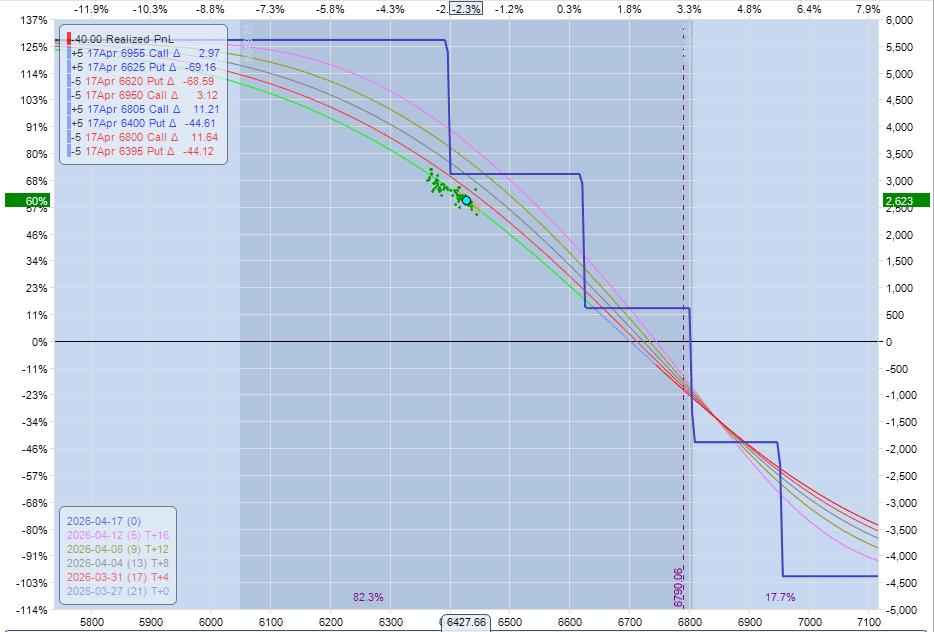
“With the drop in the SPX I have added another risk reversal to my hedge position by buying the 6400/6395 Put Spread and financing this by selling the 6800/6805 Call Spread for a net credit of 0.60 or $300 for 5 contracts. I now have a potential maximum profit of a little over $5,000 should SPX close below 6395 at expiry on 17 April. I have a similar maximum loss should SPX recover above 6855 so I will be looking to reduce this risk back closer to the ~$2000 level.”
This left me with a position that looked like this:
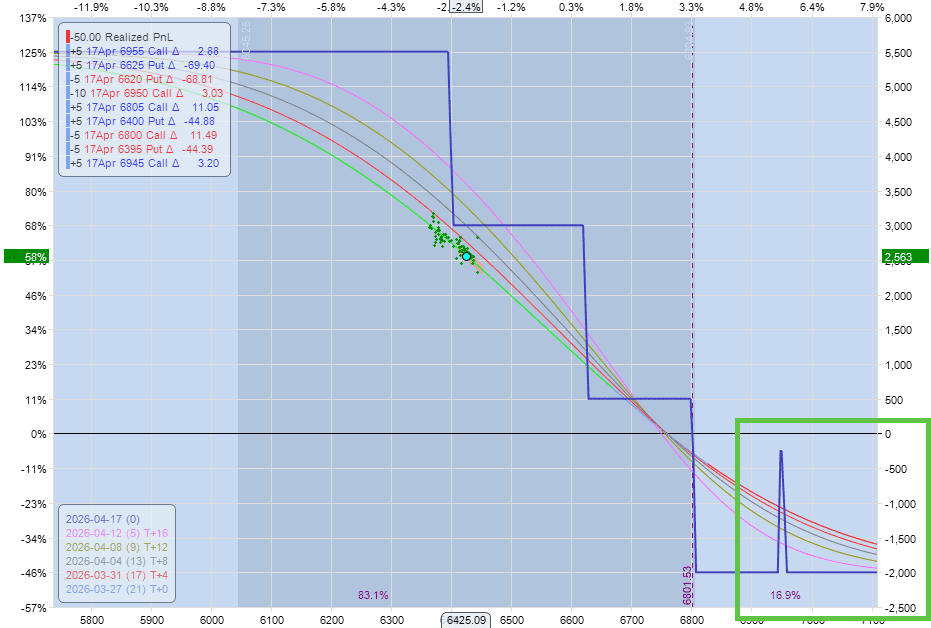
 In order to reduce my downside risk I bought a cheap 6945/6950 Call Spread at 0.20 (or $100 debit for 5 contracts) that generated a narrow butterfly spread at the 6950 strike and reduced my upside risk to ~$2,000:
At this point on Friday it was unclear what might happen next week – are we likely to see US equities fall lower on fear of the war with Iran continuing or might we see a sharp bounce on news that the war has ended and optimism returns to the markets. Consequently I chose to reduce my upside risk further by selling the 6200/6195 Put spreads (15 contracts) at 1.15 for a credit of $1,725 that leaves me with the following position:
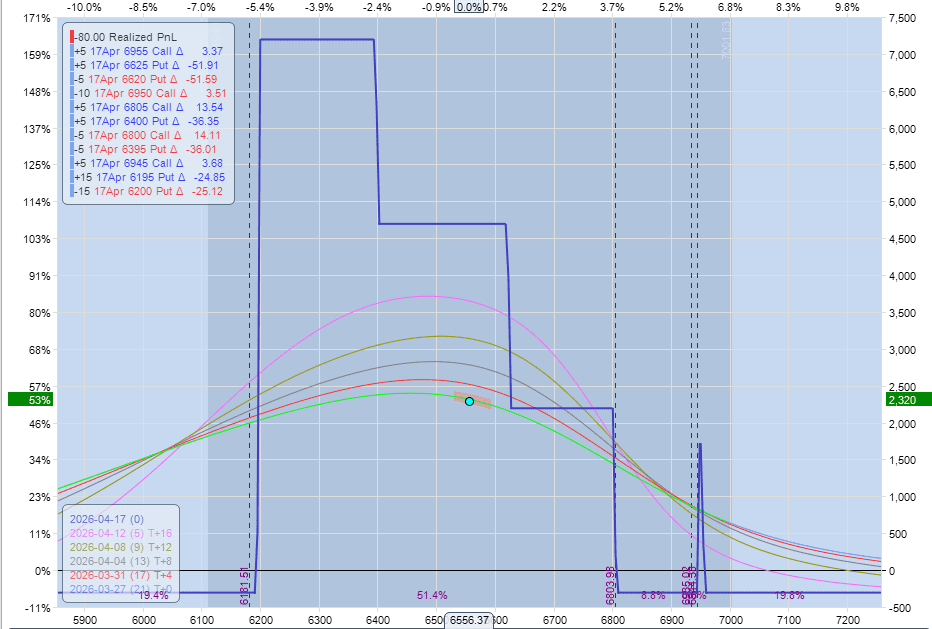 where I have a wide profit zone between 6200 and 6800 and a maximum loss outside of this range of only ~$300. i.e. I have a nice hedge, that can make up to ~$7,200, with only $300 risk. At present the position is showing ~$2,300 profit that is protecting a ~$100,000 portfolio in this current pullback.
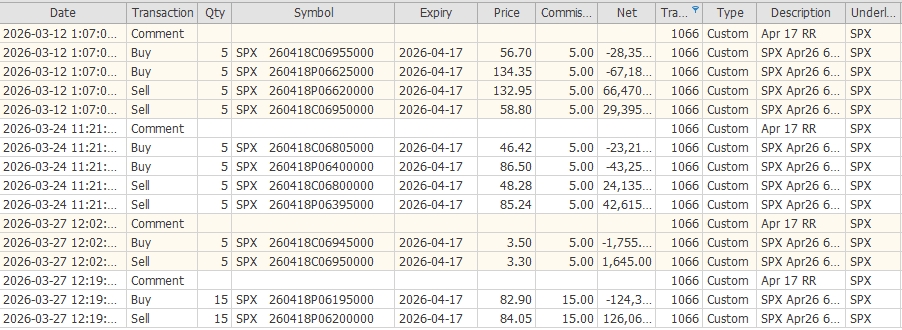
The following screenshot shows the log of trades that got me into this position:
Discover more from ITA Wealth Management
Subscribe to get the latest posts sent to your email.
Hi hedgehunter,
Very interesting and informative. My question is are these covered calls your selling?
Thank you
William, no they are not covered calls for 2 reasons:
1. Since SPX is an index we cannot buy shares in the index itself so it cannot be used to “cover” the Calls that are sold. If we wanted to write covered Calls against the “index” we would have to buy shares in something like SPY (the ETF that “tracks” the index) and Sell SPY Calls against the shares held.
2. This position is a “portfolio” hedge – so the intent is to protect the portfolio against an adverse move against the portfolio. For this reason, the approximate exposure of the portfolio, relative to the movement of the “index”, can be calculated as described in https://itawealth.com/portfolio-hedging/ – at that time it was about 30-40 SPY shares (or 3-4 SPX shares – if SPX shares were available/existed) for the portfolios that I was intending to protect. This provides guidence as to how many Option contracts might be needed to protect the portfolio.
Although the Calls sold are not “covered” by shares of an underlying asset they are not sold with high risk (should the “index” move against us) since they are sold in a “spread” structure where Calls are bought at a different strike to define the maximum risk. i.e. the maximum value of the 6950/6955 Call spread originally sold (from table in above post) is 6955-6950 = 5 x 100 =$500 . But, since I received a credit of $210 (68.80-56.70) x 100) when I sold this spread, my maximum risk cannot exceed $290 per contract even if the market moved upwards and I were not to make any adjustments. Hopefully I would be covering this loss through gains in the underlying portfolio. In this sense, the Calls could be considered to be “covered” by the portfolio – but it is not directly a covered Call.
Obviously the current position is more complicated than this single spread example but I hope this explanation helps answer your question in a little more detail. If not, please ask more questions like this. Thanks for the interest – I don’t expect too many readers of this blog to consider this type of portfolio hedging – the example is for education/interest and is “real-time” to ensure that I am not cherry picking examples 🙂
No adjustments were made to this hedge position in the last week and, although prices moved against us (index moved up), time decay in the Options sold resulted in the hedge increasing slightly in value to ~$2,500. See the screen shots in either the Darwin (https://itawealth.com/darwin-2026-portfolio-review-2-april-2026/) or Dirac (https://itawealth.com/dirac-2026-portfolio-review-2-april-2026/) Portfolio reviews for a more detailed picture of the current position.