 Well, the first quarter of 2026 is over ,and April Fool’s day is behind us, so let’s remind ourselves of how the markets have behaved so far this year. After a slow grind to new highs through January, US Equities, as represented by the SPX (S&P 500 Index), have pulled back ~ 10% through February and March and are now ~6% lower than they were at the end of 2025:
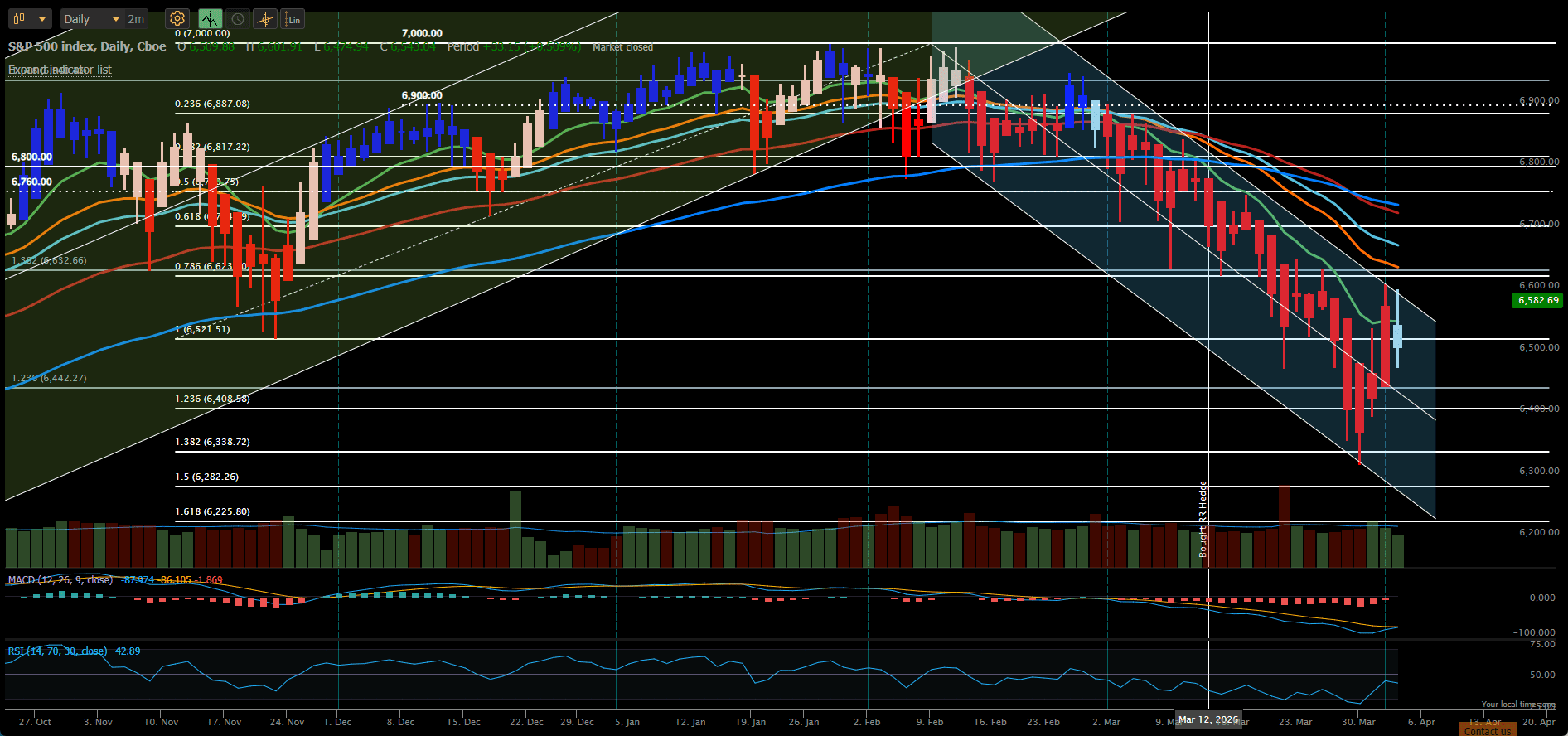 We are still in a bearish trend channel but, thanks to a modest bounce over the past week, are presently sitting closer to the top of that channel, rather than the bottom, as we were last week.
This “optimism” was reflected in most major asset classes over the past week:
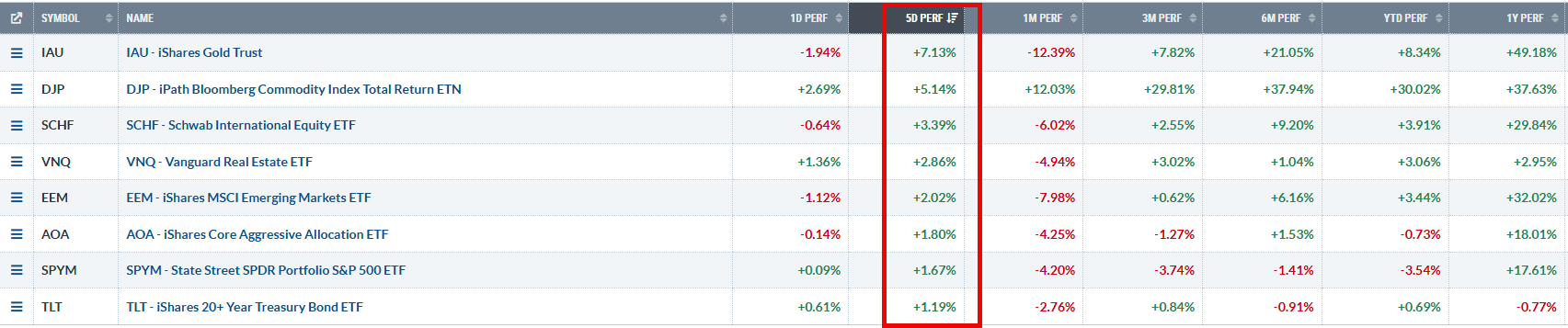 with Gold and Commodities leading the way, equities in the middle, and Bonds bringing up the rear (although still with positive returns).
In the current political and economic environment it is difficult to asses what might happen from here, but it seems obvious that we are likely to see continued high volatility at least for a little while until things settle back down to “normal”.
The Darwin Portfolio is a diversified portfolio of assets representing most of the major asset classes and the portfolio is managed using a combination of momentum and mean reversion measurements to provide suggestions as to which asset classes might be held. A current analysis of the assets within the “quiver” is shown below:
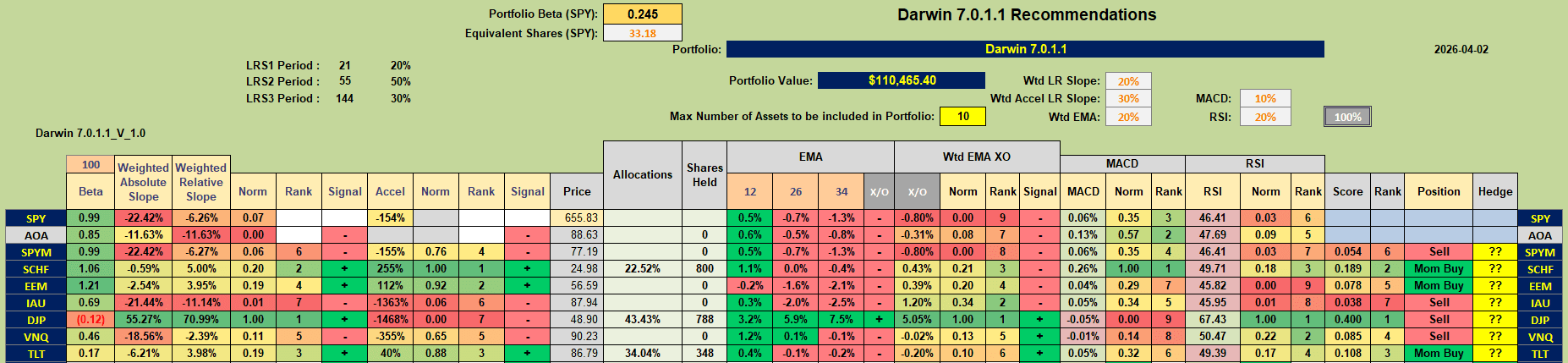 where there have been a few changes over the course of the last week with SCHF and EEM (Developed and Emerging Market Equities) suggesting Momentum Buy opportunities along with TLT (Bonds). Maybe a little unexpectedly, DJP (Commodities) is generating a Sell signal, despite the increases in Oil prices. So, let’s take a look at some of the charts, beginning with DJP:
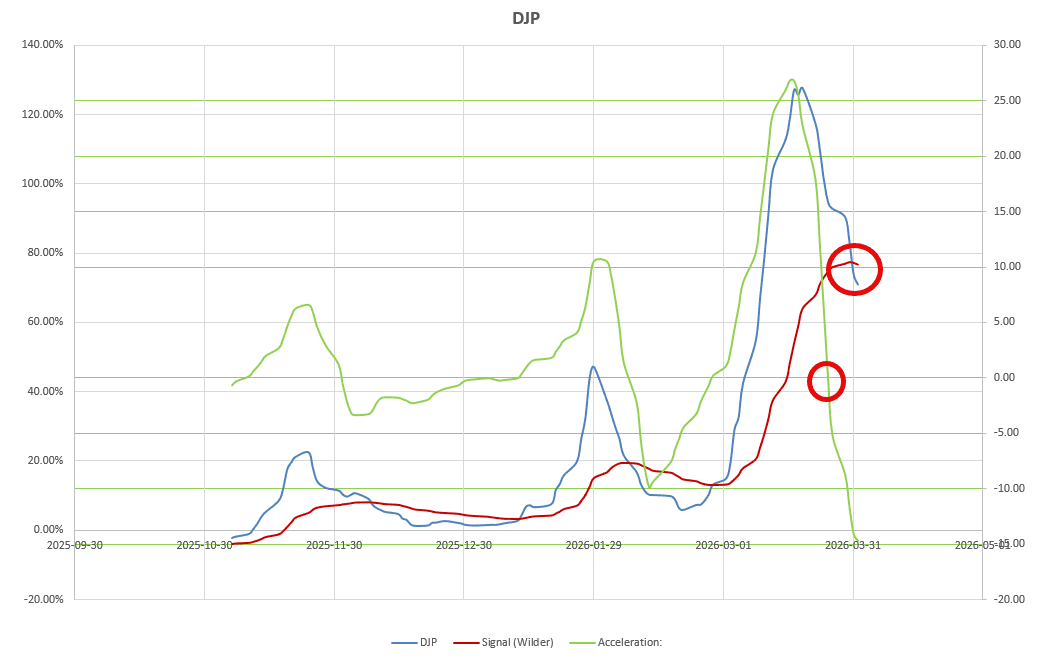 DJP has been on a very strong bullish momentum move (blue line – left hand axis) but, maybe not too surprisingly, this has slowed down a little and acceleration (rate of change of momentum – green line) has recently turned negative (red circle). At the same time, momentum itself (blue line) has just crossed below it’s 14-period Wilder moving average (brown line at other red circle). This combination triggers a Sell recommendation in the algorithm used to generate suggestions for this portfolio with these measurements designed for “investments” over the intermediate term (1-6 months). However, daily price movements and shorter term indicators, like MACD (Moving Average Convergence/Divergence) and RSI (Relative Strength Index) are not so negative and the daily chart is still looking pretty strong with Exponential Moving Averages (EMAs) positively stacked:
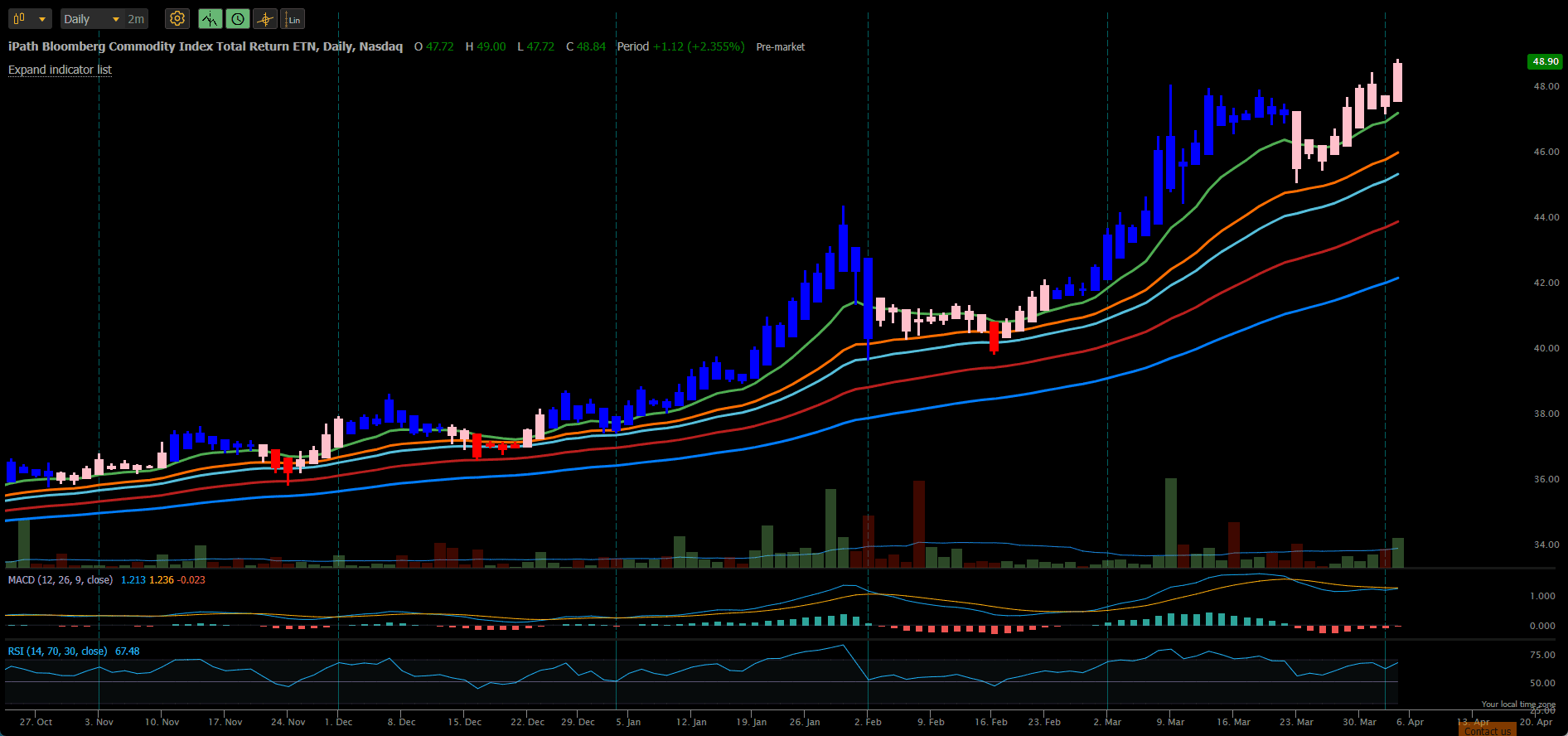 Although this may well turn out to be a good time to take profits on the strength of Oil, I have chosen to ignore the recommendations at this time and to wait to see where we might go from here.
Moving on to the Momentum Buy recommendations we can check out SCHF (Developed Markets):
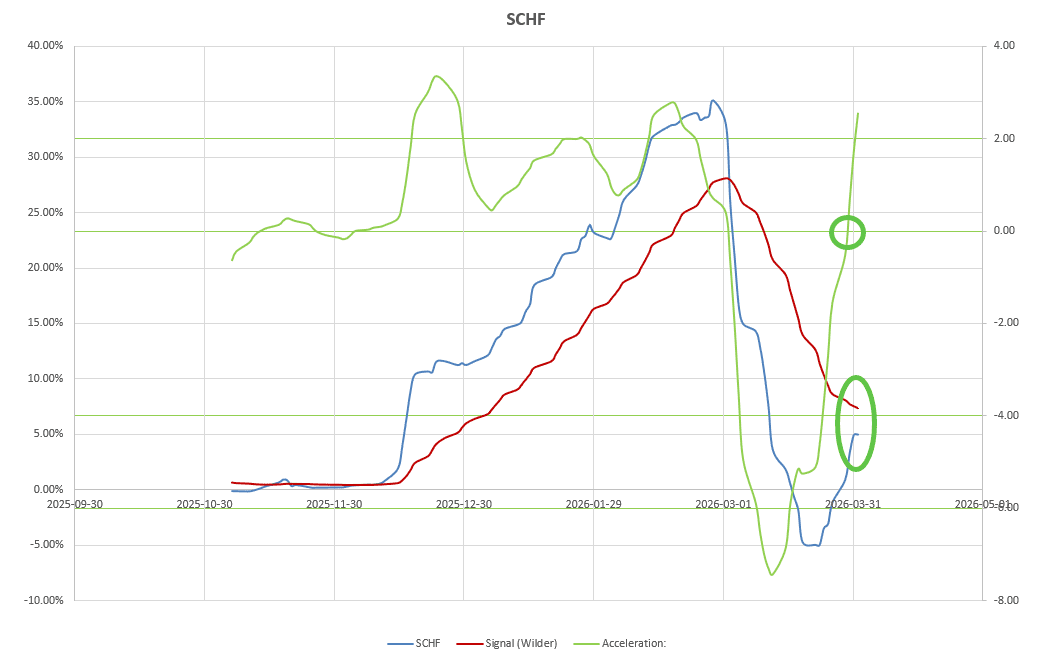 where we can see that acceleration (green line – right axis) has just turned positive and momentum (blue line – left axis) is also positive. The current algorithm generates a Momentum Buy signal under these conditions. However, momentum has not crossed above it’s 14-period moving average so there is a certain lack of confirmation here and I am watching these situations closely to decide whether I should modify the algorithm slightly to require the confirmatory cross-over. Meanwhile I have taken a limited position (800 shares) in SCHF.
The price chart for SCHF looks like this:
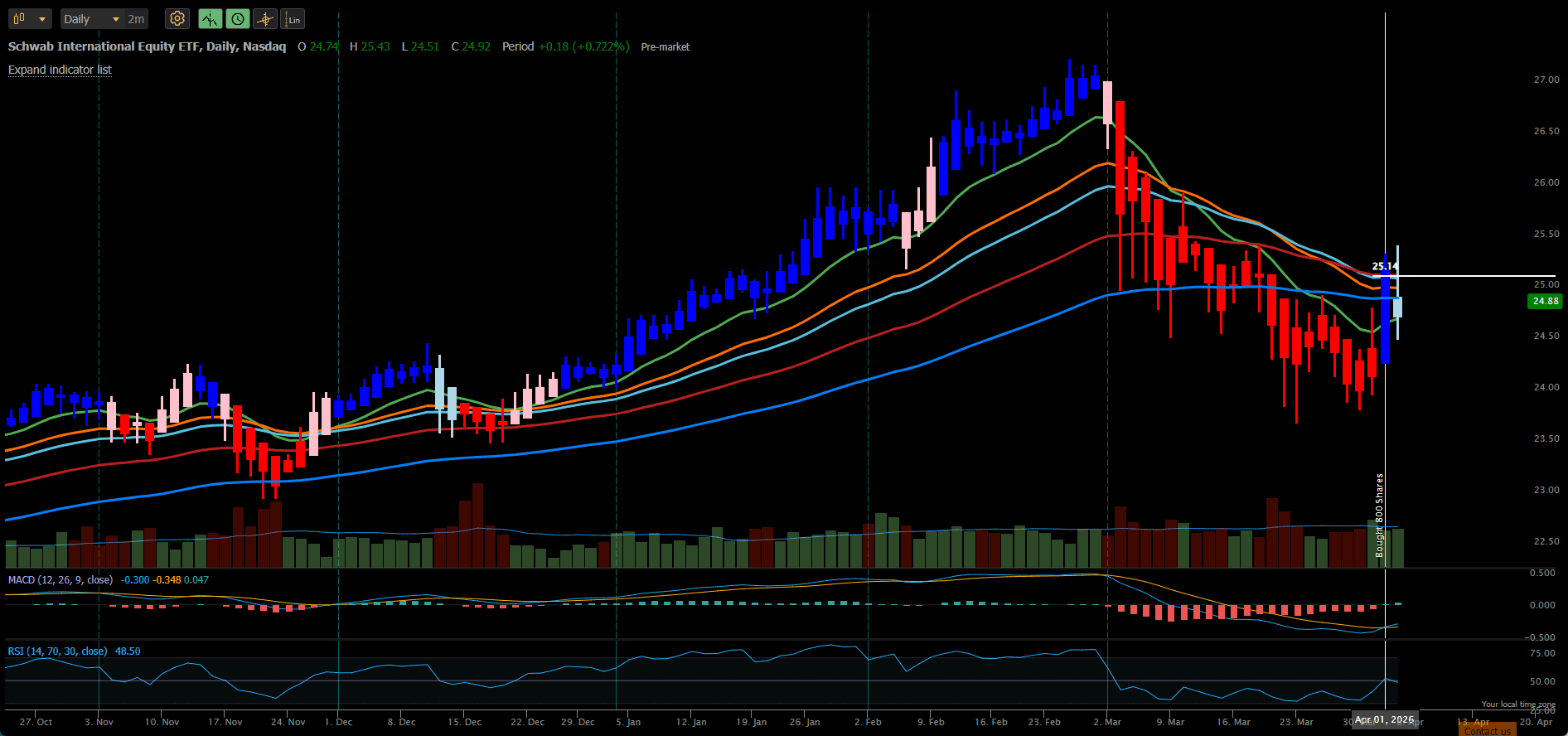 with ahorter term indicators (MACD and RSI) beginning to turn positive.
However, I am holding off on opening a position in EEM (Emerging Market Equities), that is showing a very similar momentum/acceleration chart pattern, until we see whether we get a cross-over sometime next week.
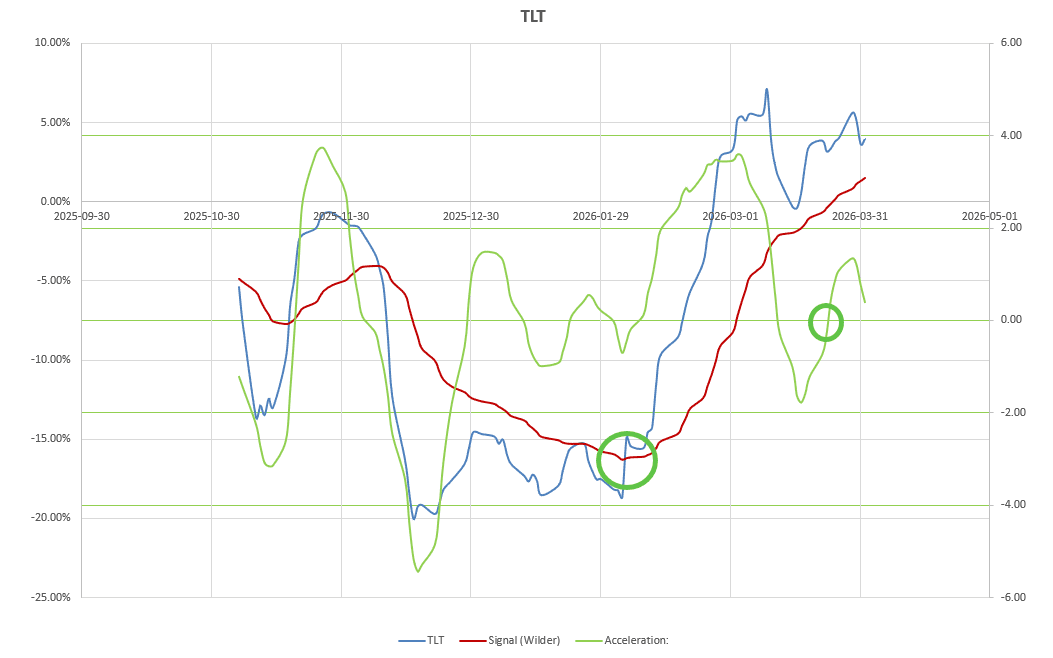
I was a little under-allocated in Bonds (TLT) at the beginning of the week, and the momentum/acceleration charts were still looking good and signaling a Buy recommendation, so I added an additional 175 shares to the portfolio:
Trades over the past week look like this:
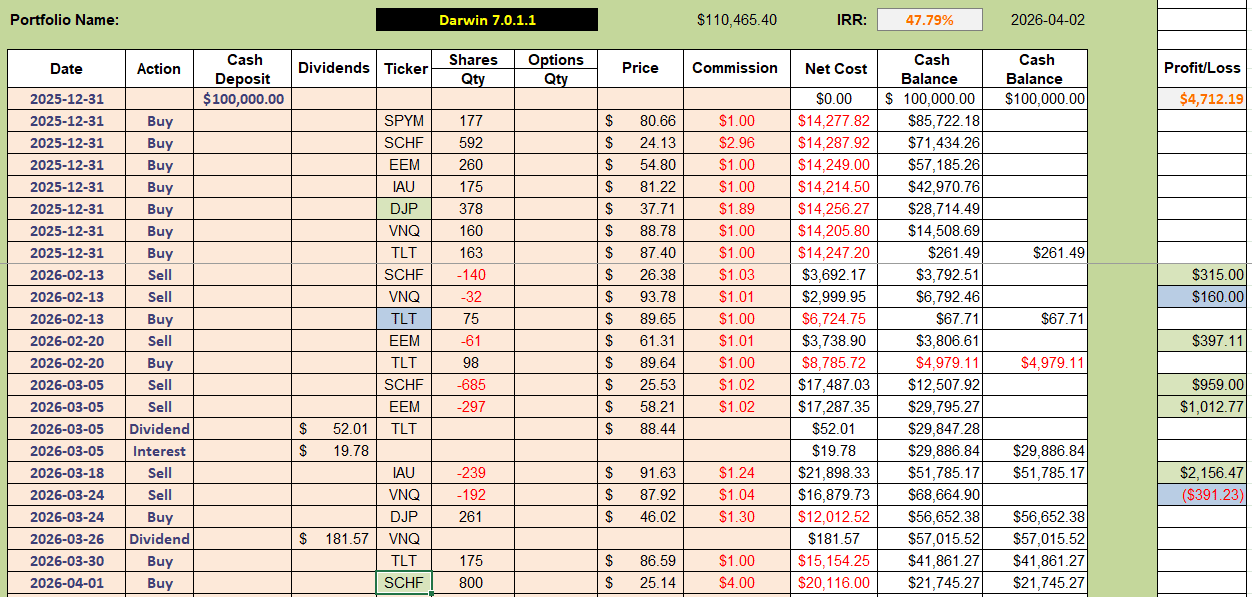 and I am currently ~80% invested.
Performance of the portfolio, to date, looks like this:
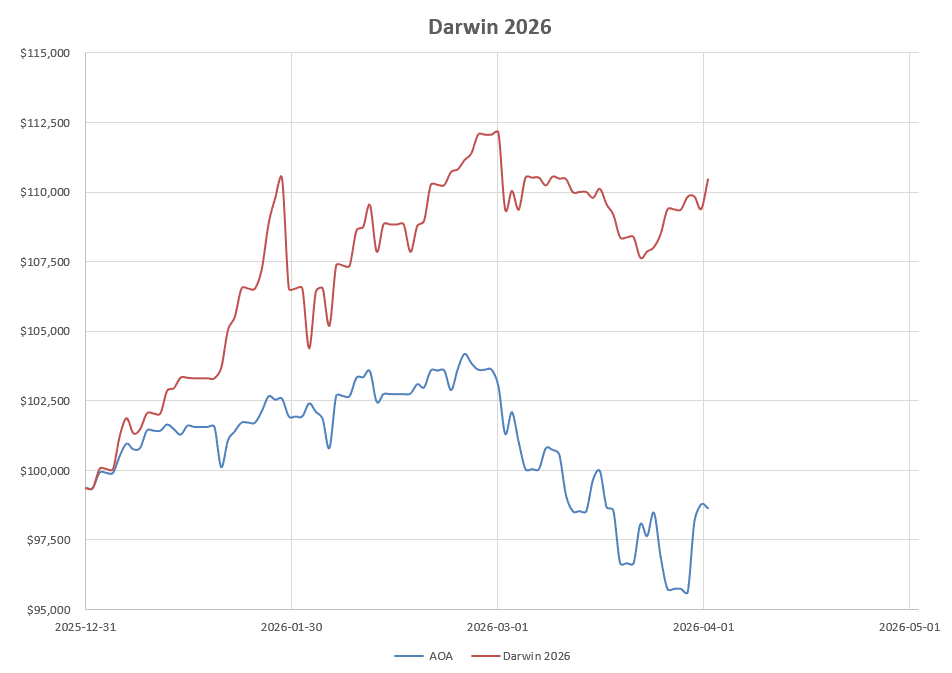 still holding up well (~48% IRR over the 3 month Period) compared with the performance of the AOA benchmark Fund that is showing a small loss over the same period. Diversification certainly seems to be helping the performance of this portfolio since returns are higher than those of less diversified portfolios such as the Dirac Portfolio (US equity sectors only).
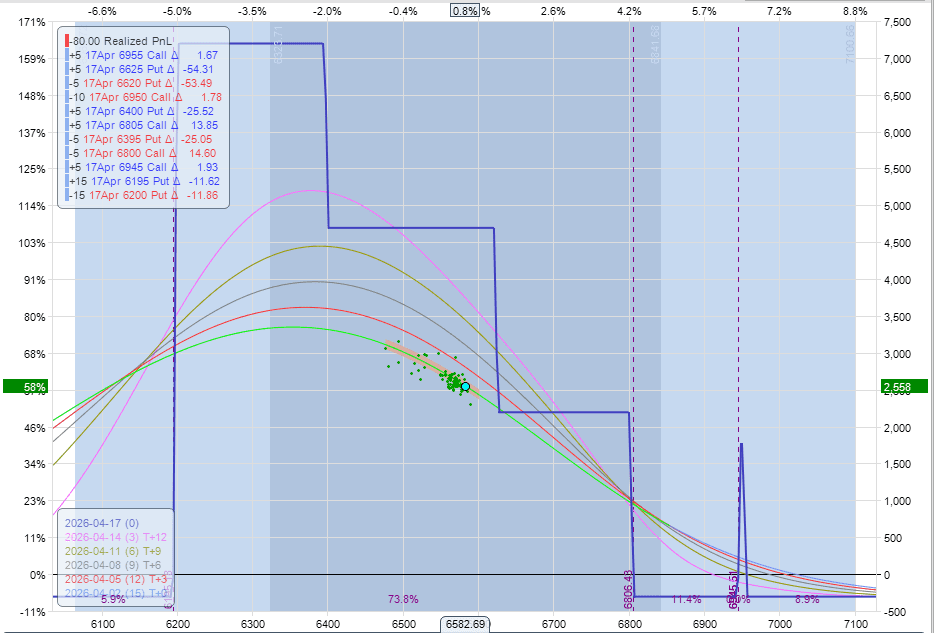
In addition, I made no adjustments to my Portfolio Hedge this week and this is still showing a nice (unrealized) gain of ~$2,500. This is not officially a part of this portfolio since I am aware that most readers of this blog don’t want to go down this rabbit-hole.
Discover more from ITA Wealth Management
Subscribe to get the latest posts sent to your email.
Hi Lowell: Rob Aigner here. I left Schnitzer Properties two years ago to retire after 18 years with Jordan. It’s a great feeling. I am managing my own $1,000,000 portfolio and would like to re-engage with you. Feels like I am starting over. Just where do you think I should begin? Can I change my e mail tp rob@raigner.net? Thank you.
I appreciate your advice.
Rob
Rob,
I was able to change your e-mail as requested.
As for giving advice, I prefer not to do that directly as I no longer carry any type of security license. Instead, I recommend following two or three portfolios that fit your requirements. Hedgehunter provides several portfolio examples in addition the ones I write about.
The current market conditions are perilous. A few months ago I wrote a blog as to how one might manage a sudden influx of cash. Here is the link to that blog post.
https://itawealth.com/what-should-i-do-if-i-sell-my-house-or-come-into-an-inheritance/
The easiest portfolios to follow that I manage are the Copernicus and Schrodinger. The most complicated are the Sector BPI portfolios. They are: Carson, Franklin and McClintock.
I have adjusted a number of the Asset Allocations of the other portfolios as I think we are in for a major draw-down if not a recession. The Huygens I posted today is an example of creating a low beta portfolio.
Welcome back.
Lowell