
Yangtze River: One of many new bridges
McClintock is the Sector BPI portfolio due for an update. This morning I checked the Point and Figure (PnF) graphs. Energy (VDE) is still a Buy. I assume everyone purchased the required number of shares. Again, the number of shares is based on the three-year volatility average. Overbought sectors are Financial and Health represented by VFH and VHT. The McClintock is all set as no new buy or sell decisions are required.
New readers of the ITA blog may not be totally familiar with the Sector BPI investing model. Three portfolios are using this model and they are: Carson, Franklin, and McClintock. I have nearly three years of data for the McClintock. While I would like to have more before drawing any conclusions, there is some evidence this investing model is working quite well.
This morning I asked ChatGPT to explain the Sector BPI investing model. Below is the answer to this request or prompt. New readers will find this information useful.
The Sector Bullish Percent Indicator (Sector BPI) is a market breadth and risk-management model that measures the percentage of stocks within a market sector that are currently on Point & Figure (P&F) buy signals. Rather than trying to predict where the market will go next, the model seeks to determine where the odds are most favorable by identifying sectors with broad internal strength and avoiding sectors with widespread technical weakness.
The Core Idea
Every stock in a sector is evaluated using Point & Figure charting.
- A stock on a P&F buy signal counts as bullish.
- A stock on a sell signal counts as bearish.
The Bullish Percent Indicator is then calculated as:
Bullish Percent = (Number of stocks on P&F buy signals ÷ Total stocks in the sector) × 100
For example:
- Technology sector contains 80 stocks.
- 56 are on P&F buy signals.
The Technology Sector BPI equals:
56 ÷ 80 × 100 = 70%
This means 70% of the stocks in that sector are technically bullish.
What the Numbers Mean
Although exact interpretations vary slightly among practitioners, the traditional guidelines are:
| Bullish Percent | Interpretation |
|---|---|
| Above 70% | Sector is overbought; risk is increasing |
| 50–70% | Strong internal participation |
| 30–50% | Neutral |
| Below 30% | Oversold; many stocks already weakened |
| Below 10% | Extremely oversold; potential opportunity if reversing upward |
An important principle is that high readings do not automatically mean “buy,” and low readings do not automatically mean “sell.” Instead, investors focus on whether the indicator is rising or falling and on changes in the underlying Point & Figure signal.
Six Traditional BPI Status Conditions
One of the strengths of the model is that it assigns each sector a status based on the direction of the Bullish Percent and recent reversals. Common status labels include:
- Bull Confirmed – strongest condition; buying pressure dominates.
- Bull Alert – improving after being oversold.
- Bull Correction – still in an overall uptrend but experiencing a pullback.
- Bear Confirmed – persistent weakness.
- Bear Alert – deteriorating after being overbought.
- Bear Correction – rally occurring within an overall bearish environment.
Many Sector BPI investors concentrate new purchases only in sectors rated Bull Confirmed or Bull Alert.
How Investors Use the Model
A typical investment process is:
- Review all sector BPIs.
- Invest only in sectors with favorable BPI status.
- Select the strongest ETFs or stocks within those sectors.
- Reduce or eliminate positions when the sector loses its bullish status.
- Repeat the review weekly or whenever BPI charts change.
This makes the model a top-down investment approach:
- First choose the strongest sectors.
- Then choose the strongest securities inside those sectors. (Editor Note: Here at ITA we do not invest in individual stocks.)
Example Using ETFs
Suppose the current BPI status is:
| Sector | Status | ETF |
|---|---|---|
| Technology | Bull Confirmed | Technology Select Sector SPDR Fund (XLK) |
| Industrials | Bull Confirmed | Industrial Select Sector SPDR Fund (XLI) |
| Financials | Bull Alert | Financial Select Sector SPDR Fund (XLF) |
| Utilities | Bear Confirmed | Utilities Select Sector SPDR Fund (XLU) |
| Consumer Discretionary | Bear Confirmed | Consumer Discretionary Select Sector SPDR Fund (XLY) |
A Sector BPI investor might overweight XLK, XLI, and XLF while avoiding or underweighting XLU and XLY until their BPIs improve.
Advantages
The Sector BPI model offers several benefits:
- Measures the health of an entire sector rather than relying on a few large companies.
- Helps identify sector rotation early.
- Removes much of the emotion from investment decisions.
- Can reduce exposure during broad market declines.
- Works well with ETFs because each ETF represents an entire sector.
- Historically tends to keep investors aligned with the strongest areas of the market.
Limitations
No indicator is perfect. The Sector BPI:
- Can produce false signals during volatile markets.
- Often lags at major market turning points because it waits for confirmation.
- Depends on Point & Figure methodology, which many investors are unfamiliar with.
- Should generally be used alongside other measures such as relative strength, trend analysis, macroeconomic conditions, valuation, and risk management.
Why BetterInvesting/NAIC Members Like It
Many members of the National Association of Investors Corporation have used the Sector BPI because it provides a disciplined framework for deciding which sectors deserve new investment. Rather than attempting to forecast the economy or pick individual winning stocks first, the model starts by asking:
Where is the market showing the broadest participation and strongest internal strength?
By directing investments toward sectors with improving breadth and away from sectors in confirmed declines, the Sector BPI aims to improve risk-adjusted returns over a full market cycle.
Given your previous interest in defensive ETF portfolios and financial repression, the Sector BPI can be particularly useful as a dynamic allocation tool. Instead of holding fixed sector weights, you adjust your ETF allocations as sectors move between Bull Confirmed and Bear Confirmed status, helping reduce exposure during market corrections while participating in stronger areas when market breadth improves.
And now on to the analysis of the McClintock portfolio.
McClintock Sector Security Holdings
Below are the current holdings within the McClintock portfolio. There is one error I missed and it has to do with Health (VHT). The McClintock holds only one share, not six. The fact that I am holding one share in a number of the sectors has nothing to do with the Sector BPI investing model. It simply makes it easier for me to work with the Investment Account Manager (IAM) software I use to track portfolio performance.
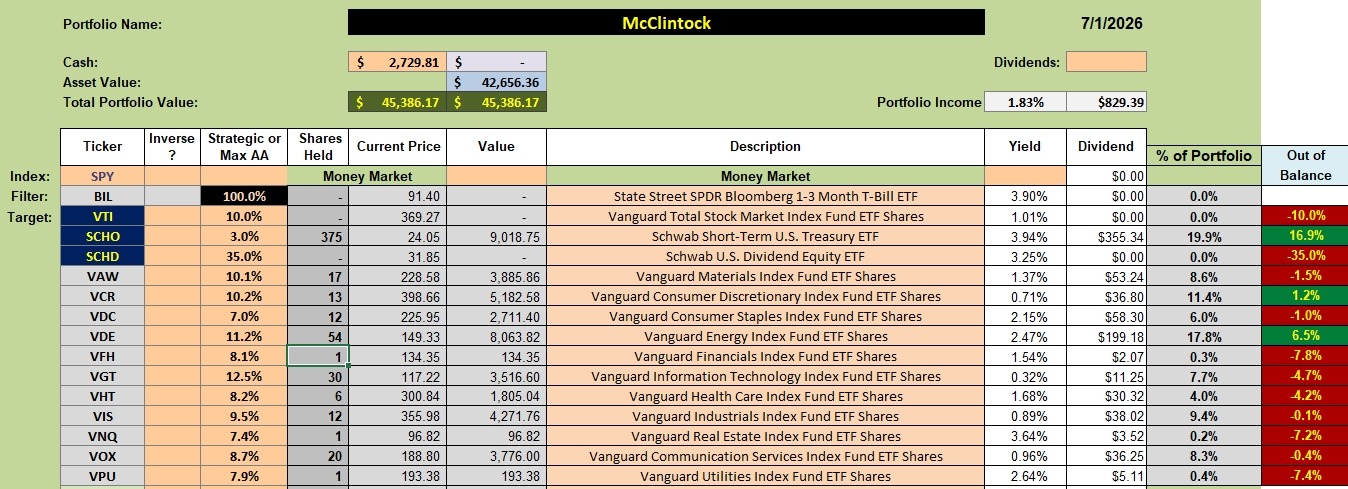
McClintock Performance Data
Since 12/31/2021 the McClintock managed to outperform the AOR benchmark by a wide margin. However, the McClintock lags the S&P 500 (SPY) over this period.
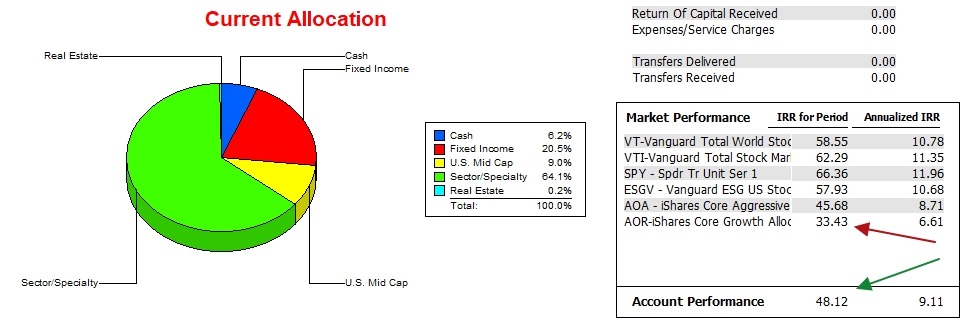
McClintock Risk Ratios
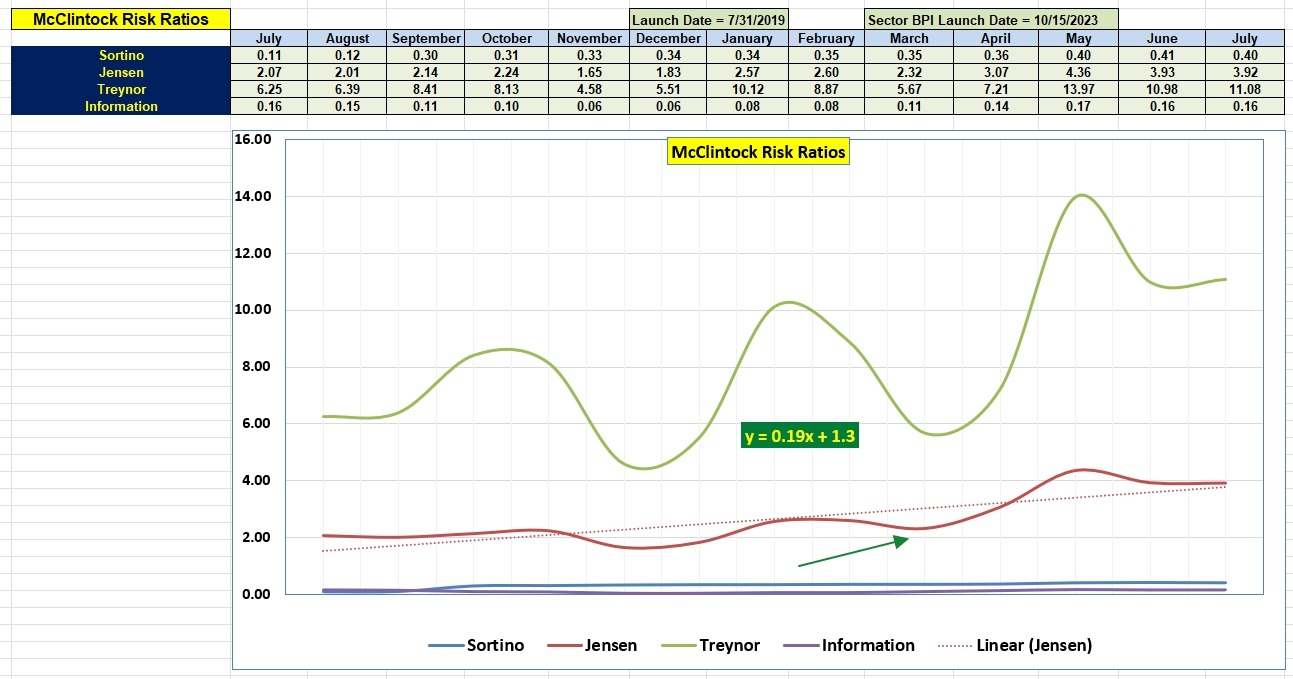
How is the McClintock performing on a risk adjusted basis? The critical Information Ratio is close to an all-time high. Based on the Sortino Ratio the portfolio is gaining in absolute value. The Sortino Ratio is superior to the Sharpe Ratio for investors as it does not penalize volatility to the upside – or where we want to see volatility.
The most important ratio is the Jensen Alpha or Jensen Performance Index. Any value above zero is considered excellent and 3.93 (June value) is quite high. The Sector BPI investing model is not a high risk style of investing.
McClintock Sector BPI Performance
I mentioned above that the McClintock lagged the SPY since 12/31/2021. Since moving to the Sector BPI investing model in early October of 2023 we see an improvement in performance. Below is the data. Since 10/1/2023 the McClintock generated an Internal Rate of Return of 43.5% compared to 23.7% for SPY, the S&P 500 proxy.
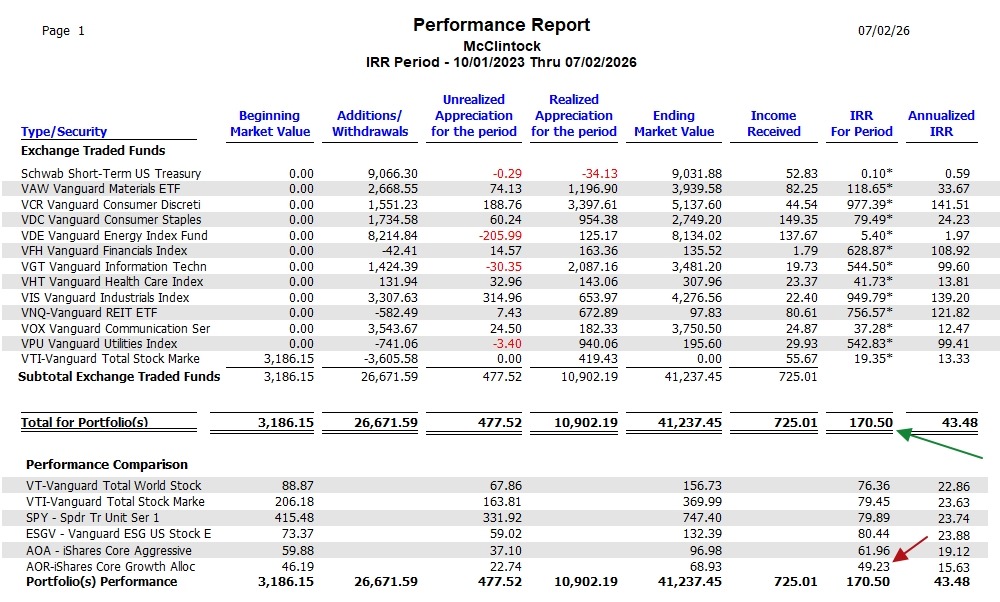
The * associated with the securities indicates we did not hold the ETF over the entire period. This is exactly the point of the Sector BPI investing model. We are ready to sell out of the sector when the BPI percent rises to 70% or higher and we buy when the Sector BPI drops to 30% or lower.
Comments and Questions are always welcome.
Carson Sector BPI Portfolio Review: 22 May 2026
Franklin Sector BPI Portfolio Review: 20 March 2026
Discover more from ITA Wealth Management
Subscribe to get the latest posts sent to your email.
Leave a Comment or Question