
Gretna Green, Scotland
I have reset the Darwin Portfolio to a $100,000 investment portfolio with small changes to the asset list (“quiver”) and the introduction of a new algorithm for trading in 2026. This post outlines these changes and my plans for managing this portfolio going forward.
Background
I have now been developing/building systems for investment and trading for over 25 years. Why do I do this? It is not with the expectation of making millions of dollars, but rather because, as a trained scientist/engineer, I have always felt that there should be an answer/solution to any situation, and I enjoy looking for these answers and for the best solutions. However, I recognize that, within the financial markets, this is not always easy and that although a given system/model may work well in some market environments it often fails in others. The challenge then becomes how one might preserve wealth within acceptable limits of risk.
First of all, we need to recognize that when we invest/trade we are rewarded (or not) for taking risk – and that this risk needs to be managed. When we buy a stock or fund there is a risk premium included in the price we pay, that we need to harvest in a structured/planned way. If we look at the performance of the S&P 500 over the past 50 years we see the following picture:
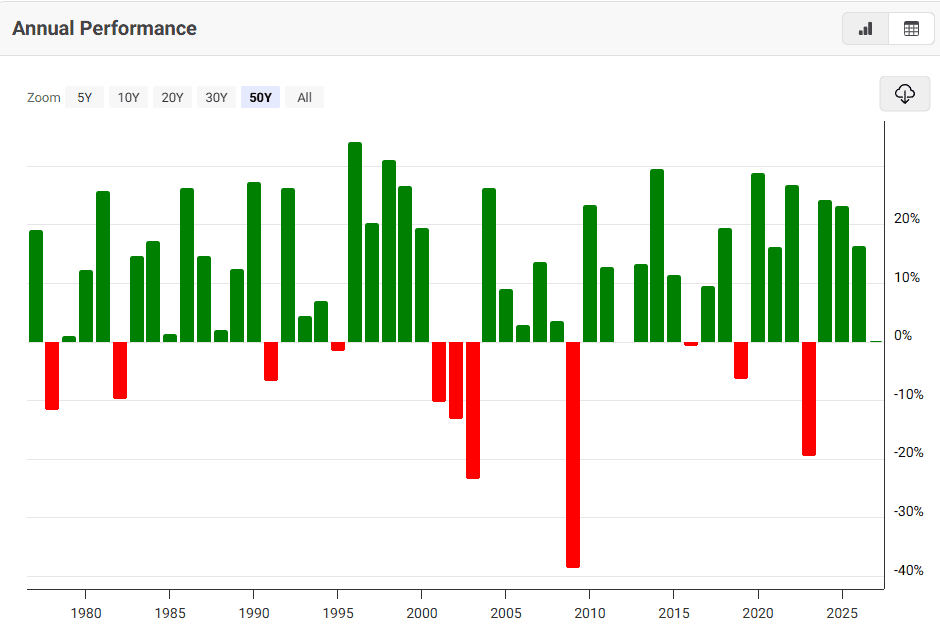
… with an average annual Return On Investment (ROI) of a little over 10% over this time-period. Not too bad. However, there have been periods of poor performance – particularly the “crash” of 2000-2003 following the burst of the tech bubble (a 50+% drawdown), in 2008 following the financial housing crisis (a ~40% drawdown) and, to a lesser extent, in 2020 in reaction to the Covid pandemic (a ~20% drawdown). Ideally, we would not have wanted to be invested in the US equity markets in these years and anyone entering their retirement years in these periods might have been particularly concerned over the preservation of their financial health. However, through diversification into other markets we might have alleviated at least some of this pain. Our acceptance of risk will change as we move through life and we recognize and accept the probability of being able to recover any losses that we might incur within the time-frame of our possible/probable need for the money. And so, our investment model/system is also likely to change.
When I lost my spreadsheet/files, that I have used for system management, about 3 months ago, I decided to look back at the systems that I have designed and developed over the years and to try to pick the features that seem to have worked best in different time frames and in different environments and this post attempts to address what I see as the major factors/parameters that may impact future performance. There is no direct “prediction” involved since I haven’t found a “robust” method of predicting the future – but there are some obvious choices/alternatives that need to be considered.
Asset Selection – What’s in the “Quiver”?
Since I want this Darwin Portfolio to remain a “global” and diversified portfolio I don’t want to change the composition of the “quiver” in any significant way. However, in order to keep things as simple/easy as possible, from a practical trade management standpoint, I have reviewed my asset list and cut it back to seven funds, as follows:
- SPYM – US Equities – large Cap S&P 500 stock – no change
- SCHF – Schwab Developed Market Equities (a shift from EFA/VEA – but same asset class, so not too significant);
- EEM – Emerging Market Equities – no change
- IAU – Gold – no change
- DJP – Commodities – a switch from Oil alone (although Oil/Gas still remain the main contributors to returns) to a more diversified blend of commodities – a slight duplication in Gold, but not too much overlap (<10%);
- VNQ – Real Estate – no change
- TLT – Long Term US Treasuries – back to regular unleveraged bond fund rather than leveraged TMF Fund
For now, I have removed IBIT (Crypto) and SVXY (Volatility) from the quiver so as to keep the number of asset classes as low as possible until we see how things go. The portfolio still maintains a reasonably wide range of correlations.
I will continue to use AOA as the benchmark fund since it provides a reasonable correlation to the holdings within the portfolio but I will not consider it for inclusion in the holdings.
Styles of Investing and System Models
There are 2 basic styles of “investing”:
- Passive (”Buy-And-Hold”) Investing
- Active (“Tactical”) Investing
Portfolios employing both of these investment styles are regularly reviewed on this site and are designed to demonstrate the expected performance of these styles that might meet the needs of investors with different time horizons and time willing to spend on monitoring/adjusting their investments.
Since I prefer to manage my portfolios actively this post addresses the latter of these 2 styles.
At the highest level I see 2 possible models that might be used for active investment/trading:
- Trend/Momentum Systems
- Mean Reversion Systems
Which of these systems/models may work best depends on the time frame being considered – with Trend/Momentum systems generally performing better over “intermediate-term” time frames and Mean Reversion systems performing better over “short-term” or “long-term” time frames. Of course, what we mean by short, intermediate and long-term is not easy to define – and is likely to vary depending on the asset class we are considering – but, for the purposes of this post, I will (arbitrarily) define “short-term” as less than 1 month, “intermediate-term” as 1-3 months, and “long-term” as greater than 3 months.
We also have to consider the risk that we will be taking over the chosen time-frame – so it doesn’t get us too far in helping us make decisions on time frame without an appreciation/acceptance of risk– it only helps from the point of view of recognition of which systems might work best. And then we need to decide whether we are comfortable accepting the consequential risk.
Ideally, it would be nice to include both models in a single system – but this is a difficult task.
Trend and Momentum are similar systems with subtle differences. Trend systems tend to rely on simple directional movement e.g. whether price is trading above or below a chosen moving average (with the period of the moving average reflecting the chosen time frame) whereas Momentum systems consider the strength or velocity (rate-of-change) of price over a chosen time period, again with the period reflecting the chosen time frame.
Mean reversion systems look for reversals in price movement from Over-Sold or Over-Bought conditions that might be defined in different ways e.g. through the use of indicators such as RSI (Relative Strength Indicator) or MACD (Moving Average Convergence/Divergence) or through the BPI (Bullish Percent Index) as used by Lowell in many of his portfolios.
Although I will generally use Mean-Reversion systems for short-term (1-5 day holding period) trading I prefer to use Momentum (and Trend) systems for longer time-period “investment” purposes.
2026 Model for Momentum Investing
Over the years I have used 2 methods to “measure” momentum. The first is the classical Rate-Of-Change (ROC) method that simply measures the difference in price, from beginning to end, over a chosen time period. The second is to measure the slope of the linear regression (minimum variance) line through all points within the chosen time-period. This methodology also offers the option to measure the confidence of the measurement (r-squared) that is affected by volatility.
Although I believe that either method of measurement is equally valid, I prefer to use the linear regression (LR) method as it results in smoother (less noisy) data than the ROC method and offers the additional option of including volatility into the analysis.
In addition, since I prefer to look at relative performance, I choose to look at the ratio of asset price relative to a benchmark (by dividing the asset price by the benchmark price) rather than using the asset price alone:
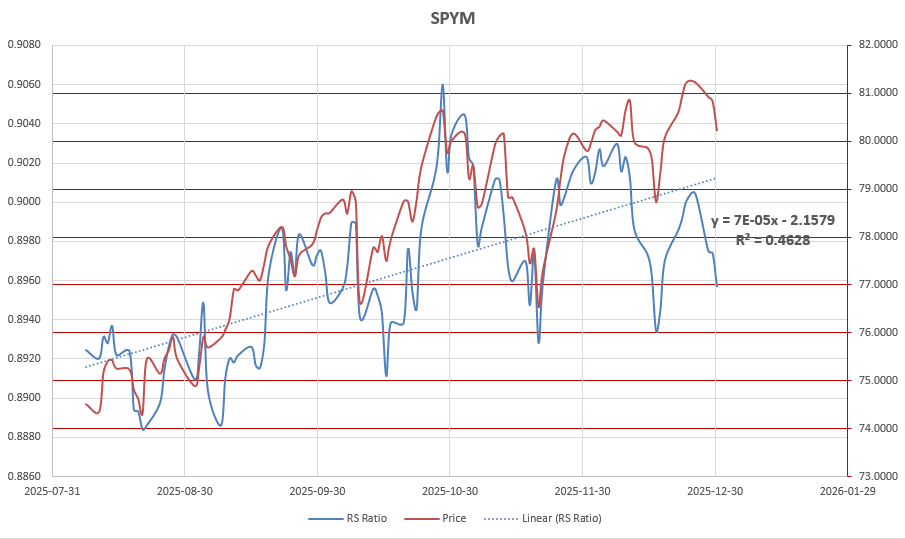
As shown in the above figure for SPYM (S&P 500 Large Cap ETF), there is a close correlation between the 2 lines, but there are subtle differences depending on whether the asset is moving faster or slower than the benchmark. Also shown in the figure is the 100-period slope (momentum) that is positive with an r-squared (confidence measurement) of 0.46.
Having calculated the ratio of asset price to benchmark price I then calculate the slope of the regression line through the data points within a chosen range:
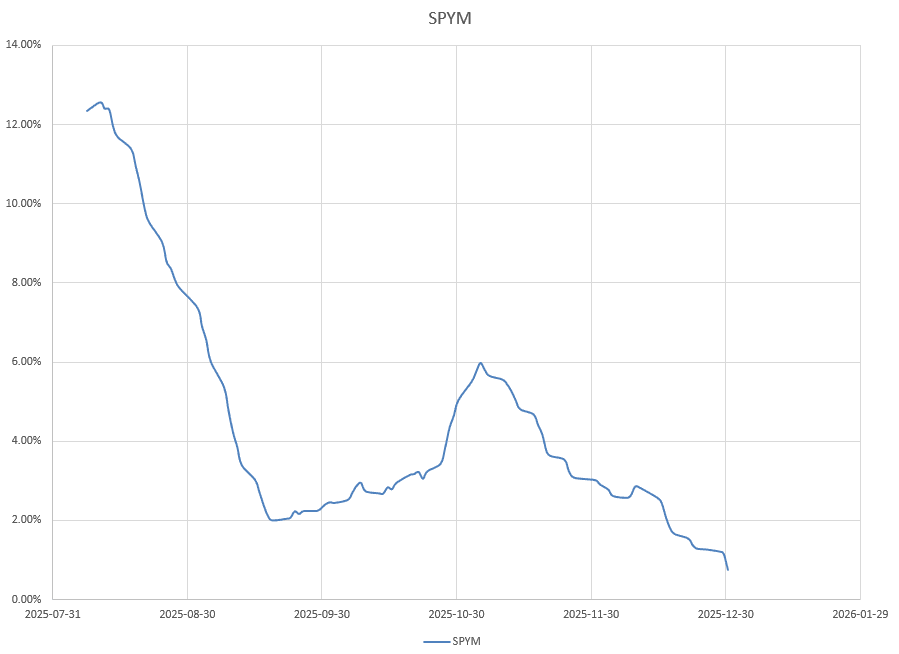
The above chart shows the slope (representing momentum) of the 55-period regression line over the past 5 months. The trend is clearly down and, while still positive, is approaching the zero line.
The level of confidence in the slope measurement over the same period is shown below:
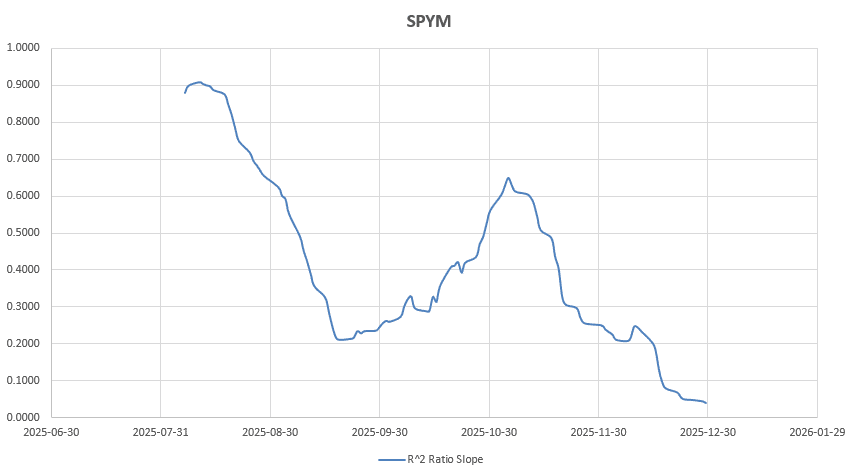
When we adjust the momentum based on our confidence level then we end up with the following graph:
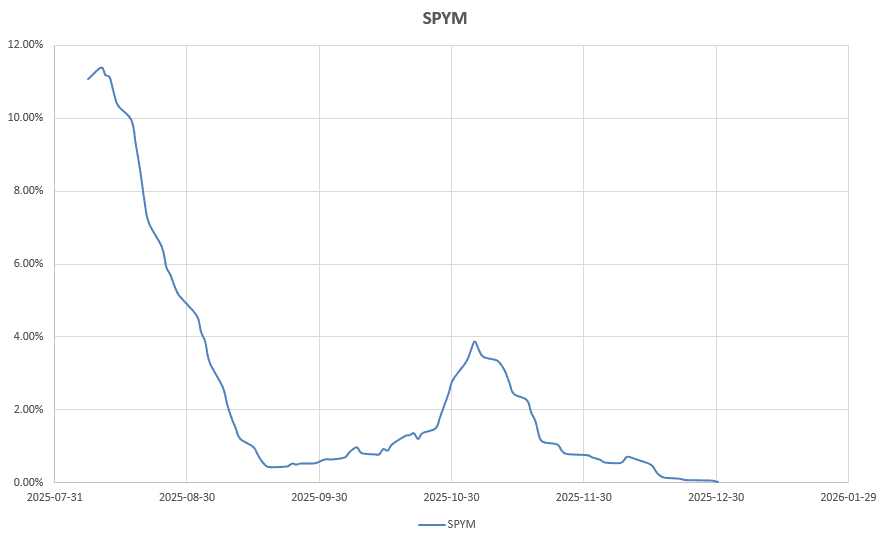
There are not a lot of obvious differences here, other than that the second peak, after factoring in the confidence level, based on volatility, is lower than the first peak (1/3 vs 1/2) , and this results in differences in relative strength between different assets following adjustments. Obviously, we see here that there is little positive momentum in the S&P 500 over the past 55 days – and that is consistent with the sideways consolidation that we have been seeing in this period.
I do this over 21-day, 55-day and 144-day time periods. Why do I choose these time periods? – for no other reason than that I am obsessed with Fibonacci numbers and, also, that they correspond (roughly) with periods of 1 month, 3 months and 7 months – that covers the range of intermediate term performance that I want to focus on. Of course, I want to try to find the most appropriate time-frame over which to make my decisions, so I run these calculations, taking into account the confidence level (r-squared) over each period, based on volatility, and weight the relative strengths (momentum) over all three periods. The weighting of the 3 look-back periods that I have chosen to use is 20%, 50% and 30% respectively – again, for no better reason than that they seem reasonable based on my past experience in developing systems such as this. There has been no attempt to optimize any of these parameters.
After going through this exercise, I come up with a graph (time-weighted momentum) that looks like this (blue line):
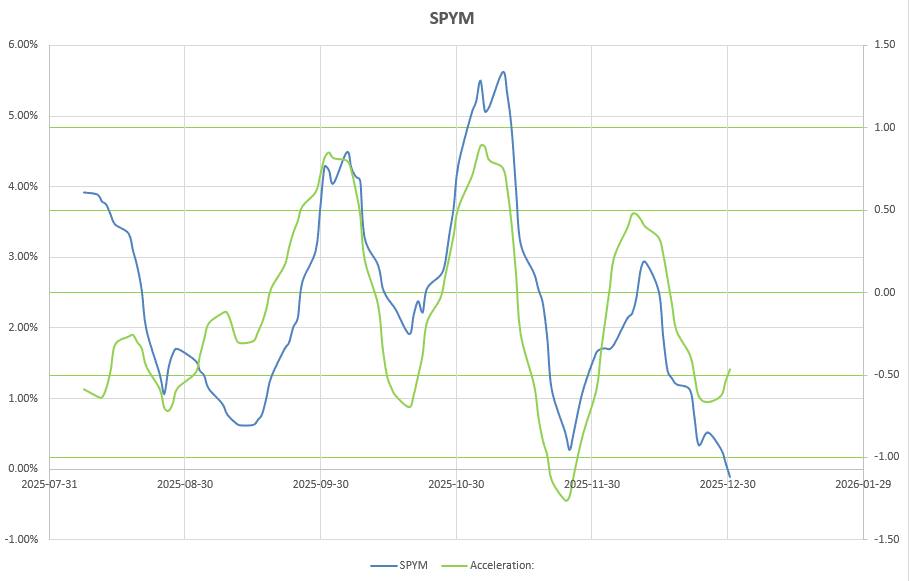
Long time readers of this blog may know that I also like to use “acceleration” or rate-of-change of velocity (or momentum in financial parlance), as an input to my trading algorithms – primarily because it is faster acting than momentum itself and generates signals well ahead of momentum signals alone. In past system models built into the Kipling workbook this parameter was referred to as the BLSH (Buy Low Sell High) input option. Of course, this signal may be too fast and result in “whipsaw” trades – but that is all part of investment/trading and so we have to accept it and, hopefully, manage it to the extent of minimizing damage. The green line in the above figure shows the 10-day acceleration – or slope of the blue momentum line. The 10-day period is chosen since this should trigger a change in trend within ~5 days of the high or low in momentum (assuming symmetrical bullish/bearish trends). The scale on the left axis of the chart is a measure of momentum, while the scale on the right of the chart is a measure of acceleration.
The Algorithm – Rules for Buy, Sell and Hold
In my new, revised, workbook I have built in the following, relatively simple/straightforward rules (algorithm) for trading:
- Buy Signal – either momentum or acceleration is positive
- Sell Signal – both momentum and acceleration are negative
- Hold Signal – A position is already held and momentum is positive as acceleration turns negative.
In the above figure we see that momentum (blue line) has just turned negative (dropped below zero on the left horizontal axis) and that acceleration is also negative (below zero on the right horizontal axis). In my algorithm this triggers a Sell signal.
In my algorithm I require that either momentum or acceleration be positive to generate a Buy signal. If both are positive this means that performance (momentum) relative to the benchmark is higher and is improving (positive acceleration) – all good and similar (although not identical due to the inclusion of acceleration) to Gary Antonacci’s Dual Momentum (DM) System.
The other significant difference is that If momentum is negative and acceleration is positive, then we are bottom-fishing and looking for a mean reversion. This is how I am planning to combine the 2 (often conflicting) systems. If acceleration should turn negative then this would immediately trigger a Sell signal, hopefully with only a small loss – since it will be fast (within ~5 days of the momentum turn-around).
If acceleration turns negative on positive momentum, then this triggers a Hold signal and we are hoping for a small pullback followed by a continuation of the momentum/trend through a later switch back to positive acceleration.
Asset Allocation
The other major decision to be made in any Investment Plan is how to allocate available funds to each asset. There are numerous choices here from fixed percentage asset allocations (with maximum allocation limits) to Risk Parity allocation and numerous variations of these themes. I have tried just about all of them over the years without being convinced that one method is significantly better than any other. I often therefore resort to “if in doubt – equal weight” and that is what I plan to do for this portfolio in 2026. Another significant decision that I have decided to take is to fully invest all available funds. My primary motive for doing this is because, when we compare with a benchmark, we assume that the benchmark is fully invested 100% of the time – and so, even though “Cash” is a valid position if it is a planned position, it is not generally valid if Cash is held simply because the investor doesn’t know what he/she wants to do with it.
Because, at any particular time, the algorithm may generate Buy signals for a different number of assets within the “quiver”, this means that allocations will need to be adjusted regularly to bring everything into “equal” balance. This is a bit of a drawback but, provided that the “quiver” is relatively small (less than 10 assets) this should not be an overwhelming task.
On Wednesday afternoon (December 31, 2025 – End -Of-Month/End-Of-Year) the worksheet showing the trade/position recommendations looked as follows:
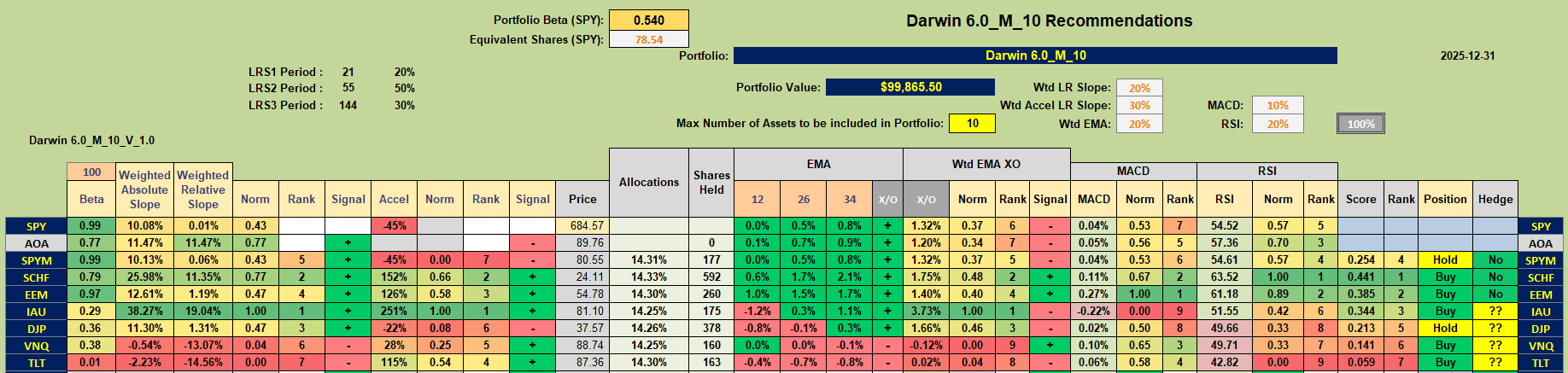
…. and I chose to start the new system for portfolio management in 2026.
The spreadsheet contains a lot of information that is not necessary/required to manage the portfolio as described above but provides options for possible changes/adjustments to the algorithm in the future. For now, I am starting with the simplest system that only uses the data/information in the “Signal” Columns (Columns 7 and 11) on the left side of the table and the recommendations (based on these 2 signals) shown in the “Position” Column (3rd Column from the right side of the table).
With two “Hold” recommendations I had to decide whether to allocate funds to these 2 ETFs (SPYM and DJP) or to divide funds equally between the other 5 ETFs. Since this was the start of the new system, I decided to maximize my diversification and divide the available funds ($100,000) between all 7 ETFs (~14% per ETF). The number of shares purchased is shown in the “Shares Held” Column.
Since I am not presently using any other data, I don’t want to complicate things too much other than to point out potential options that might be employed later depending on market conditions and how performance is progressing. However, the sheet does show the Portfolio Beta of 78.5 relative to SPY (S&P 500 ETF) – or present holdings equivalent to holding ~78 shares of SPY – that might be useful to an investor wishing to hedge the Portfolio in some way. Also included in the workbook are numerous calculations of Exponential Moving Averages (EMAs) and crossover information (for different time frames) that provide signals based on “Trend” alone, rather than simply momentum. These are generally intermediate to longer-term indicators with shorter-term indicators being provided by MACD and RSI measurements. These data are normalized and can be combined/weighted to generate a score and ranking for each ETF (4th and 5th Columns from the right side of the table). I am not presently using these rankings since I have set my maximum number of assets to be included in the portfolio to 10 – or greater than the 7 ETFs in the quiver – i.e. no limitation on the number of ETFs to be held. This keeps things as simple/straightforward as possible but allows for the option to choose fewer assets for inclusion in the portfolio and to make these selections based on a wider ranking process.
Review/Adjustment Plan
At least to start I want to be flexible here – I would like to be able to react reasonably quickly should market conditions change – but I do not want to trade more than necessary. Of course, I don’t really know what this means, so I will (nominally) choose to adjust/rebalance monthly provided that this requires at least a 5% change in fund allocation to each asset – but I will probably be monitoring daily to get a feel for how the market is behaving.
Of course, even after one day (Jan 2, 2026) the picture has changed and the analysis sheet now shows the following information/suggestions:
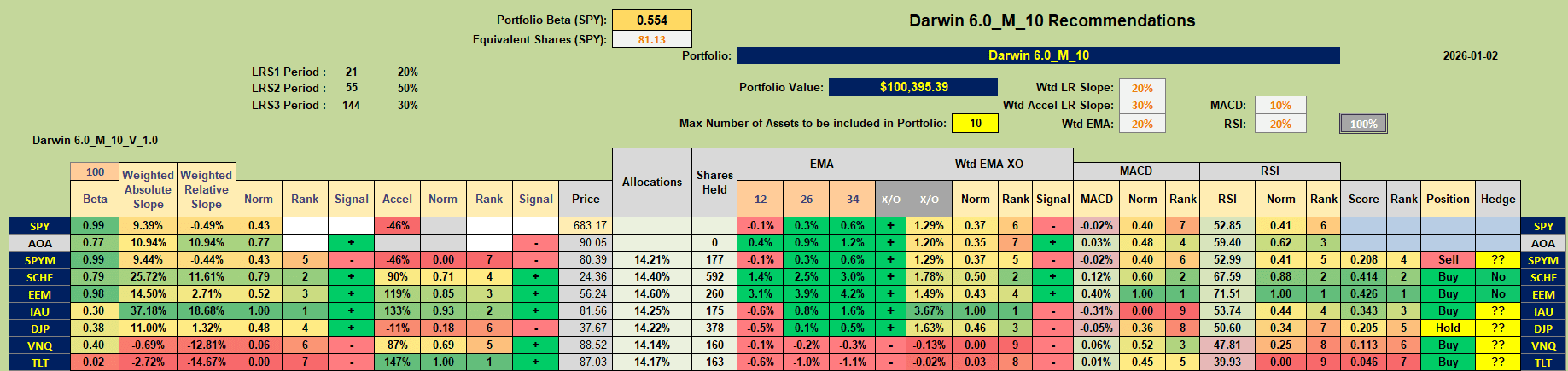
Where the Hold recommendation for SPYM has now flipped to a Sell recommendation as described in the 2026 Model Section above.
Should I choose to adjust, the adjustments would look like this:
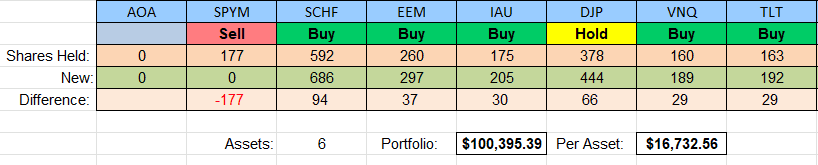
Where I would Sell the 177 shares of SPYM that are currently held and distribute the proceeds between the other 6 ETFs to rebalance to equal weight (with greater than 5% adjustment per ETF) and remain 100% invested.
I don’t see any need to panic at this point but I will be monitoring this portfolio through the next few days and make the adjustments as appropriate.
DJP remains as a Hold recommendation but could flip either way:
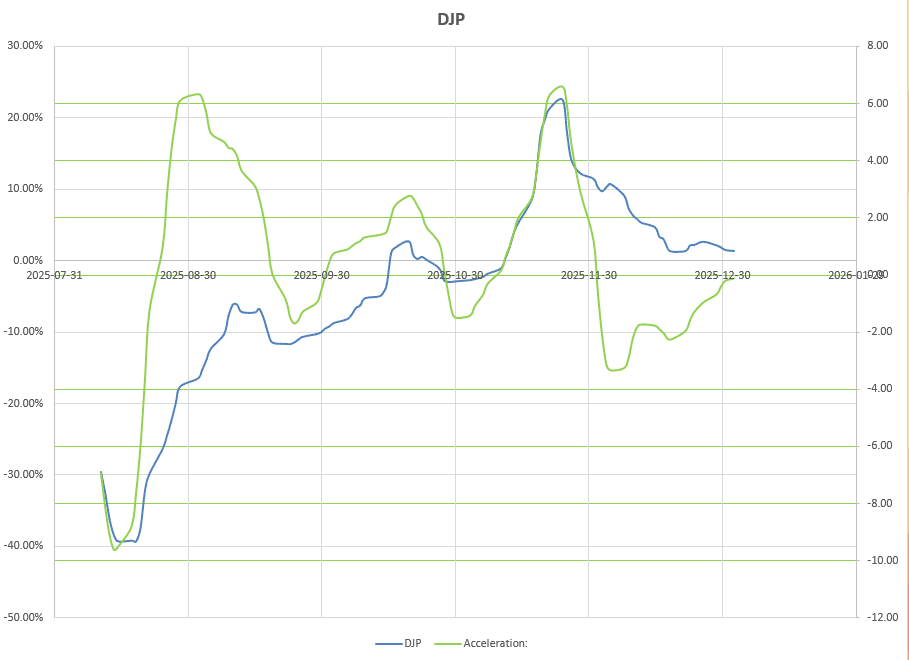
…. as momentum is dropping but acceleration is rising – agreement in either direction would clarify the Buy/Sell question – meanwhile a Hold position is in order.
Despite the switch to a Sell recommendation for SPYM the portfolio managed to close it’s first day of trading showing a $395 profit.
I will post reviews/updates of adjustments to this portfolio as appropriate but at least weekly, at least to start with.
If I have not made things at least partially clear, please request clarifications in the comment section.
Discover more from ITA Wealth Management
Subscribe to get the latest posts sent to your email.
Leave a Comment or Question