
Orchid Gardens, Singapore
This week saw a lot of volatility in the US Equity Markets, so let’s take a look at the current recommendations of our momentum/acceleration model for the 10 Sector ETFs that comprise this portfolio:
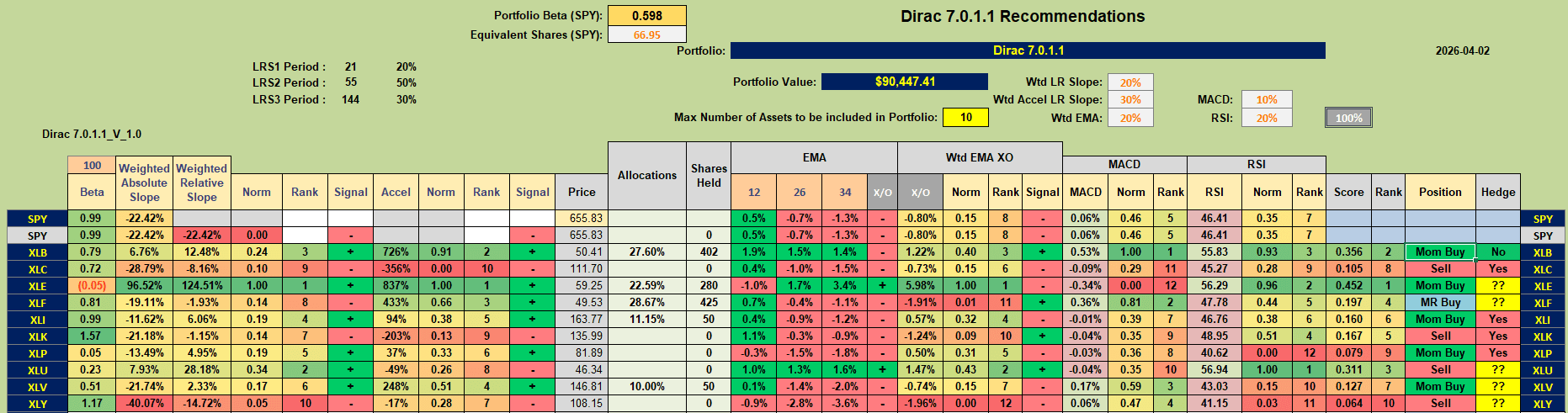 We now see five Momentum Buy recommendations (XLB – Materials), XLE (Energy), XLI (Industrials), XLP (Consumer Staples) and XLV (Health Care) and one Mean Reversion Buy recommendation for XLF (Financials). In addition we have a Sell recommendation for XLK (Technology) that was recently a recommended Buy and which was held in the portfolio at last week’s review.
Let’s first take a look at the momentum/acceleration chart for XLK:
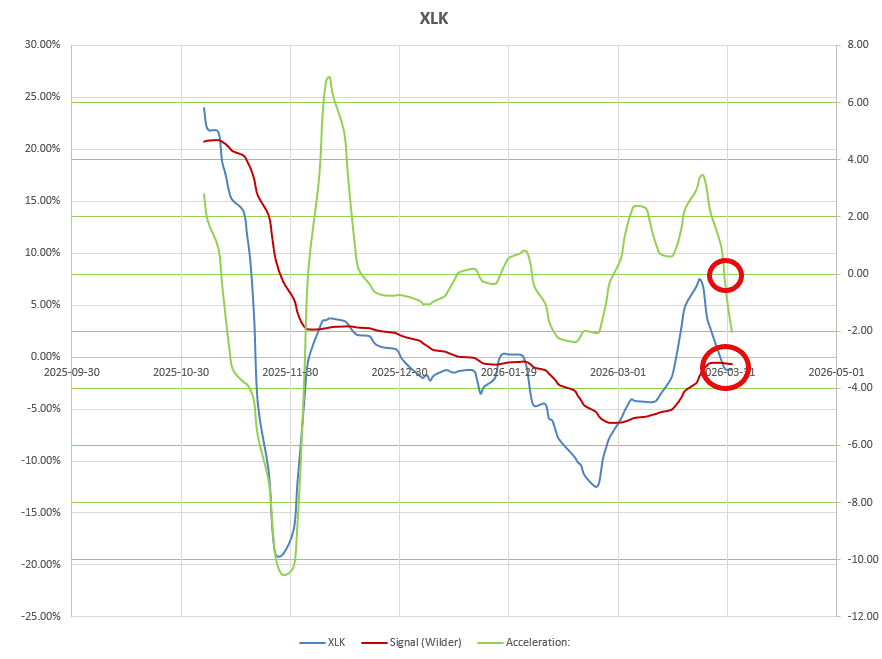 where we see negative momentum (blue line) with a crossover below it’s 14-period Wilder moving average (brown line) and negative acceleration (green line) as highlighted in the red circles. Since this was a mean-reversion (bottom fishing) Buy signal when the position was opened these signals were enough for me to Sell the shares held and close the position for a ~$620 loss. Technology does not seem to be quite ready to lead a bullish trend as it was last year.
Because there were a lot of suggested Buy recommendations, and I would need money from the sale of shares from existing holdings to aquire new positions, I took a look at XLE (Energy) that has been the leader in the current economic /politival environmrnt:
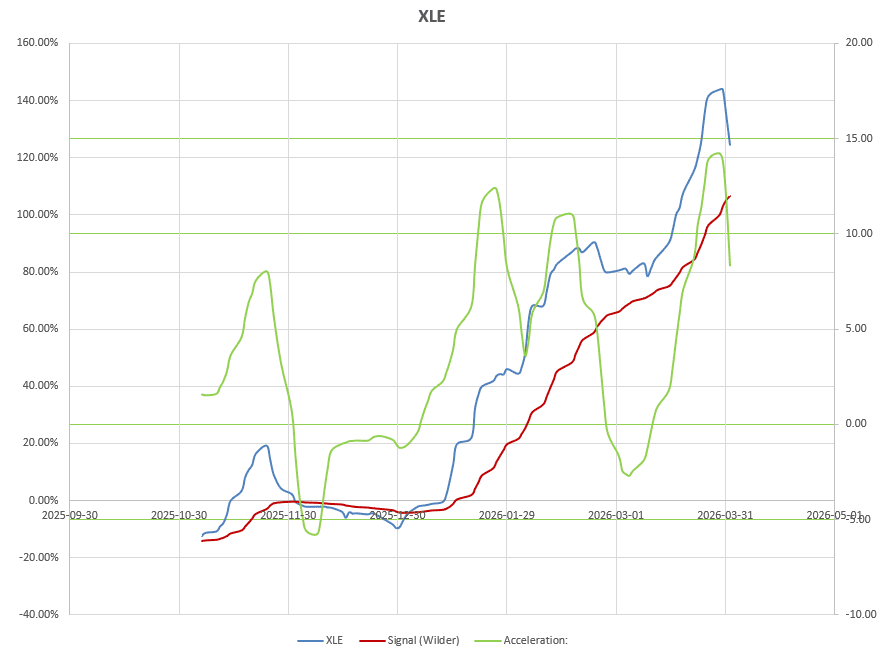 Although the charts are still signalling momentum Buy signals, there is a suggestion that this momentum is slowing (curves dropping) so I chose to sell a portion of my holdings (70 shares) to lock in ~$800 profit.
This left me with money to open some new positions. The first aquisition was made on Tuesday and was the purchase of 402 shares in XLB:
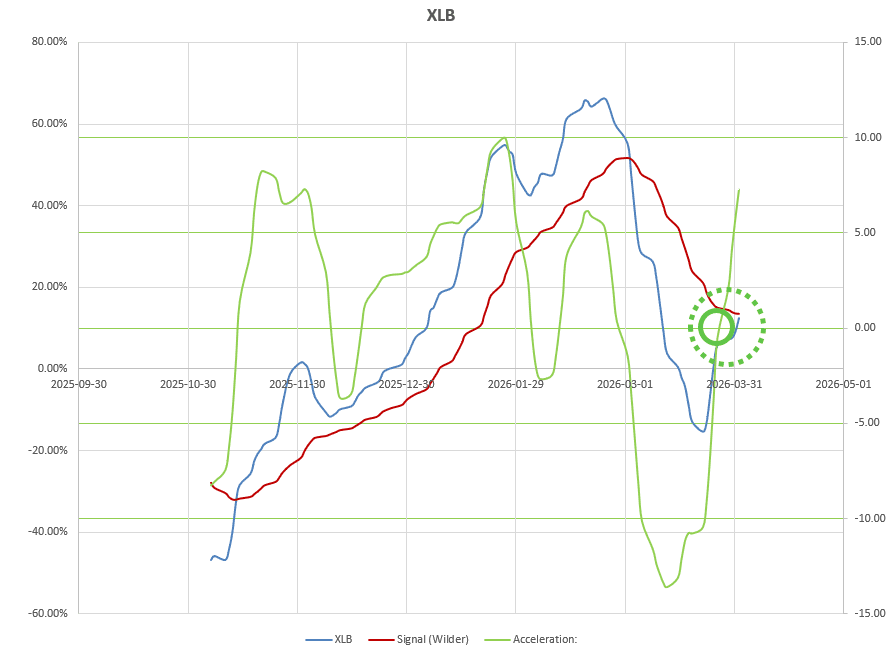 Acceleration has turned positive and momentum appears to be close to moving above it’s 14-period Wilder moving average and also in positive momentum territory (relative to it’s SPY benchmark).
The charts for XLI and XLV are not quite as convincing:
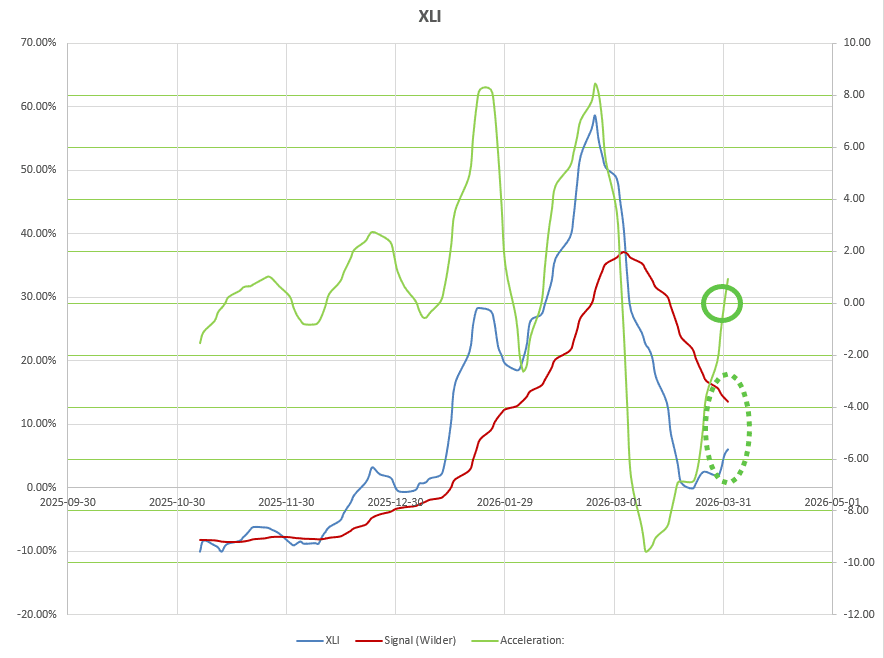 with XLI showing a gap between momentum and its Wilder moving average, and XLV
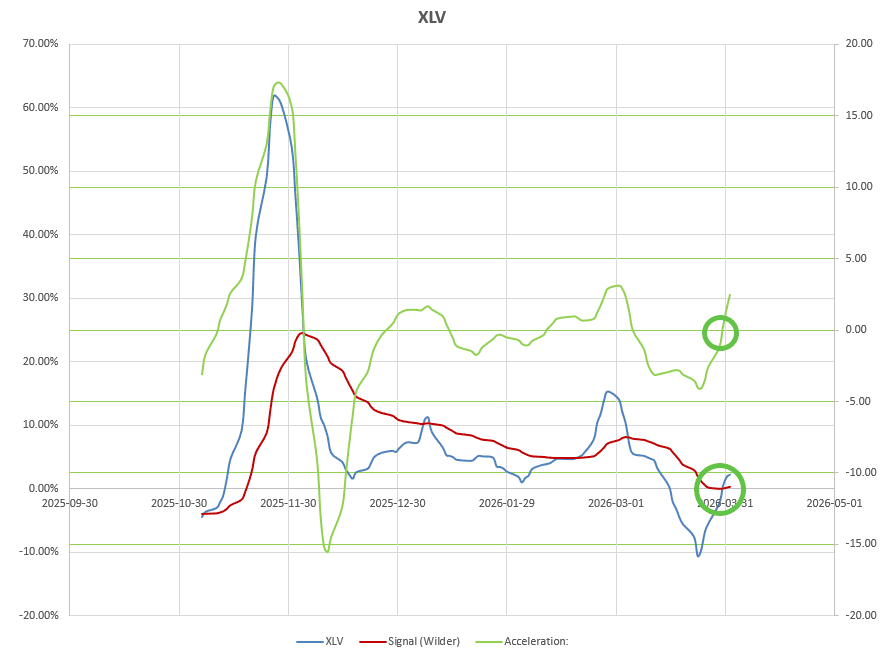 being “stuck” in a zero to low relative momentum range for ~3 months – but both still show valid signals to justify the recommendations. I decided to tread carefully here (since the markets are obviously moving quickly) so I opened smaller than “equal” weighting positions in these ETFs (50 shares in each) until the picture gets a little clearer.
XLP looks like this, again with a gap between momentum and its Wilder MA:
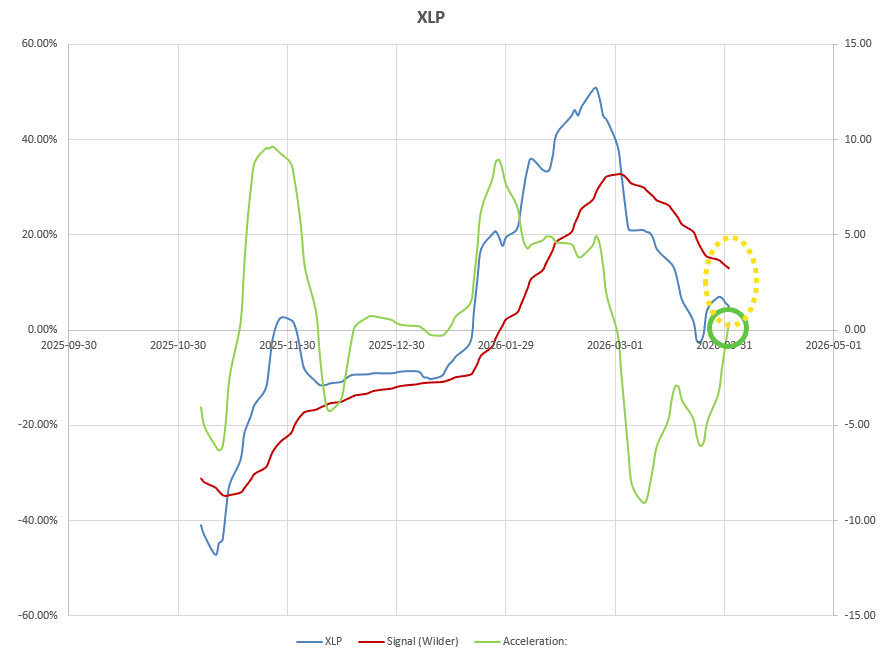 and I will wait to see how this develops. There are no immediate plans for XLF other than maybe to adjust allocations if/when the markets settle down a bit – XLF is still a recommended Mean Reversion (bottom-fishing) Buy opportunity.
The trades look like this:
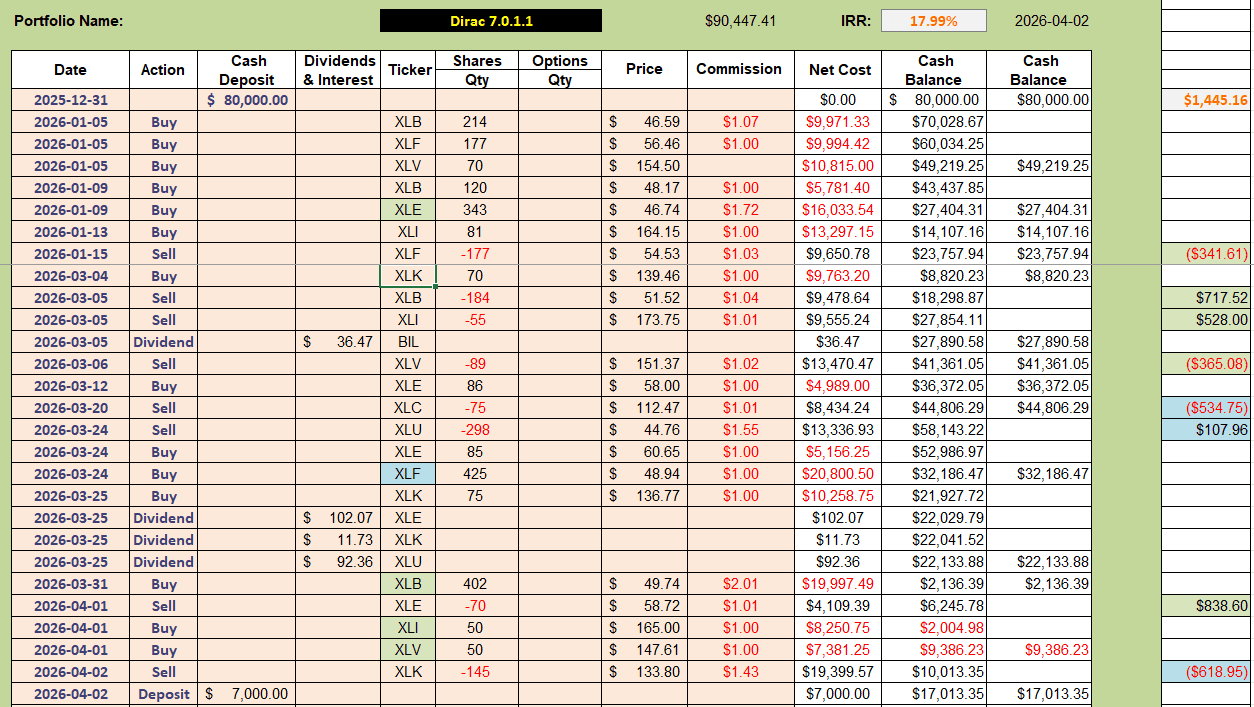 resulting in current holdings as shown below:
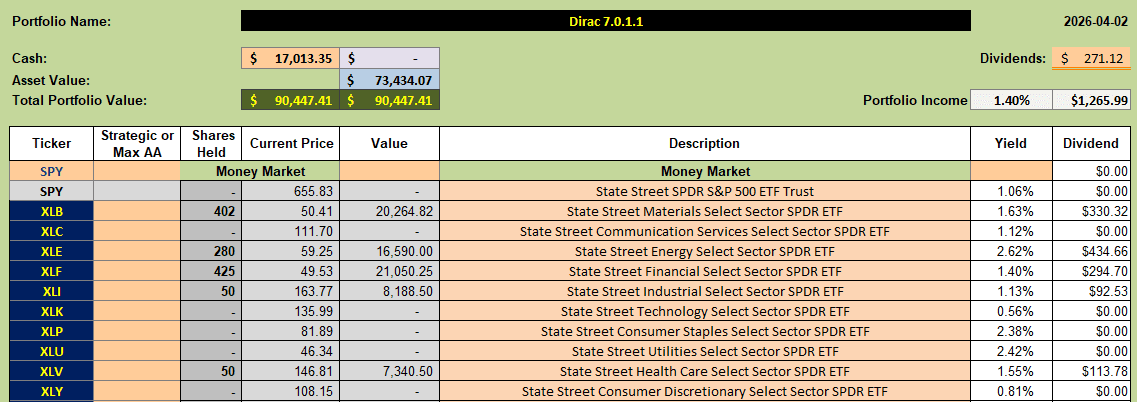 I am clearly not “equal weighted” at this point in time – and I have transferred $7,000 Cash to the portfolio (a “Roth-type” retirement account) from a “401(k)-type” retirement account that requires annual withdrawals. I will rebalance once the market calms down a little. One of the disadvantages of employing a management strategy that targets equal weighting but may hold a different number of assets from month to month is that this would require significaant adjustments/high number of trades – so I am trying to keep the “trading” to a minimum whilst still attempting to maintain equality in allocations.
The performance of the Dirac Portfolio over the first 3 months of the year looks like this:
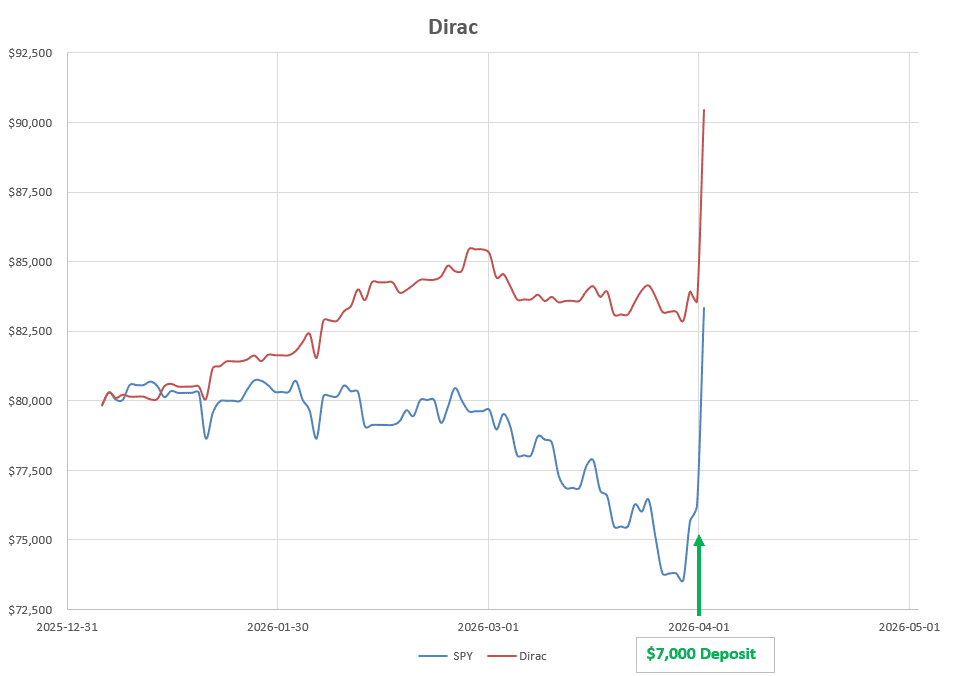 … clearly ahead of its SPY benchmark, but with a lower Internal Rate of Return (18%) than a more diversified global porfolio such as the Darwin Portfolio. Ignore the recent “jump” in portfolio value – this is just the addition of $7,000 Cash into the Portfolio – it does not impact the IRR.
Again, although not officially a part of this portfolio – but as an example of Portfolio Hedging – my Option Hedge position looks like this:
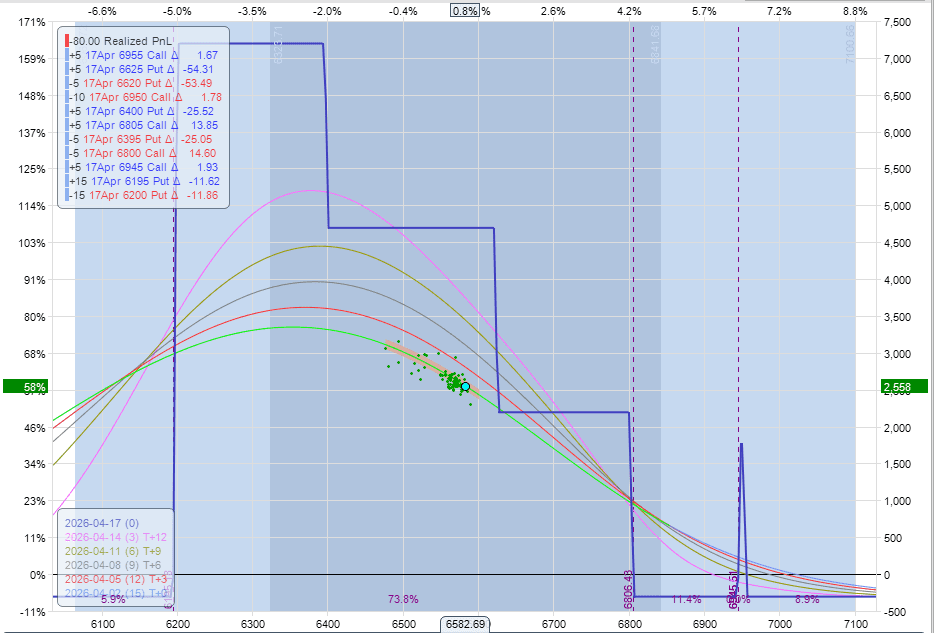 showing a current (unrealized) profit of ~$2,500.
Discover more from ITA Wealth Management
Subscribe to get the latest posts sent to your email.
Leave a Comment or Question