
Ready to greet Santa.
Kepler is the portfolio up for review this morning. Major asset allocation changes are coming to the Kepler for two reasons. 1) The portfolio has been a poor performer. Therefore adjustments are appropriate 2) The new asset allocation model is designed to be somewhat recession resistant. I say “somewhat” as I don’t think there is going to be any full-proof place to hide in 2026 unless one is willing to short the market. Shorting the market is not the best idea as historically the market trends upward and it is extremely difficult, if not impossible, to time the market. One needs to be correct twice. When to get out and when to get back in. That second call, when to get back in, is the more difficult one from a psychological position. When the market hits bottom or close to it, investors are reluctant to buy stocks as the thought is – the market is going to go lower.
With the Kepler I am going with a wide diversification concentrating more of the portfolio using treasuries such as IEF, TLT, and SHV. In addition I sold all shares of VOO as this S&P 500 Exchange Traded Fund (ETF) had too much exposure to the overvalued Artificial Intelligent dominated stocks. In place of VOO I am using RSP, also oriented to S&P 500 stocks, but an equal-weight ETF. Stocks in RSP are give equal-weight whereas stocks in VOO are cap-weighted.
Kepler Asset Allocation Model
Below is the current makeup of the Kepler portfolio. Yes, there are overlapping ETFs such as VYM and SCHD. I’m not too worried about such conditions as the recommended percentages are not that high to either ETF.
Three sector ETFs are included and they are: Utilities (VPU), Healthcare (VHT), and Consumer Staples (VDC). All three ETFs provide products and services needed during recessions and depressions so it makes sense to hold them in this market protection environment.
Readers will note the projected yield is close to 3.0%. Future dividends will generate cash to help keep the portfolio in balance.
Also included in the following asset allocation is exposure to developed international equities (VEA) and emerging markets (VWO). If U.S. Equities stumbles, we have some hope the markets elsewhere on the globe will prosper. One reason for this logic is that the G7 no longer dominates global Gross Domestic Product (GDP). BRICS is now the dominate economic engine of the world.
Definition of BRICS: “The BRICS economic alliance is a bloc of major emerging economies (Brazil, Russia, India, China, South Africa, plus newer members like Iran, Egypt, UAE) aiming to increase cooperation, boost South-Global influence in global governance, and challenge Western economic dominance by promoting trade, investment, and alternative financial systems, including creating institutions like the New Development Bank. It functions as a platform for political coordination and economic partnership, advocating for a multipolar world order.”
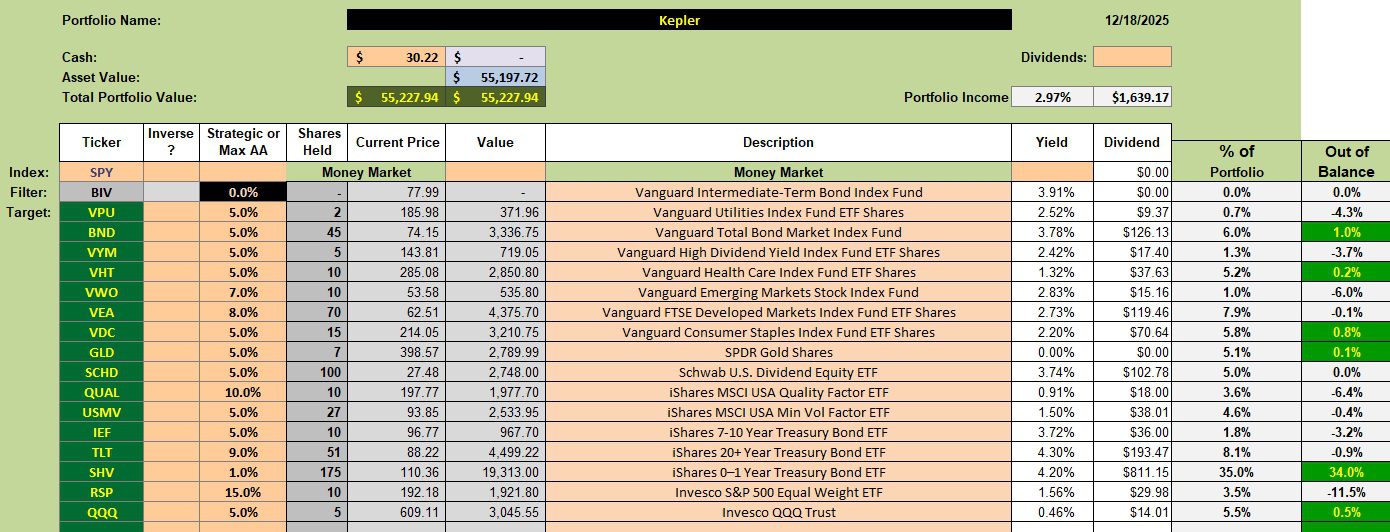
Kepler Rebalancing Recommendations
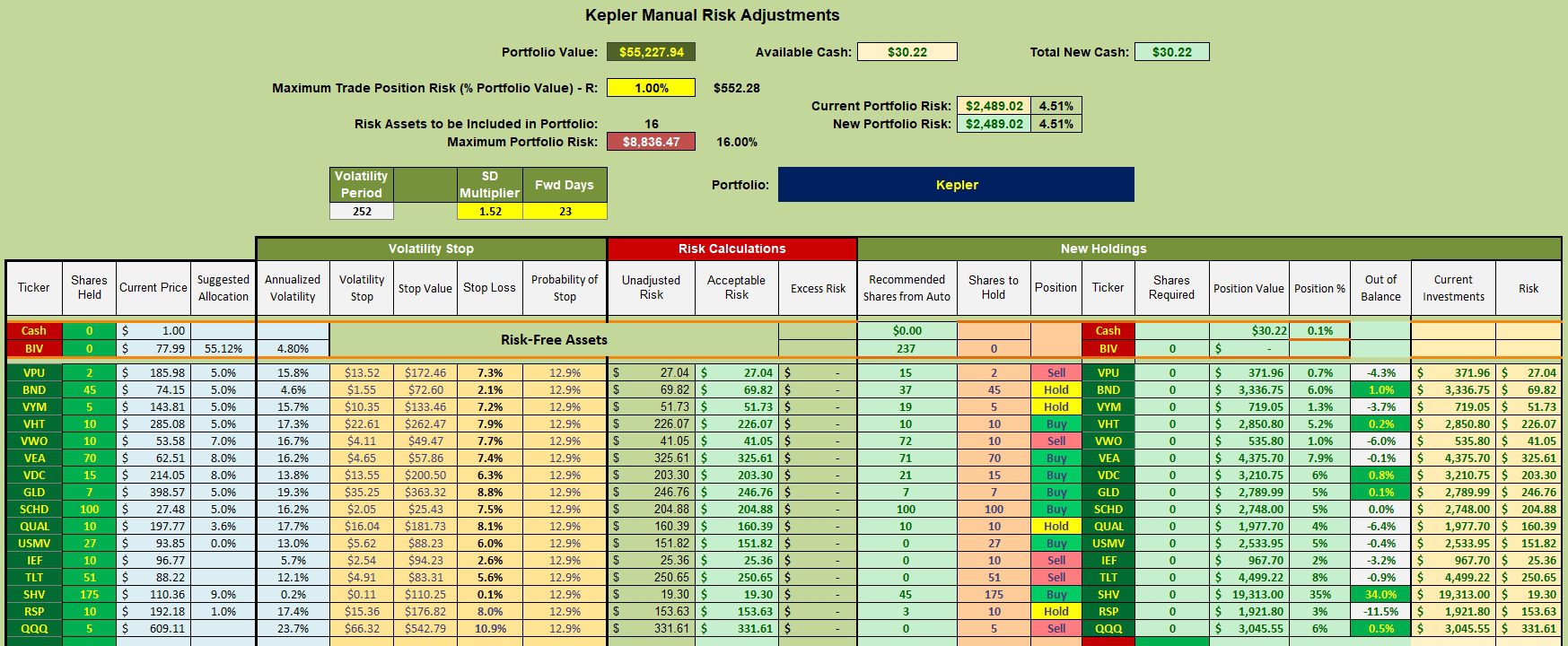
How does rebalancing the Kepler portfolio work? The following worksheet comes out of the Kipling spreadsheet. The goal is to keep each ETF with a Buy designation within one percentage point (1.0%) of the target percentage. If cash is needed, I sell shares of SHV to raise the needed cash. I sold shares of SHV this morning in order to bring all ETFs with a Buy recommendation into balance. Note the Out of Balance column or the third one from the right.
ETFs with a Hold or Sell recommend are not touched. One of the overarching goals for 2026 is to reduce portfolio churning in order to reduce taxes. Minimizing transactions should also help performance as well as reduce taxes.
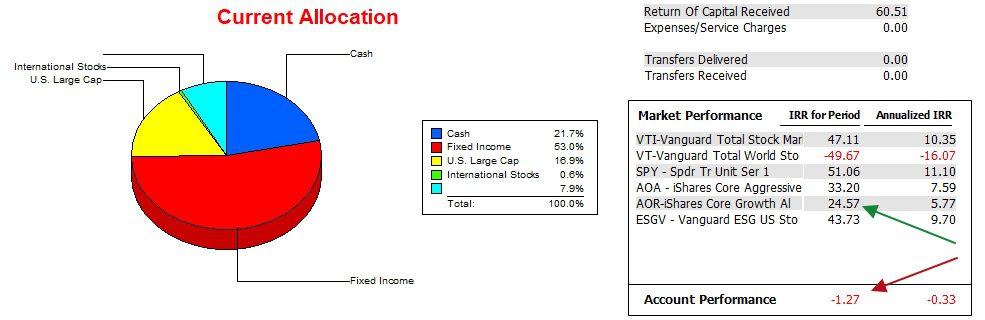
Kepler Performance Data
Now we come to the disappointing news. Since 12/31/2021 (launch date) the Kepler lags the AOR benchmark by a wide margin. With 53% of the portfolio in Fixed Income, this is a very conservative portfolio.
BTW, I think the IRR values for VT is an error that I just noticed.
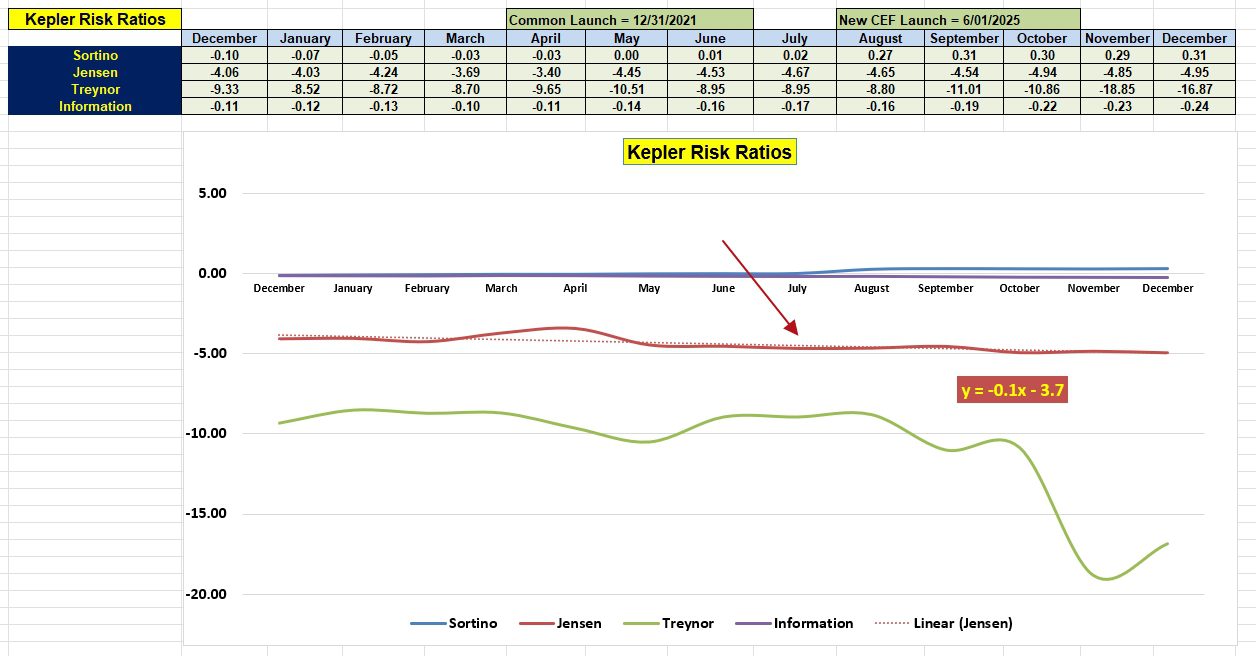
Kepler Risk Ratios
How is the Kepler performing when risk is taken into account? The Jensen Alpha is the most important of the four risk measurements and it continues to hang in the -4% region. Not good as the Jensen should be positive. Based on the slope, Jensen has been trending down all year. The hope is that the new asset allocation will turn this performance around.
If managing an asset allocation portfolio such as the Kepler is too difficult, then seriously consider setting up an Intelligent Portfolio with Schwab. The Schrodinger is such a portfolio. Below is a link to the Schrodinger. There are many blog posts laying out how the Schrodinger works. Once this style of portfolio is set up, one does nothing except add new money. The owner of the Schrodinger deposits new cash into the portfolio on a regular basis and when the cash reaches a certain level, Schwab’s computers reinvest the cash. The computer model goes into action and re-balances the portfolio. The owner of the portfolio does nothing. This is truly a passive style of investing and works for those who have no investing knowledge.
Discover more from ITA Wealth Management
Subscribe to get the latest posts sent to your email.
Leave a Comment or Question