
Birds of Paradise
Warning: This post is likely of no direct interest to most readers of this Blog – it is written for education and interest only, and outlines one of the potential advantages of using Options for portfolio insurance.
These are nervous times and we should be concerned about preserving our hard-earned wealth in the months ahead. We do this to some extent by holding diversified portfolios or structuring our management systems to (hopefully) minimize, if not totally avoid, significant drawdowns.
In my Darwin Portfolio I hold a selection of ETFs from a diversified quiver representing 7 of the major asset classes:
 and I am managing this portfolio using a system that rotates holdings based on momentum and (possible) mean-reversion. At present the portfolio is holding positions in only 4 of the ETFs in the quiver and, due to diversification, these ETFs are equivalent to holding ~30 shares in SPY (S&P 500 ETF).
Similarly, in my Dirac Portfolio:
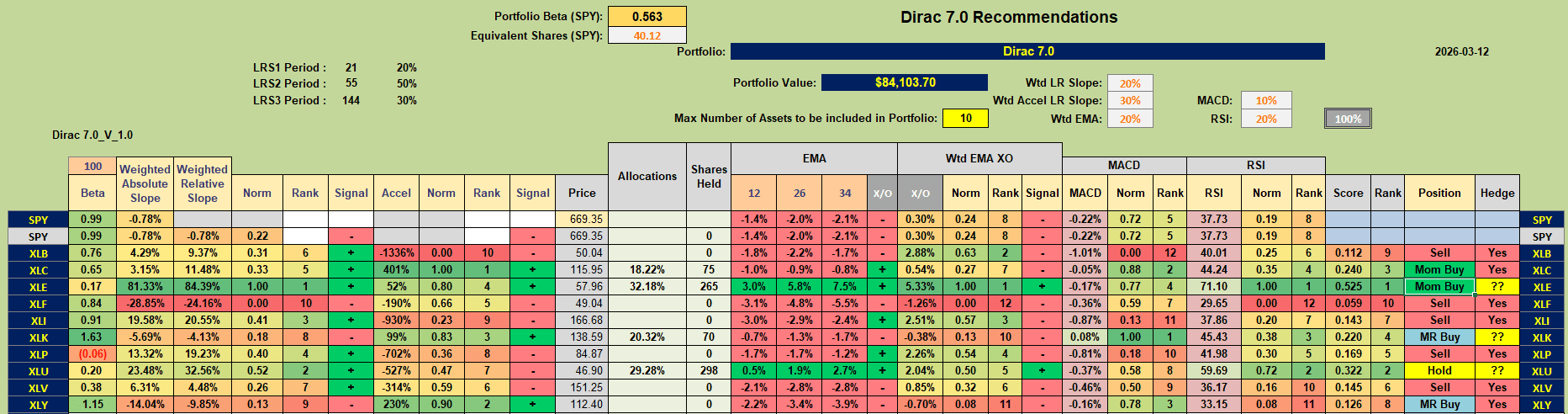 I am holding 4 of 10 Sector ETFs that make up the S&P 500 and these holdings are equivalent to holding ~40 shares in SPY (more than the Darwin Portfolio because of less diversification).
However, I am presently still nervous due to the current global political uncertainties in the world. I have therefore decided to look for a little extra insurance through the use of Options.
Rather than try to insure each holding separately I focus on the equivalent portfolio holdings in terms of an index or fund that tracks an index. Based on the Beta of each holding (anticipated correlated movement relative to the index) we can calculate a Portfolio Beta (0.237 for Darwin, 0.563 for Dirac) that allows us to determine the number of shares equivalent in a suitable traded vehicle. In the above examples I used SPY as the Beta comparison.
Now, the simplest way to hedge these portfolios would be to simply buy appropriate Put Options to provide downside protection. But, this can become expensive if we do not see significant downside movement.
I therefore prefer to use Options in a slightly more complicated way that costs less (or maybe offers a small credit) in exchange for accepting a little risk.
If we take a look at the chart of SPX (the S&P 500 Index – SPY is virtually identical but 1/10 the size/values) it looks like this (as regular readers of my weekly Darwin reports will recognize):
 and, as I have been reminding readers for the past (2-3 months) we have been trading in the 6800-7000 consolidation range until last week, when we dropped out of this sideways channel and into a possible bearish downtrend/pullback channel. If I believe that we will not break above ~6950 I can Sell a 6950/6955 Call Spread (Sell the 695 Call and Buy the 6955 Call), expiring 17 April (about a month away) for $189. I can then use this money to buy a protective Put Spread (e.g. Buy the 6625 Put and Sell the 6620 Put) for $149 – in this case for a small credit. If I Sell/Buy 5 of each of these Spreads I hold a position that looks like this:
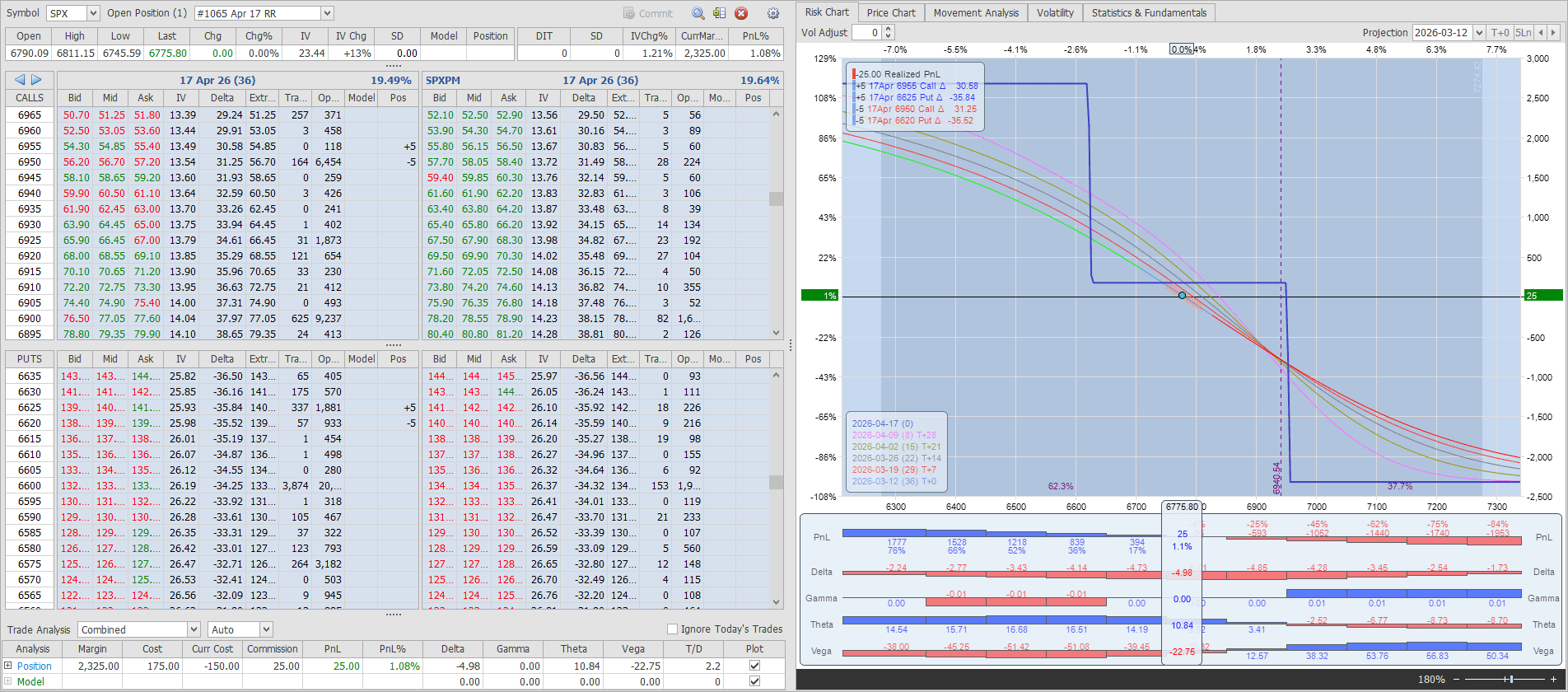 for a total credit of $175. i.e. it has not cost me anything to place this trade.
What does this give me:
- If SPX stays between 6625 and 6950 all Options will expire worthless and I keep the $175 credit;
- If SPX drops below 6620 I will make a maximum of $2,675 profit (that will hopefully offset losses on the Portfolio holdings);
- If SPX bounces above 6955 I will lose $2,325 (that is hopefully offset by the profits from the portfolio holdings.
Of course, there are many adjustments that can be made in the period befor expiration in April – and, I will report on any adjustments that I may make in this time period – however, I have a low risk/reasonable reward position that provides downside protection.
Note that I chose the strikes carefully:
- The short 6950 Call is at/near resistance at all-time highs – this offering a low risk of loss on the position;
- The long Put purchased at 6625 is above potential support at ~6600 and so provides protection and maximum profit should we break through this level.
In between there is little/no risk with $175 for a cup of coffee.
I will update as appropriate if I make any adjustments. For anyone with an interest in more information or who would like clarifications just let me know in the comments section below.
Discover more from ITA Wealth Management
Subscribe to get the latest posts sent to your email.
Leave a Comment or Question