
Oregon Coast
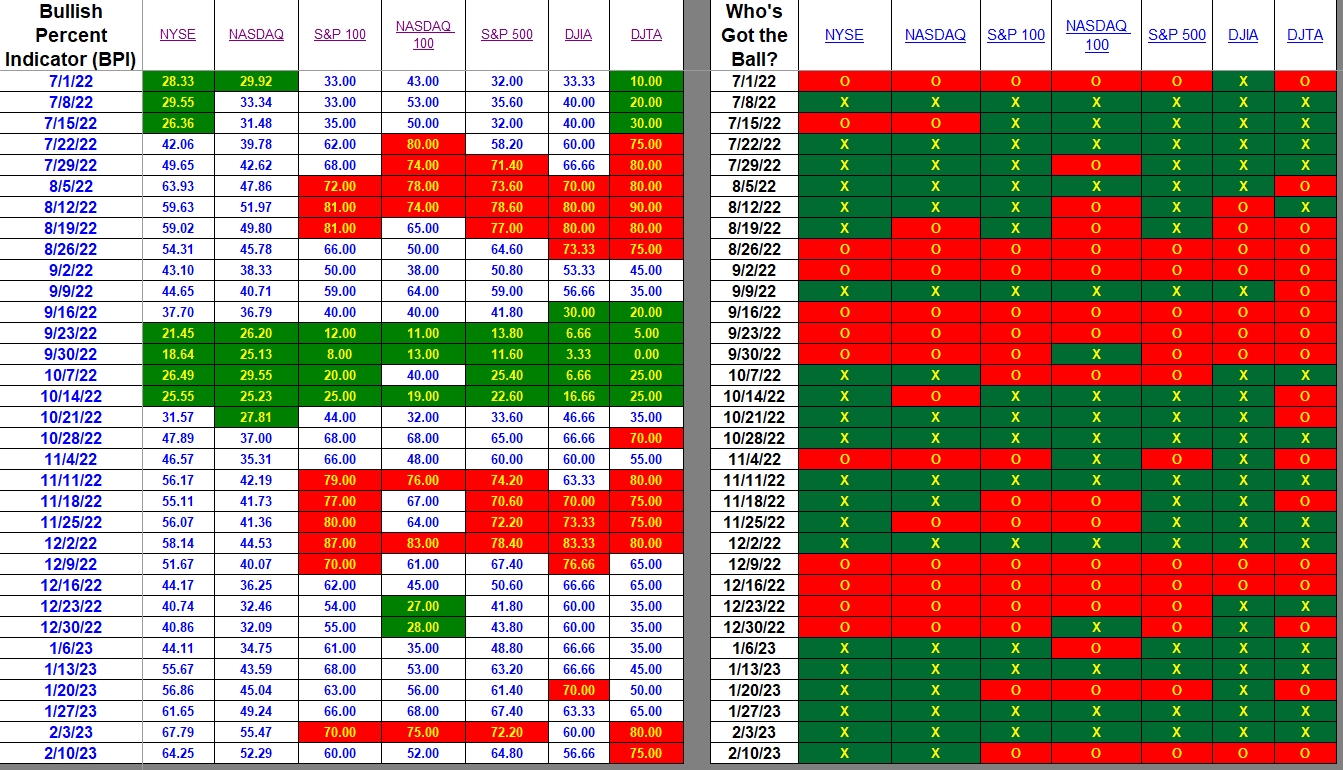
The following tables set the stage for investors using or experimenting with the Sector BPI Model. The first table lays out the Bullish Percent Indicators for seven major indexes while the sector table breaks the U.S. Equities market into eleven sectors. None of the eleven are currently showing an over-sold condition so we enter next week with no buying opportunities. Energy and Utilities come close and may even call for a buy sometime this week.
Index BPI
NYSE and NASDAQ, the two broad indexes, are still bullish indicating small-cap stocks are holding up. That is a good sign for the overall market. This coming week could be interesting as we watch to see how the larger companies behave. The big picture is simply – the market is fairly valued as the indexes are hovering around the 50% to 60% bullish zone.
Sector BPI
Five of the eleven sectors are over-bought or show up as 70% bullish or higher. If VCR, VFH, VIX, VGT, or VNQ are currently in a portfolio, my recommendation is to place a TSLO on those ETFs. For example, if VNQ is held in a Schwab account, I would place a 1.7% TSLO on that ETF. TD Ameritrade requires one to use integer percentages so go with 2.0%.

Explaining the Hypothesis of the Sector BPI Model
In addition to checking in on several Sector BPI portfolios this coming week, the Einstein is scheduled for an update.
Discover more from ITA Wealth Management
Subscribe to get the latest posts sent to your email.
Lowell,
I notice that you use a very tight TSLO (1.7%) for VNQ. I have a couple of comments relative to setting the TSLOs.
Although I have both Fidelity and Schwab accounts (including a Schrodinger-like account), I like making trades with the Schwab account over the Fidelity account for three reasons. First, Schwab allows you to use fractional TSLO percentages, such as you have used above. There are times when I want to set 3.5% TSLOs, rather than 3% or 4% TSLOs.
Second, Schwab also makes it very easy to set TSLOs based on Last, Bid, and Ask prices. I follow the general recommendation of using the Ask price when setting TSLOs. Theoretically, you should have fewer “pre-mature” sales using the Ask price, rather than the Last price, especially at the beginning of the day when price spreads can be high. You can also set up TSLOs based on Last, Bid, and Ask in Fidelity accounts, but it is not as easy to do as it is in Schwab accounts.
A third significant advantage of Schwab is that you can set the time of day at which orders become active. I tend to set mine at around 10:00 am Pacific Time to avoid selling during the volatility at the beginning of the day. So, for example, using your VNQ above, the price at the beginning of the day when the market first opens might be lower than recent highs by 1.7%. Two things could happen in the 3.5 hours until 10:01 am. VNQ could remain at least 1.7% lower than the recent highs, in which case a sale would occur. Or, the VNQ price could recover in the first 3.5 hours of the day, thus avoiding a pre-mature sale. I would guess that the tighter the TSLO that you want to use the greater the advantage of being able to control the timing of the comparison of current price to your TSLO price.
~jim
Jim,
I tend to set my TSLOs after 9:00 a.m. Pacific time so as to avoid early morning volatility. However, after once set I don’t adjust it. With such a tight TSLO for VNQ, I assume it will be sold out of the portfolio. I used VNQ as an example, but right now I don’t think any of the Sector BPI portfolios I’m tracking hold that particular ETF.
Lowell
Lowell,
Just to be clear about my third point above, when I set a conditional trade time in Schwab (e.g., after 10:00 am), that means a stock or ETF price won’t be compared against my TSLO during the day until after 10:00 am Pacific Time, for all days the TSLO is in force.
~jim
Jim,
I have yet to set the time. Will look into it as that seems like a super idea. Thank you for the suggestion.
Lowell
Jim,
I don’t see where one can set the TSLO “start” time on the Schwab website. Please provide more information or the path to this option.
Lowell
Any readers tracking BPI data and using it to manage one or more Sector BPI portfolios will want to check in when I publish BPI data tomorrow. If the current charts hold, I see two buying opportunities. There are times when BPI data comes in after 5:00 p.m. PST. This is why I wait before publishing any data.
Lowell