
Floral Gardens, Singapore
I have found Lowell’s recent posts on this subject very interesting – so I asked Claude (AI) for his/her suggestions:
“Here’s a Financial Repression-resistant ETF portfolio for a retiree. Financial repression = central banks keeping real rates negative, inflating away debt — erodes cash, bonds, and nominal assets. The defense: hard assets, inflation-linkers, real yields, international diversification, and income.
Financial Repression Defense Portfolio (10–15 ETFs)
| # | Ticker | Name | Category | Alloc % | Expense Ratio | Rationale |
| 1 | GLD | SPDR Gold Shares | Gold | 12% | 0.40% | Classic FR hedge; gold thrives when real rates are suppressed |
| 2 | IAU | iShares Gold Trust | Gold (backup/cheaper) | 0% | 0.25% | Lower-cost alternative to GLD — swap if preferred |
| 3 | SCHP | Schwab U.S. TIPS ETF | Inflation-Protected Bonds | 12% | 0.03% | Near-zero expense ratio TIPS; direct inflation hedge on US Treasuries |
| 4 | VTIP | Vanguard Short-Term TIPS | Short TIPS | 8% | 0.04% | Less rate duration risk than long TIPS; cleaner inflation payout |
| 5 | VNQ | Vanguard Real Estate ETF | US REITs | 8% | 0.13% | Real assets + income; current yield ~4.2% |
| 6 | VPU | Vanguard Utilities ETF | Utilities | 8% | 0.10% | Regulated, pricing-power businesses; defensive income |
| 7 | XLE | Energy Select Sector SPDR | Energy | 8% | 0.09% | Commodities pricing power; energy is an inflation engine itself |
| 8 | PDBC | Invesco Optimum Yield Diversified Commodity | Broad Commodities | 8% | 0.59% | Broad commodity basket (energy, metals, agri); direct FR hedge |
| 9 | VEA | Vanguard FTSE Developed Markets | Intl Developed Equities | 10% | 0.06% | EUR/JPY/GBP exposure; diversifies away from USD debasement |
| 10 | VXUS | Vanguard Total International Stock | Broad Intl | 8% | 0.07% | Adds EM exposure; currencies that may benefit from USD weakness |
| 11 | VTI | Vanguard Total Stock Market | US Broad Equity | 8% | 0.03% | Core domestic equity; real companies own real assets |
| 12 | INFL | Horizon Kinetics Inflation Beneficiaries | Inflation Equity | 5% | 0.85% | Unique — royalty cos, energy, land; built specifically for FR |
| 13 | DFIP | Dimensional Inflation-Protected Securities | TIPS (active) | 5% | 0.12% | Active TIPS with shorter duration tilt; low cost |
Total: 100%
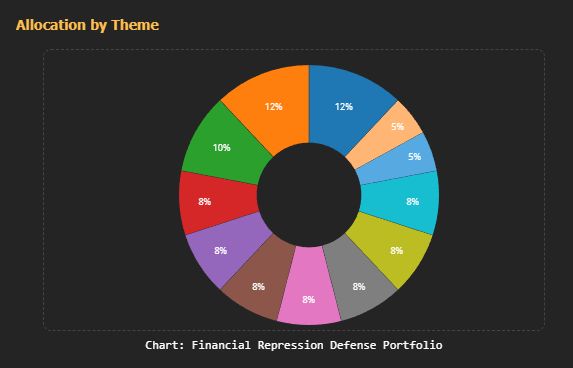
Key Design Logic
| Theme | Tickers | Weight | Why |
| Hard money / Gold | GLD | 12% | Loses nothing to currency debasement |
| Inflation-linked bonds | SCHP, VTIP, DFIP | 25% | Principal adjusts with CPI by law |
| Real assets (REITs + Energy + Commod.) | VNQ, XLE, PDBC | 24% | Own things, not claims on things |
| International diversification | VEA, VXUS | 18% | Dollar debasement hedge |
| Income-generating equity | VPU, VTI, INFL | 21% | Real earnings in real-world companies |
Blended expense ratio: ~0.19% (weighted average) — extremely lean for what it covers.”
(Visited 107 times, 6 visits today)
Discover more from ITA Wealth Management
Subscribe to get the latest posts sent to your email.
David,
The recommendations coming out of Claude are quite similar to those recommended by ChatGPT. Thank you for posting these recommendations.
Lowell
Hi
What is your view on owning gold mining stocks or ETFs in place of or instead of GLD?
Thank you
William,
I am planning on using GLDM (5%) and IAU (5%). Does this answer your question? I don’t plan on using individual gold stocks.
Lowell
I, personally, prefer IAU (used in Darwin Portfolio) – but, in terms of returns/risk if wanting to track the pure metal price, I don’t see that it really matters which one you choose. Adding miners changes the profile a little and it depends on what timeframe you look at as to which might be better – I’d just take a look at the comparison charts over different time frames (most platforms allow you to do this) and take the one that makes you feel more comfortable. Or just split them and use both as Lowell suggests.
What percentage of one’s overall holdings are you suggesting should be invested using this approach? I have lucked out and achieved substantial gains in the stocks and ETFs related to the AI build-out. Selling them would lead to very large capital gains taxes, probably greater than the savings that might be realized by using this approach.
Herb,
Good to hear from you again 🙂
From my perspective this structure is just another portfolio that one might use as a diversifier in a portfolio of portfolios. I think that the percentage that one might invest in such a portfolio might be significantly different from investor to investor depending on the investor’s views of what might happen in the future and their appetite for risk – obviously you have a good appetite for risk going into the AI crowd – well done 🙂 – it must be hard to have to worry about all that tax that might have to be paid at some point 🙂
I am doing a little (manual – ugh!) backtesting on such a portfolio – but, since I don’t mind a little trading I’m looking at how my current momentum/acceleration model would behave – I (personally, again) prefer a more dynamic approach that might keep me out of drawdowns (at least on some of the components) that an asset allocation model might be subject to – notwithstanding the benefits of diversification.
I don’t think that one would back up the truck to setup one of these portfolios (certainly I wouldn’t – but, again that’s just my preference) – maybe 25% max ??. If my backtesting doesn’t scare me off I will probably open a small portfolio (single digit percentage of total portfolio) so that readers can follow it – but it will be quite small – depending on how much I can scrape together to try it out in the real (not backtest) world.
Regards
David
Thanks for the reply, David. ‘Long time, no see!’
Actually, I didn’t go into the AI crowd; I just stayed with things I had been in for a number of years, and then made a few changes, not selling much, adding a little as our disposable income grew from reduced living expenses and RMD from my original retirement account.
As for worrying about eventual taxation, we’re both in our mid-80’s, and we have sufficient “guaranteed” future income from other sources so that none of our big gainers will have to be sold, and whatever remains will pass on to our heirs in a family trust we recently established, all tax-free according to current policies. As far as I know, none of our heirs needs nor expects anything definite from our estates. We may need to spend a bunch of it as our health declines, and we move into assisted living and beyond.
‘Hope all is going well for you,
Herb
Herbert,
The AI build out is of great concert as the loans are immense and the earnings are relatively meager. Yesterday I learned that Chase Morgan moved 39 billion in loans off to what are called “shadow banks.” Not sure exactly what “shadow” means, but it sounds like higher risk holding companies. If the huge loans cannot be paid off the house of cards will collapse and bring down the broad market. Remember 2008?
Portfolios such as Bohr and Bethe are quite conservative and will not grow at S&P 500 rates if the market continues as it has for the last few years. This market is highly overvalued. At least that is my opinion and it is shared by folks such as Jamie Dimon.
If you have access to ChatGPT or a similar generator, request AI generate a portfolio and see what comes up.
Lowell
Hello, Lowell; ‘Long time, no see’ for you, too. Thanks for hanging in there all these years with this blog.
Yes, I remember 2008. And the dot-com sell-off before it. Actually, I probably benefitted overall from the Year 2000 market gyrations. Practically all of my retirement investments were in my TIAA-CREF retirement account that benefitted from my college employment. As things grew heated, I moved some into bonds, but then back again into stocks. In 1998 or so, my retirement account out-grew my annual salary. We both took early-retirement in 1999, and I bought an annuity (20-year guaranteed, 1/2 to survivor) with about 2/3 of my TIAA money. The remaining 1/3 stayed invested at TIAA-CREF, suffered through the 2008 crash, grew back and is still growing even as I get RMD money annually.
What happens next is anybody’s guess. But I think that in the long run, GE, GEV, GOOGL, AMZN, AAPL, INTC, TXN, SMH, and SCHG will fare as well as most of the others because of their participation and importance to the overall economy, regardless of the AI situation.
Herb
Herb,
Without going into a lot of detail, I think 2026 and 2027 will be worse than the financial crisis or 2008 as the 39 trillion dollar debt with another trillion added on each year with interest will remain a major problem. Inflation seems the only way to get out from under the national debt. Maybe I am listening to market “piglets” and the information is suspect. The math just does not work for me to see the market continue to move higher over the next 12 to 15 months.
I’m moving more and more to treasuries. I’m not to the point where I have courage to short the market. Hedgehunter will likely use options to handle the coming problem.
Lowell