
Spring Plants
Yesterday the U.S. Equities market took quite a hit. This morning stocks are down again. What is going on to drive down the S&P 500, a good benchmark for monitoring the overall market? Check out this YouTube video. If the video does not start at the beginning, just move the slider back to the starting position.
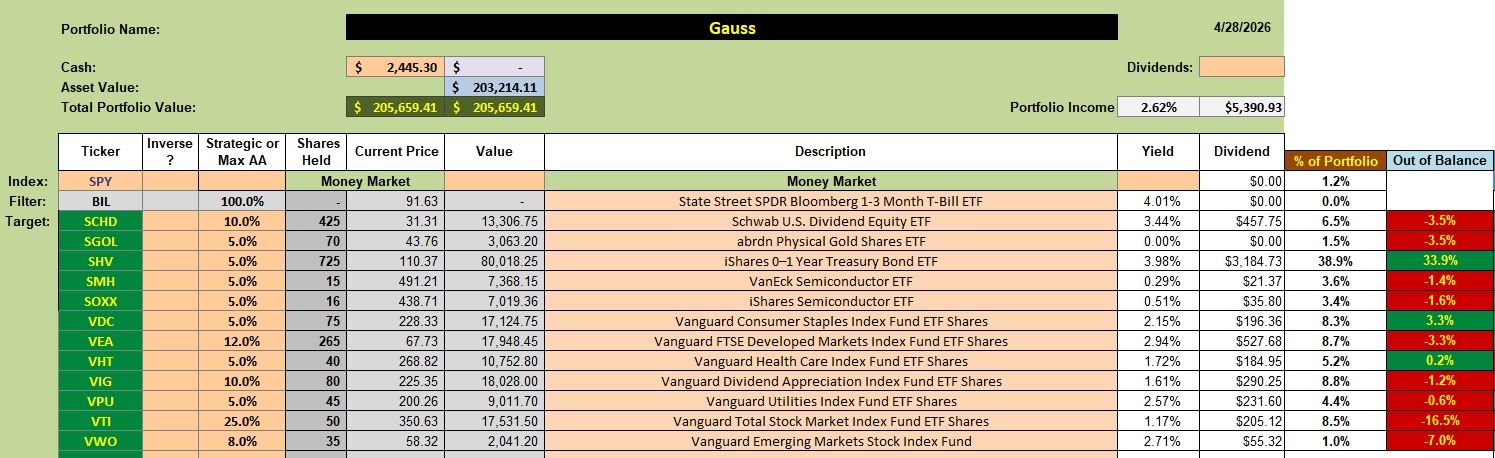
Up for review this morning is the Gauss portfolio. The decision facing this portfolio is whether or not to sell shares of SHV and begin to build up the various asset classes and bring them close to the target percentages or to leave the money in this short-term treasury and wait for a further decline in the market. If we are to believe inflation is around 3%, at least the return of SHV is slightly above this percentage so we are not losing money to inflation.
In future blog posts I will be explaining more about what is likely coming down the pike and it is Financial Repression. Briefly stated, Financial Repression is a government way of “paying down the debt” through a process of keeping interest rates below the rate of inflation. In other words, erode the buying power of the public. Now is the time to pay attention to FED decisions. Kevin Warsh is Trump’s choice to fill the new chairman position. We have strong indicators he will do the bidding of the president as he would not answer the simple question as to who won the 2020 election. The president wants interest rates lowered and this is a clear signal Financial Repression is on the horizon. The question facing investors, and especially, readers of this ITA blog – how do we position our portfolios to avoid or reduce the assault on our buying power?
Here is another definition of Financial Repression.
“Financial repression is a set of government policies—such as interest rate caps, capital controls, and bank regulations—that channel household savings into funding government debt at below-market rates. It acts as a “stealth tax” on savers to reduce high public debt burdens, often resulting in negative real interest rates where inflation exceeds interest income.”
Now on to the analysis of the Gauss.
Gauss Security Holdings
The Gauss asset allocation is set up to provide a buffer to a market correction or even a recession. For example, I am holding Healthcare (VHT) as we are all going to need these products and services. Utilities (VPU) is another basic human need as we require clean water, electricity, natural gas, Internet, and other sources of energy. A third sector is Staples (VDC) or Consumer Staples. Products such as soap, toothpaste, food, etc. are items purchased every day. These three sectors should do well even in times of a recession.
In addition, the Gauss has exposure to all U.S. Equities (VTI). Developed International Equities and Emerging Markets are covered by VEA and VWO respectively. In addition the Gauss is holding shares in Gold and AI stocks through SMH and SOXX. Note that I am not holding any bonds as long term bonds in particular will not do well should we enter a Financial Repression period.
The Gauss does not currently hold any inflation protection ETFs, but that could change this summer.
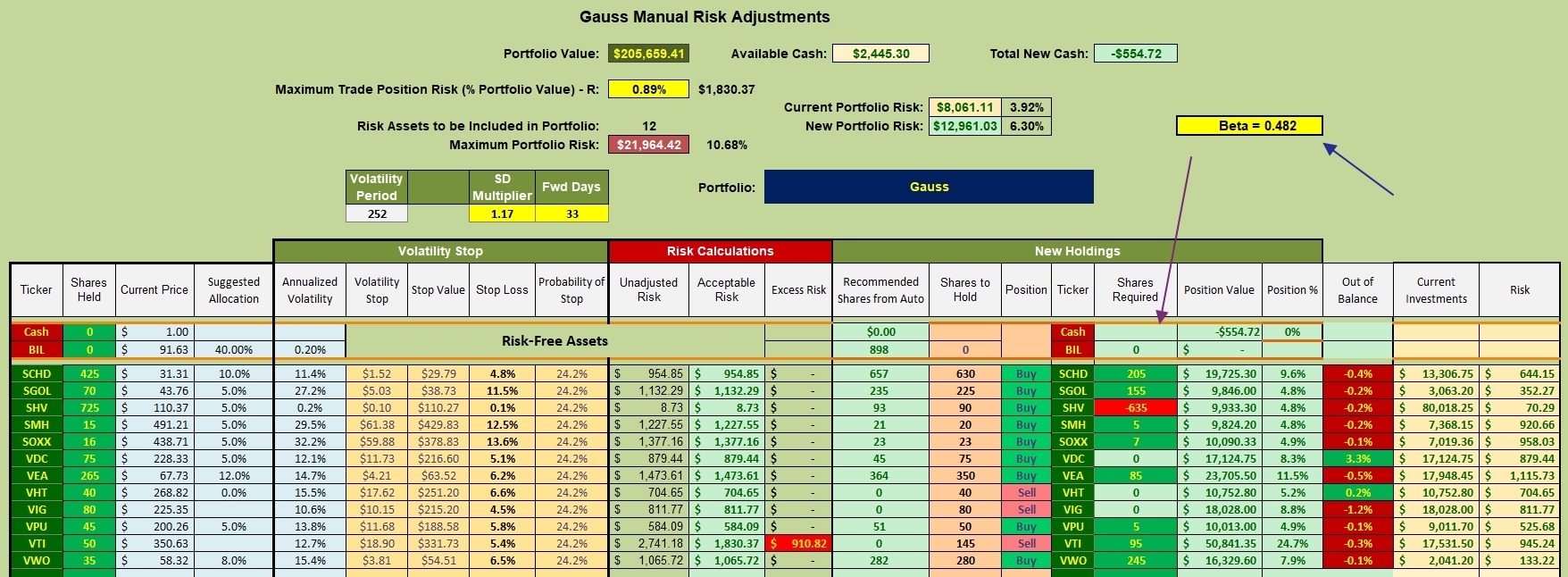
Gauss Rebalancing Recommendations
This month I am standing pat with the above portfolio. Were I to re-balance the Gauss selling shares of SHV would be necessary to raise cash to invest as shown by the purple arrow. The plan is to seriously consider these moves later this summer. The seven to 10 mega-cap stocks are having a hard time showing earnings sufficient to cover the huge investments in AI data banks. This is beginning to place downward pressure on the equities market.
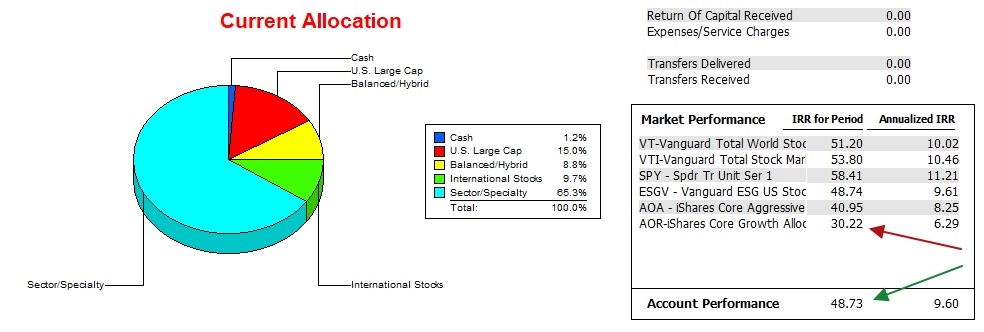
Gauss Performance Data
Since 12/31/2021 the Gauss has performed quite well compared to the AOR benchmark. Not so well when one checks on the SPY return. Once more, it is extremely difficult to top the S&P 500.
One other thought to keep in mind is that portfolio churning requires additional performance to offset taxes. A number of years ago I did a “back of envelope” calculation and came up with what I call the 2% drag. When one is buying and selling securities one needs to show an additional performance of approximate 2.0% to offset the tax burden.
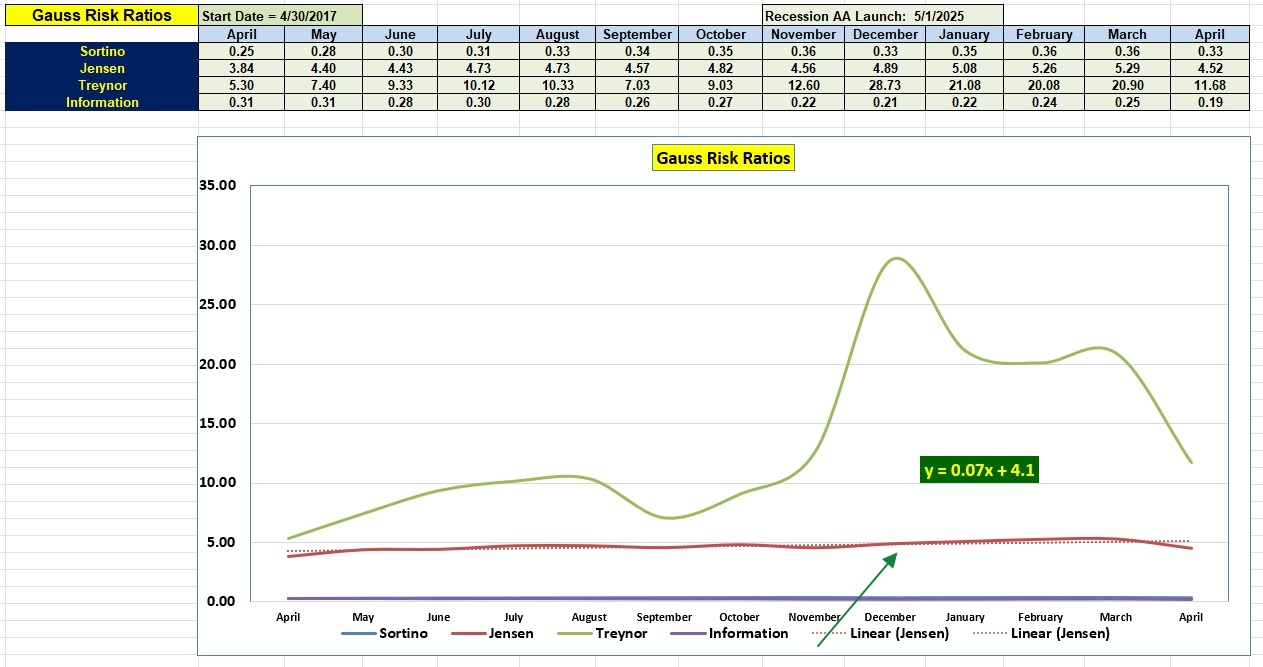
Gauss Risk Ratios
April showed an overall decline in performance when accounting for risk. The slope of the Jensen Alpha is barely positive.
If we dip back to April of 2025, all risk measurements are higher with exception of the very important Information Ratio.
Pass the ITA link on to friends and family and recommend they register as a Guest so as to have access to all blog posts.
Discover more from ITA Wealth Management
Subscribe to get the latest posts sent to your email.
Leave a Comment or Question