
Peonies about to burst forth.
In addition to reviewing the Millikan portfolio, this blog post will also provide readers with some clues as to how to manage a Relative Strength or Relative Momentum portfolio over the next few months. This portfolio is built around the principles of asset allocation and market factors. This is evident when one looks over the following investment quiver.
Millikan Investment Quiver
Asset allocation ETFs cover cap sizes, value, growth, and bonds while market factors focus on cap size, momentum, quality, and value. There are overlapping features to the asset allocation and factor investment quivers.
The Millikan portfolio carries a high percentage in cash and what to do with this money is a critical going forward. Read on to see suggestions as to how to do this.

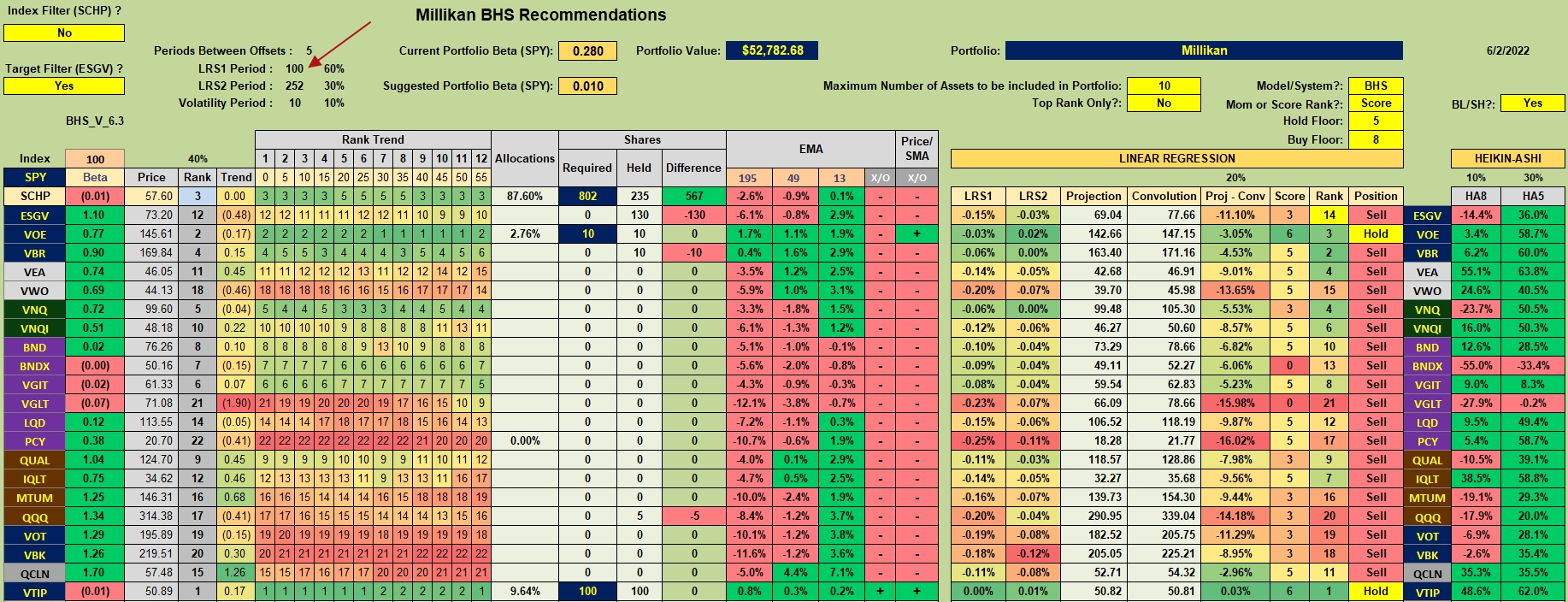
Millikan Security Recommendations
A little life is beginning to show up in the U.S. Equities market as we see Hold recommendations for both VOE and VTIP. Heretofore, all position recommendations were a Sell. Any time VTIP ranks as the number one ETF we know it is not a bullish market. I’m referring to the rank or 4th column from the right.
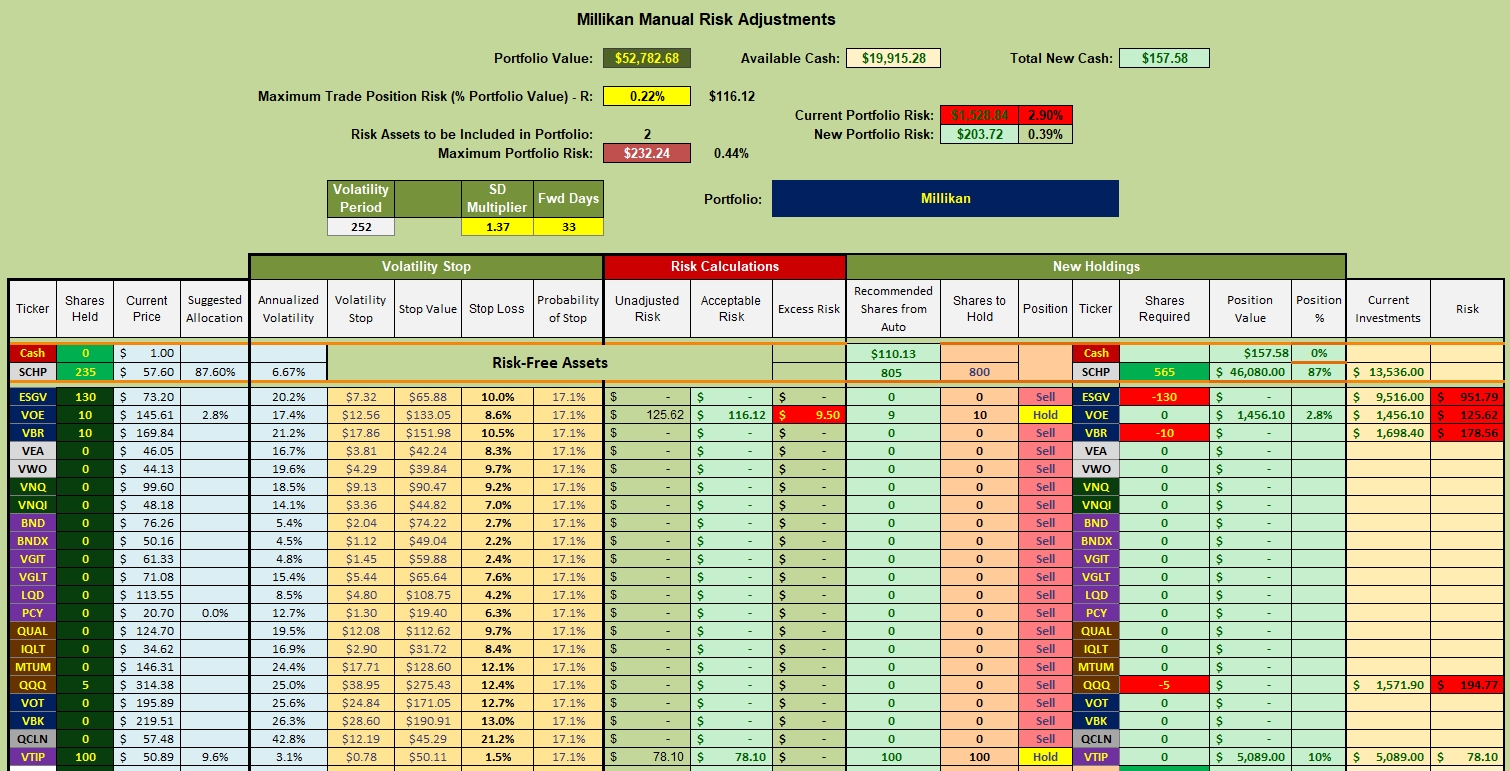
Millikan Manual Risk Adjustments
Note that I adjusted the SD Multiplier to 1.37 so the Stop Loss for ESGV moves from the normal 8.0% value up to 10.0%. I’m willing to take a bit more risk with the Millikan. I also adjusted the Maximum Trade Position Risk to 0.22% so the Total New Cash comes in under $200. The 0.22% setting lowers the Maximum Portfolio Risk to a very low 0.44%.
To achieve these results I will set TSLOs under ESGV, VBR, and QQQ. Available cash is to be invested in SCHP. This is a very conservative position as the projected beta is a very low 0.01. That means we are looking for a flat performance from this portfolio when compared to the S&P 500.
Millikan Performance Data
Since 11/30/2020 the Internal Rate of Return (IRR) for the Millikan is a modest 2.85% while the AOR benchmark is 1.55%.

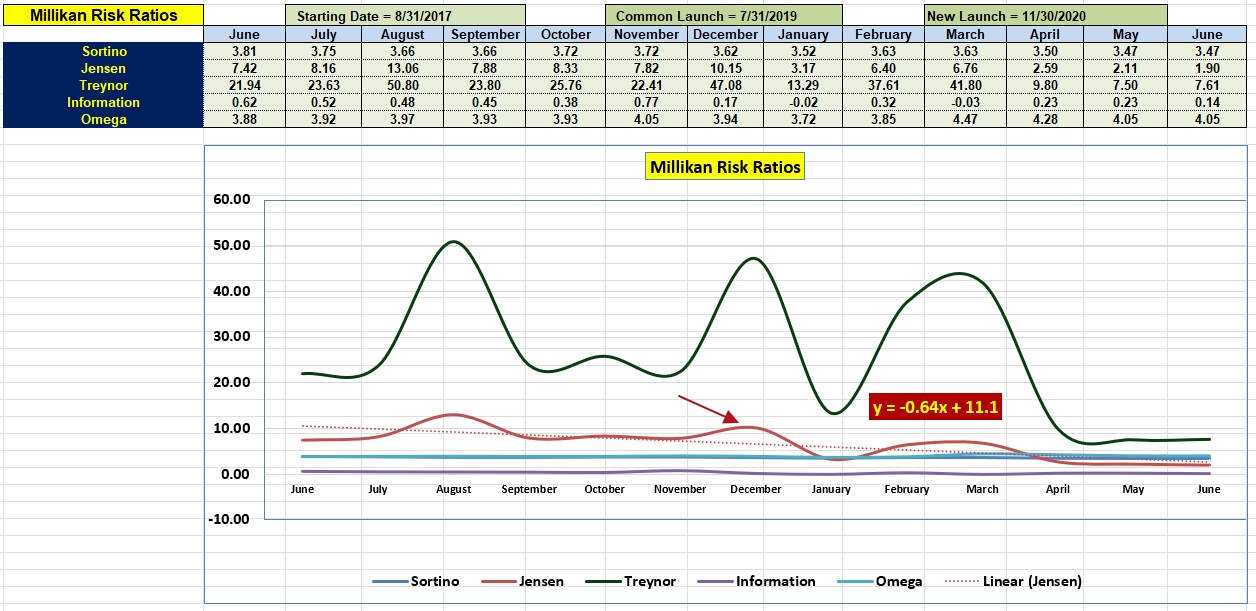
Millikan Risk Ratios
Since this update comes so early in June, don’t pay too much attention to the June numbers. Focus more on the May values. Millikan is one of the few portfolios with a negative slope (-0.64) for the Jensen Alpha. If the market improves and we clear the high August value (13.0) we may be able to turn the negative slope into a positive number.
Once the TSLOs are set, this portfolio is set to run another month. I’ll likely review the Millikan before the schedule July update.
As we head into the summer months, I suggest setting Trailing Stop Loss Orders (TSLOs) under equity holdings. I tend to set them anywhere between 5% and 10%. If cash is available, as is the case with the Millikan, there are two choices. 1) Invest in TIPs such as VTIP or SCHP or 2) set limit orders for ESGV below the 10% TSLO.
For example, set a limit order to purchase X shares of ESGV at 11% below the current price. Then set another limit order to purchase X + Y shares at 12% to 15% below the current price. If cash is still available, continue to set buy limit orders at X + Y + Z at 16% to 20% below the current price. Continue this process until cash is depleted. If you have questions, drop a message in the Comment section provided with each blog post.
The ITA blog is now free to all users who sign up as a Guest. Send the link ( https://itawealth.com ) on to your friends and relatives.
Discover more from ITA Wealth Management
Subscribe to get the latest posts sent to your email.
TSLOs and limit orders to purchase ESGV at prices 12% to 20% below the current price are in place.
Lowell