
Venice
Today’s market brings us closer to closing the equity losses from early April. As one of the Sector BPI portfolios, the Carson experienced only minor losses in April. Several sectors are currently in the overbought zone and as a result, Trailing Stop Loss Orders (TSLOs) are in place to lock in profits. It is difficult to know which direction the market is going to move this summer as the tariffs have yet to take full effect.
Carson Security Holdings
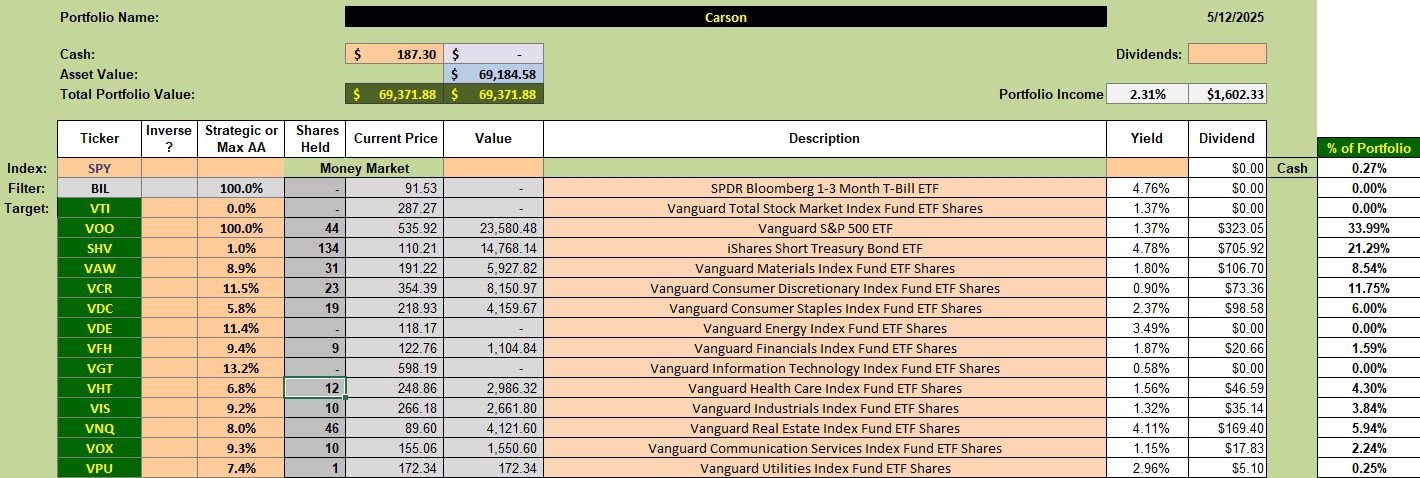
Below are the current holdings for the Carson Sector BPI portfolio. The Discretionary sector moved into the overbought zone yesterday so a TSLO is set for VCR.
If you have been following the Carson and other Sector BPI portfolios you are aware of other TSLOs set for a number of sectors.
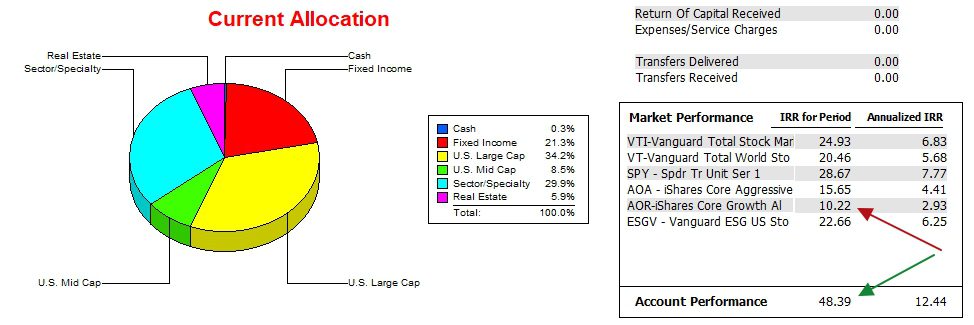
Carson Performance Data
Since 12/31/2021 the Carson has outperformed all benchmarks tracked by ITA. The following information comes from the Investment Account Manager software, a commercial product and one I highly recommend for serious investors.
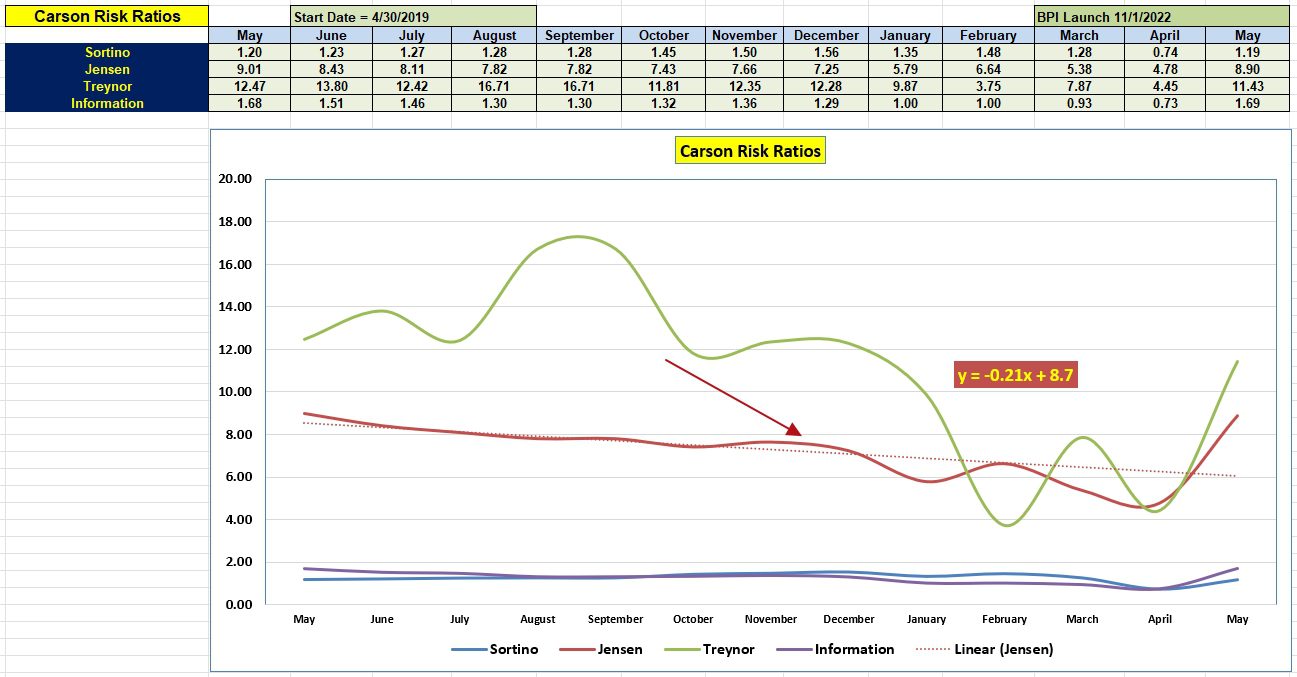
Carson Risk Ratios
The last few days of strong market movement upward has lifted several risk ratios. However, only the Information Ratio is higher than it was a year ago. Despite the recent upswing the slope of the Jensen Alpha is still negative. Any Jensen above zero is considered excellent so it is difficult to maintain high numbers for this important performance index.
Tweaking Sector BPI Plus Investing Model: Part II
Discover more from ITA Wealth Management
Subscribe to get the latest posts sent to your email.
Regarding tariffs and their impact on the stability of the equity markets, the initial hearings on a case which could render the Trump Tariffs moot, opened Tuesday in the US Court of International Trade (CIT). The summary below from California AG Bonta covers the details and legal argument against their legality. CIT cases before a 3 judge panel, such as this, tend to move more quickly than typical US Federal Court decisions. If the tariffs are found to be illegal the market impacts could be quick, strong, and unpredictable. This raises the practical question, how a cautious and prudent investor should prepare?
https://oag.ca.gov/news/press-releases/attorney-general-bonta-continues-challenge-tariffs-all-fronts-president-trump
.
The following link is to an interview with one of the attorneys in the Trump tariffs case before the CIT. He provides additional details supporting a forecast of timing and probable court decisions, appeals, and six probable Supreme Court decisions and rulings on the Trump tariff XOs and policies. To me, this appears to be a well informed forecast. I also anticipate this type of legal analysis is being considered strategically by investment advisors and influencers. What is not clear for me, as a small investor, is how best to use this information to prepare for market impacts over the next few months.
https://newrepublic.com/article/195223/transcript-trump-tariff-fiasco-worsens-media-exposes-fresh-scam
.
How best to prepare for “Individual-1 Uncertainties” is the question we are all dealing with? This is my advice and it may be wrong.
1. Diversify portfolio into different management models.
a. The Copernicus and Schrodinger are two approaches.
b. Sector BPI management model is one that provides some downside protection.
2. Use TSLOs. These are working very well so long as the market moves up. One odd announcement could trigger multiple sell signals only to be followed up by another announcement that would cause the market to leap upward.
3. Use short-term treasuries and wait out this administration.
4. When possible purchase more shares on market draw-downs.
Lowell
Thank you — I lean toward option 1.a with extra weighting to wait out this administration. Today’s (May 16) Paul Krugman substack makes an excellent data- supported argument for anticipating stagflation, here is the link: https://paulkrugman.substack.com/p/the-trade-war-isnt-over
.
Lee,
Excellent article. Thank you for posting the link.
I am playing it safe as I have little faith in the mental acuity of Individual-1.
Lowell