
What to do with a poor performing portfolio? Advice to the owner of the Einstein is to continue to add money to the portfolio and work toward keeping the various asset class close to target. Instead of concentrating on the Internal Rate of Return, focus on the Jensen Alpha and Information Ratio.
Einstein Security Holdings
The asset allocation model is set up to resist a market draw-down. It is anyone’s guess as to when this is likely to happen.
Most of the asset classes are currently out of balance. With the market this high I am not inclined to rush into full compliance. Rather a slow approach is the one I will take in hopes of picking up shares at lower prices.
I did hear a bit if interesting news and it goes as follows. Quantum computing will likely make the current data centers obsolete and we know how much money is currently being poured into mega data centers. Earnings do not match the investment in these centers and if they turn into bone yards in four or five years the market is in for a shock.
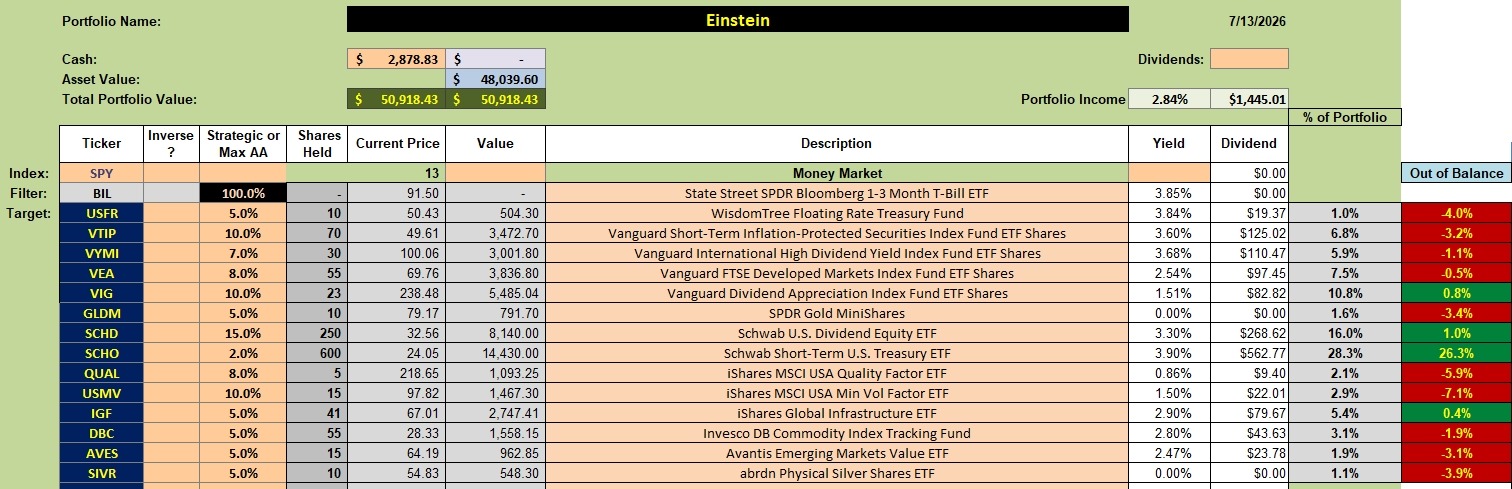
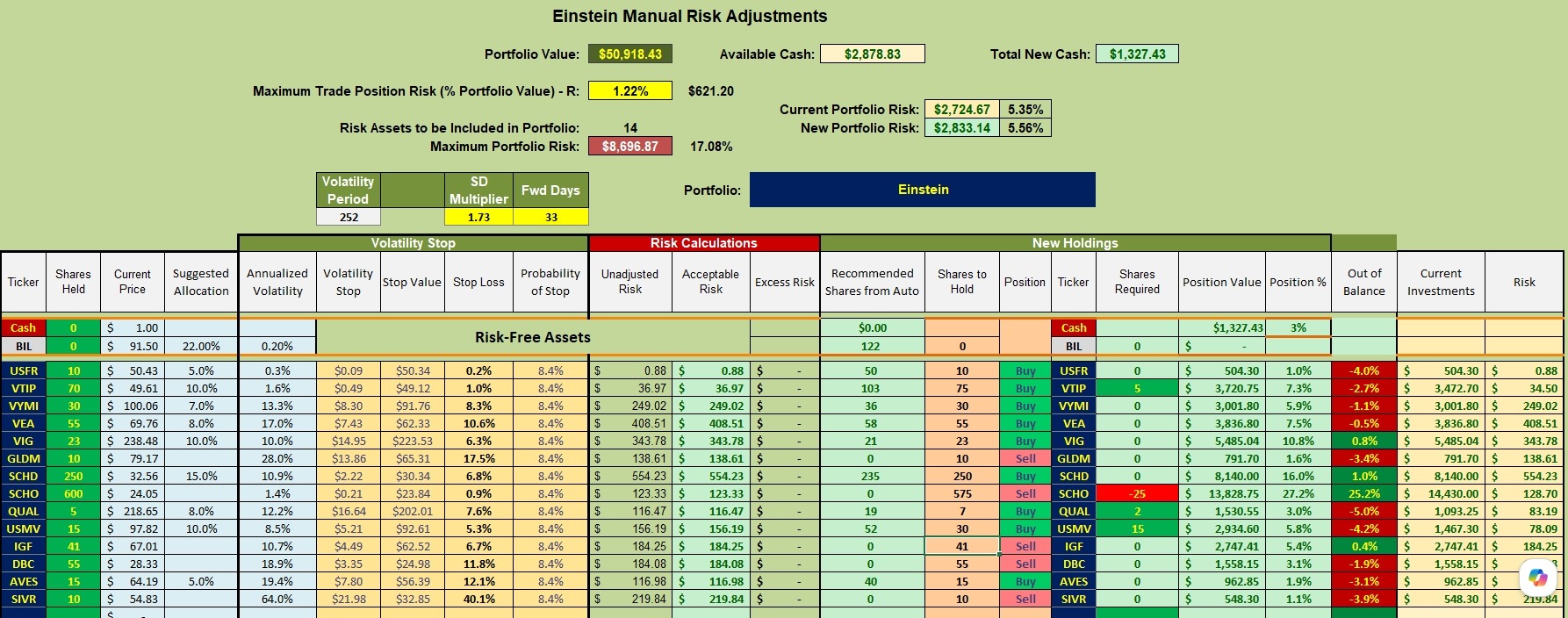
Einstein Rebalancing Recommendations
As with several other portfolio I am concentrating on bringing ETFs out of balance back into balance. But using a slow process. If cash is available, in August I will try to see all ETFs within 4.5% of target. It may be as long as a year before the portfolio is in balance.
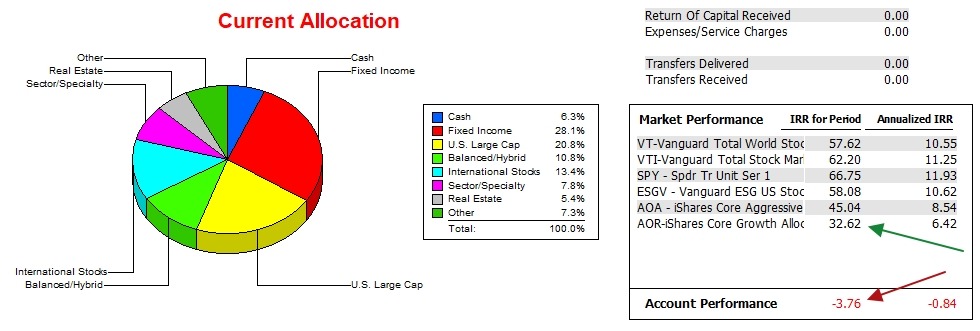
Einstein Performance Data
Since 12/31/2021 the Einstein has lagged all benchmark by a wide margin. When the IRR is this far behind the AOR benchmark I look to the Risk Ratios for more information as to which direction portfolio is moving.
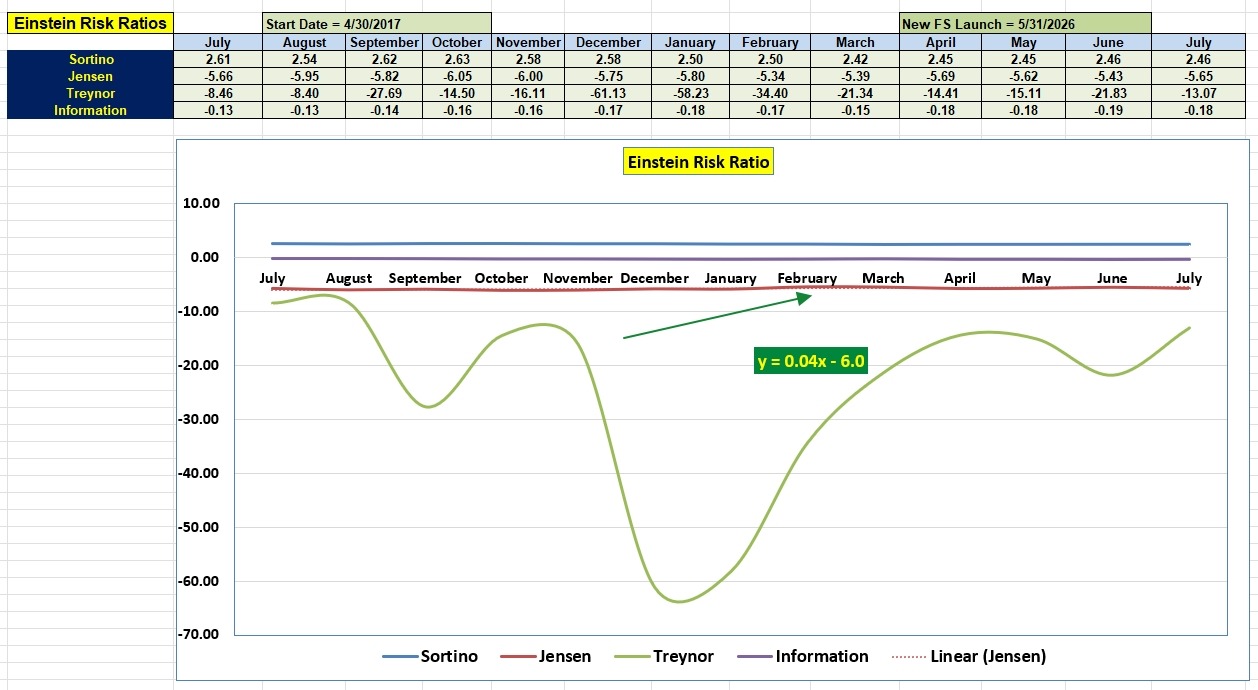
Einstein Risk Ratios
The Jensen Alpha varied little over the past year. The same is true for the Information Ratio, although in this case the percentage drop is much greater. The Sortino Ratio continues in the positive range so that is some good news for this disappointing portfolio.
The hope is that the new asset allocation model will stabilize the performance of the Einstein.
Discover more from ITA Wealth Management
Subscribe to get the latest posts sent to your email.
Lowell, your observations about the possibility of quantum computing displacing current AI Data Centers is of great interest to me. Following is the Gemini AI analysis, with my prompt and the response in a Q&A format. Upfront, this looks plausible to me and seems like a good starting point for further research. Meanwhile, it is my opinion that the current pushback against Data Centers might be saving speculators from an even more serious over investment in this type of infrastructure.
Q: How long until quantum computing can become competitive with current AI Data Centers?
Gemini A: “. . . BLUF (Bottom Line Up Front)
Quantum computing is not expected to broadly replace AI data centers; instead, it will become competitive by integrating with them. The industry consensus forecasts initial “quantum advantage” on specific, narrow workloads between 2026 and 2028, with fully scalable, fault-tolerant quantum processing units (QPUs) targeted for 2029–2030.
Reality Check Protocol
1. Base Rates (Outside View)
Infrastructure Transition Timelines: The data center industry spent roughly the last five years (2021–2026) redesigning its infrastructure to handle the massive power and cooling demands of classical AI. Historically, integrating a fundamentally new hardware paradigm (like the shift from CPUs to AI-optimized GPUs) takes 5 to 10 years to reach widespread utility and mature enterprise adoption.
Market Growth Projections: The quantum computing market is currently estimated to grow at a 30% annual rate, moving from roughly $1.4 billion in 2025 to a projected $3 billion by 2028.
Hybrid Architecture Trend: Rather than chasing standalone “quantum supremacy,” the current baseline for data center expansion is a hybrid model. Operators are physically co-locating QPUs next to classical GPU/CPU nodes to reduce communication latency and offset the extreme processing bottlenecks of current AI systems.
2. Two-Source Verification
Targeting 2026–2030 for Quantum Advantage (Verified)
Source 1: IBM’s 2026 Quantum Technology Atlas officially targets this year (2026) for demonstrating the first examples of quantum advantage using a hybrid setup, with a goal of achieving large-scale, fault-tolerant computing by 2029.
Source 2: Consulting models from McKinsey and data from hyperscalers (like Google’s Willow QPU roadmap) align on a 5-year horizon from today, targeting 2028–2030 for commercial viability and error-corrected logical qubits.
Data Center Co-location Over Replacement (Verified)
Source 1: Data Center Knowledge reports that major operators are already actively building hybrid data centers, using frameworks like Nvidia’s NVQLink to bridge QPUs and classical AI supercomputers.
Source 2: Research from JLL confirms that quantum installations are already occurring within existing hyperscale facilities to create efficiency gains, rather than building isolated quantum-only centers.
D-Wave Outperforming Supercomputers on 12kW (Unverified)
Single Source: A claim that a D-Wave system achieved a massive quantum advantage milestone in March 2025 by outperforming classical supercomputers on just a few kilowatts of power relies on a single YouTube commentary source and remains highly contested in peer-reviewed literature.
3. Pre-Mortem Analysis
The Scenario: It is 2032, and quantum computing has entirely failed to become competitive or integrate effectively with classical AI data centers.
Failure Point 1: The Error Correction Trap. The physics of qubit decoherence proved too stubborn. The “overhead” (the ratio of physical qubits required to sustain a single, stable logical qubit) remained economically non-viable, meaning quantum computers could not run long enough algorithms to beat classical AI without collapsing.
Failure Point 2: Hostile Facility Environments. The specialized infrastructure required for quantum—specifically cryogenic refrigeration, electromagnetic shielding, and extreme vibration mitigation—could not be scaled affordably within standard AI hyperscale campuses. The heavy floor vibrations from standard liquid cooling pumps continually disrupted the QPUs.
Failure Point 3: Classical AI Outpaced Quantum. Algorithmic efficiency on classical GPUs and neural networks improved much faster than quantum hardware scaled. The “classical wall” was continually pushed back via AI software optimizations, making the massive capital expenditure of quantum hardware uncompetitive for standard enterprise operations. . . . ”
All the best,
– Lee
.
Lee,
I am picking up similar information from ChatGPT. It looks like we will have a better idea of the quantum computing impact around 2030 or a little later. Should be an interesting time.
Lowell