
Garden of friend.
Before beginning this review of the Carson I checked the sector Bullish Percent Indicator (BPI) data since Utilities moved into the oversold zone on Tuesday. Here we are on Thursday and Utilities is still positioned at 30% bullish or recommending a purchase. The move to add VPU is explained below.
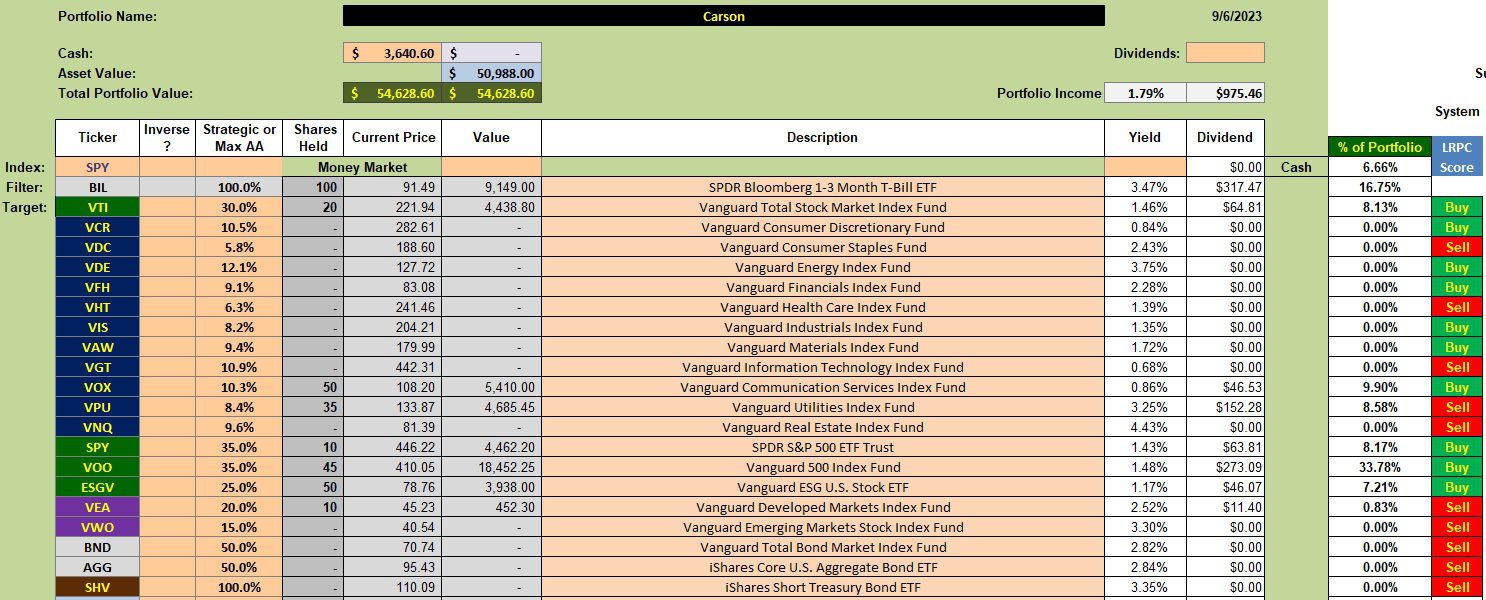
Carson Investment Quiver and Holdings
Here is the current investment quiver and holdings for the Carson. Two limit orders for VPU were struck and as you can see below the Carson now holds 35 shares or 8.6% of the portfolio. The recommended percentage of 8.4% is the percentage value within the confines of the eleven sectors. We are on target. The Carson has been holding VOX for many months.
When there are few buy recommendations within the eleven sectors we move to equities such as VOO, SPY, VTI, and ESGV. Including these equity options is the Plus portion of the Sector BPI Plus investing model. More on this later.
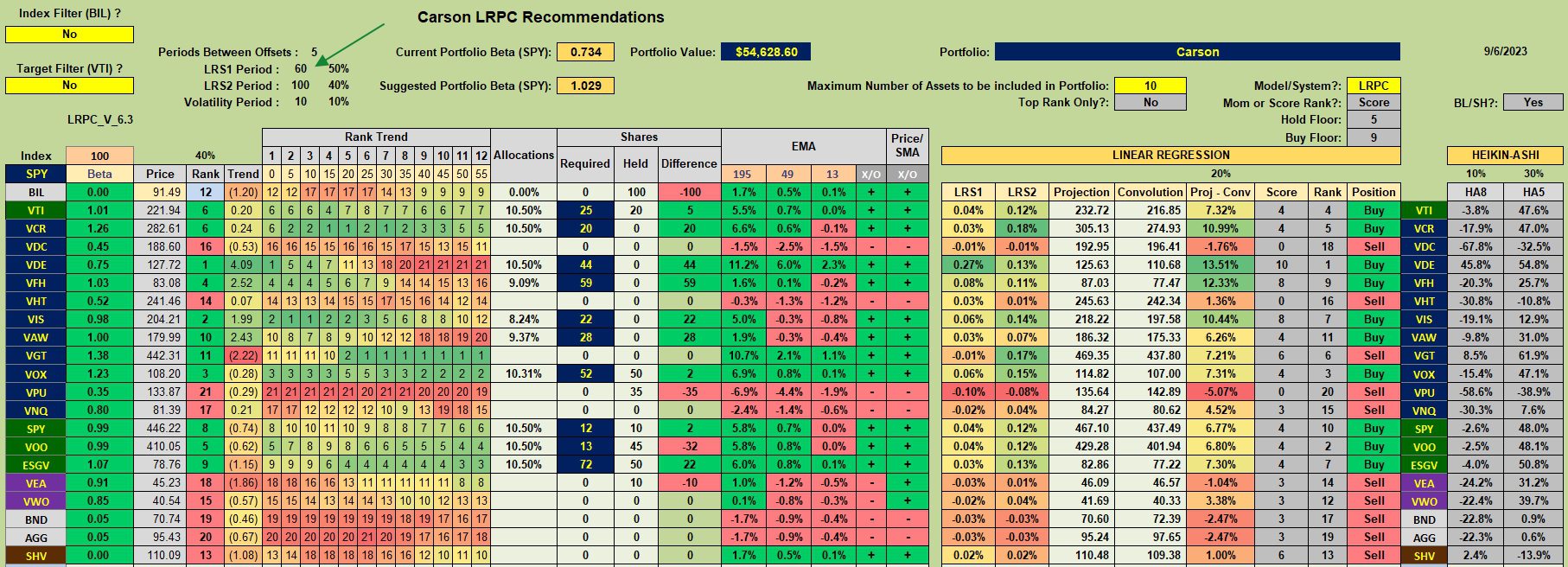
Carson Security Recommendations
Using the Kipling spreadsheet the following worksheet shows the recommendations if the LRPC investment model is selected and the 60- and 100-trading days look-back combination is chosen. VTI, VOO, SPY, and ESGV are all recommended for purchase. Now we need to know how many shares of each to buy or hold. Note that the Carson currently holds shares of VEA and the recommendation is to sell all shares. How is this recommendation handled?
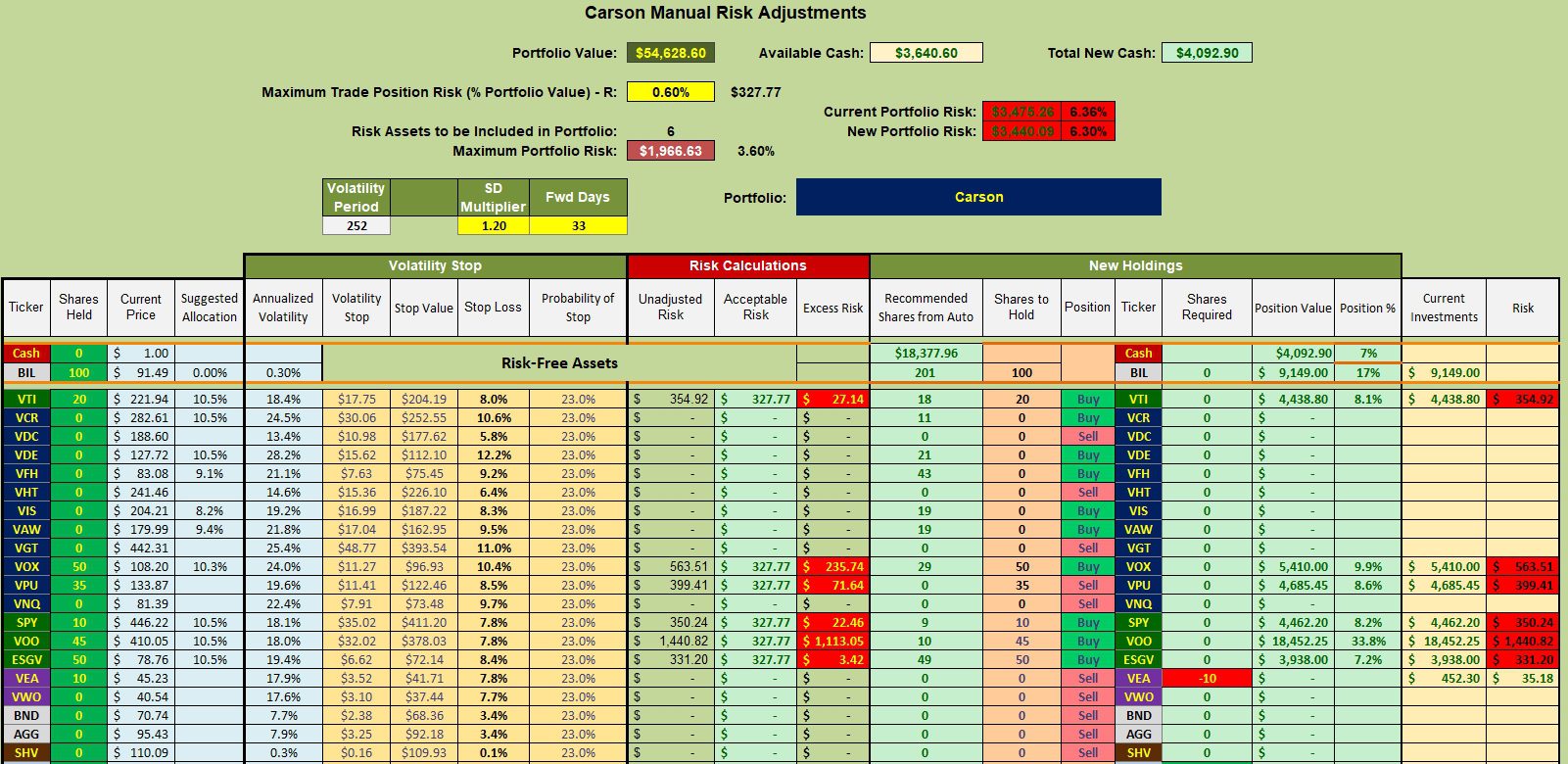
Carson Manual Risk Adjustments
The Manual Risk Adjustment worksheet within the Kipling spreadsheets helps guide us when it comes to specific recommendations.
- Holding 20 shares of VTI is close to the recommended 18 shares. To protect capital I set a Trailing Stop Loss Order (TSLO) of 8% for VTI.
- Pay no attention to the Buy orders if associated with the sector ETFs as we use BPI data for those buy and sell recommendations. Only Utilities (VPU) is currently a buy (based on BPI data) and the Carson currently holds 35 shares of VPU.
- Move down to SPY where we hold 10 shares when 9 are recommended. No change needed. I have a TSLO set for SPY to protect capital in case of a recession. I generally set the TSLO for these equities somewhere between 7% and 10%.
- VOO is over subscribed as the Carson holds 45 shares when only 10 are recommended. No change needed. A TSLO is also set for VOO so as to protect capital.
- ESGV holds 50 shares with a recommendation for 49. No change needed and a TSLO is set for ESGV for the same capital preservation.
- A Sell recommendation is linked with VEA and I have a 3% TSLO set for this ETF.
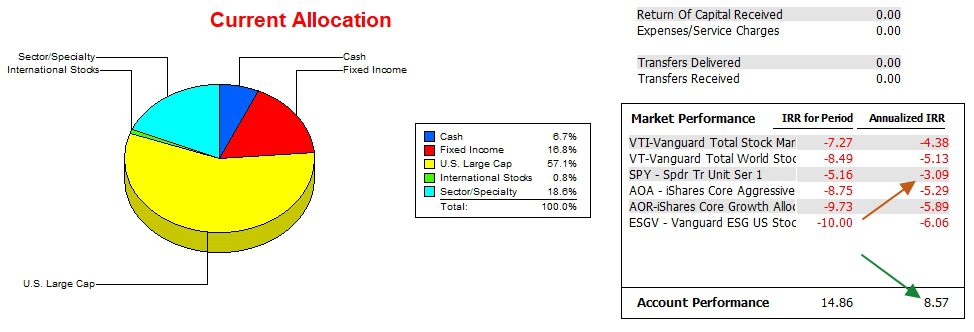
Carson Performance Data
Over the past 20 months the Carson outperformed the S&P 500 (SPY) by a wide margin. The lead is even greater when compared with the other five references. It will be difficult to maintain this delta. However, if the Sector BPI Plus model works as expected we should outperform the SPY benchmark.
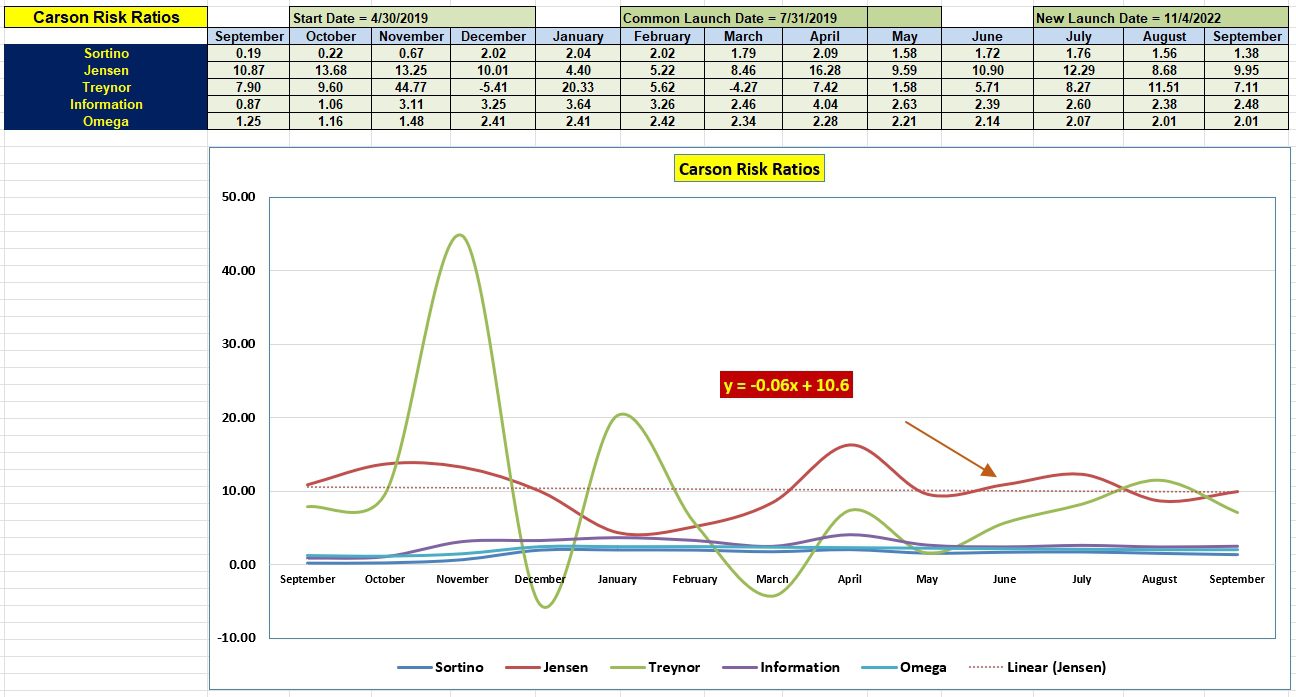
Carson Risk Ratios
While the Sortino Ratio lost ground over these first few days of September, the Jensen Alpha and Information Ratio increased. The Jensen did not increase sufficiently to move the slope into positive territory, but it is very close. With a little cooperation from U.S. Equities we should see a positive slope for the Jensen Performance Index by the end of 2023.
Here is data for several other Sector BPI Plus portfolios.
Franklin Portfolio Review: 21 July 2023
Millikan Sector BPI Update: 20 July 2023
Gauss Portfolio Update: 19 March 2023
Discover more from ITA Wealth Management
Subscribe to get the latest posts sent to your email.
Lowell,
Is there a reason that you changed the Volatility percent from the default 20% to 10%?
~jim
Jim,
I want to place more emphasis on the look-back period vs volatility. Particularly for the Sector BPI portfolios where volatility is taken into account through the BPI movements. I need to check to see if I’ve made the change for all Sector BPI portfolios.
Lowell