
Structure
The following paragraph within the quotes was AI generated. “Hello! We hope this message finds you well. We are excited to share with you our latest portfolio review. Our team has been working diligently to analyze the market trends and fine-tune our asset allocation strategies. In this review, we delve into the performance of various sectors and provide insights on the current state of the stock markets. Stay tuned for a comprehensive overview of your portfolio’s progress.”
And now for the review or update of the Gauss portfolio. As mentioned a few days ago I am moving toward simplicity, not complexity. Portfolios using VOO and/or VTI for the equity exposure are at a higher risk, but this can be somewhat controlled by using stop loss or trailing stop loss orders.
As you may recall, Health, Materials, Energy, and Real Estate were all oversold in recent weeks. I intent to hold on to VHT, VAW, VDE, and VNQ until they are overbought. This will restrict the complete rebalancing process for the Gauss. In this post I show where the Gauss is headed as well as were it currently stands.
Gauss Portfolio Holdings
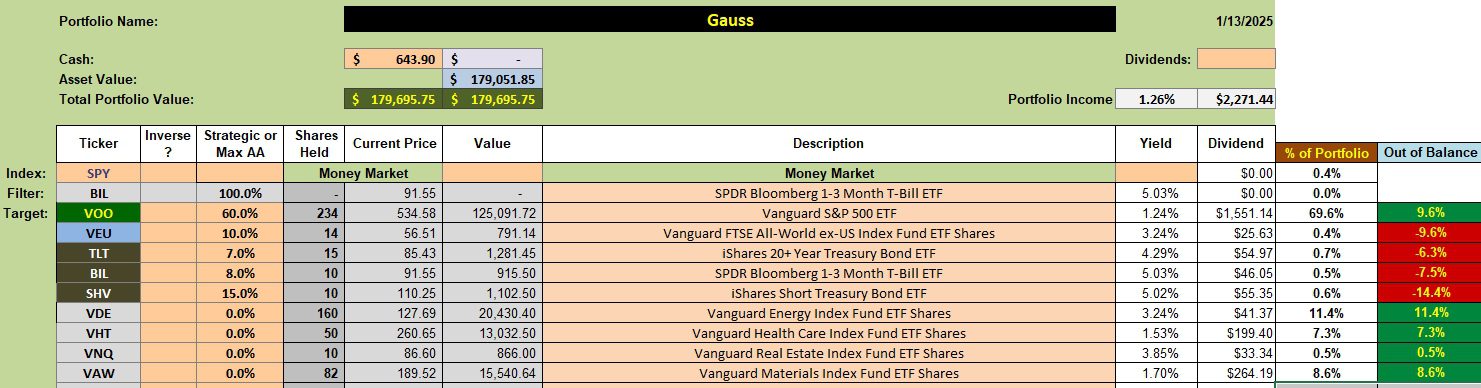
Below readers will see the current holdings of the Gauss. Eventually the portfolio will concentrate on VOO, VEU, TLT, BIL, and SHV. The percentages are found in the third column from the left. Pay no attention to BIL at the top of the list. The goal is to invest 8% in BIL as an income generating security.
Gauss Rebalancing Recommendations
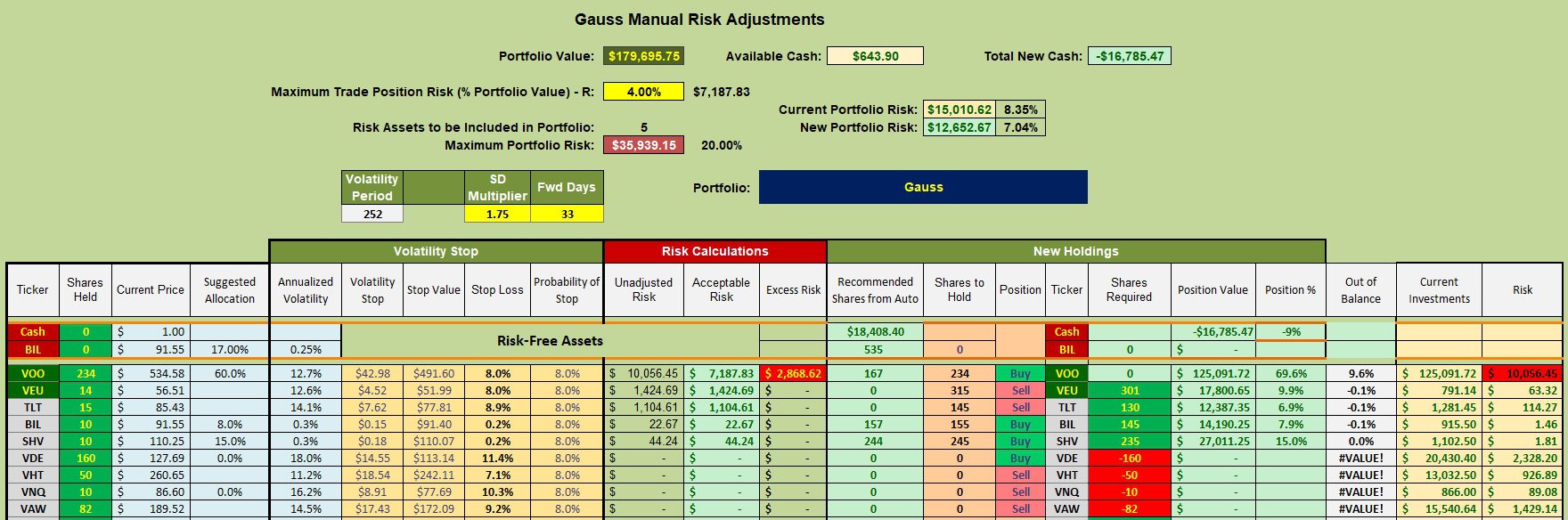
The following table lays out the future plans for the Gauss. Until sector ETFs are sold there is insufficient cash to populate VEU, TLT, BIL, and SHV. The Shares Required column shows where the Gauss is headed.
Gauss Performance Data
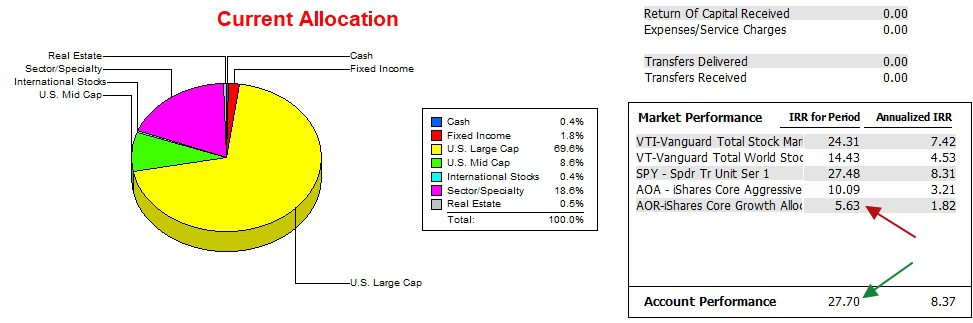
Since 2021 the Gauss has performed very well as it is generating an Internal Rate of Return (IRR) that exceeds the S&P 500 ETF (SPY). In addition the portfolio is outperforming other potential benchmarks. I plan to use AOR as the benchmark with the new allocation plan.
Gauss Risk Ratios
Since March of 2024 the Jensen Alpha has consistently bounced around near the zero mark. Anytime the Jensen is positive is a plus. This indicates the portfolio is performing better than the benchmark when risk is part of the equation. The Jensen Alpha also is knows as the Jensen Performance index. It takes into account these four factors or metrics.
- Portfolio Beta
- IRR of Portfolio
- IRR of Benchmark
- Interest rate of risk-free treasury. I use the interest rate of SHV which just dropped to 5.02%.
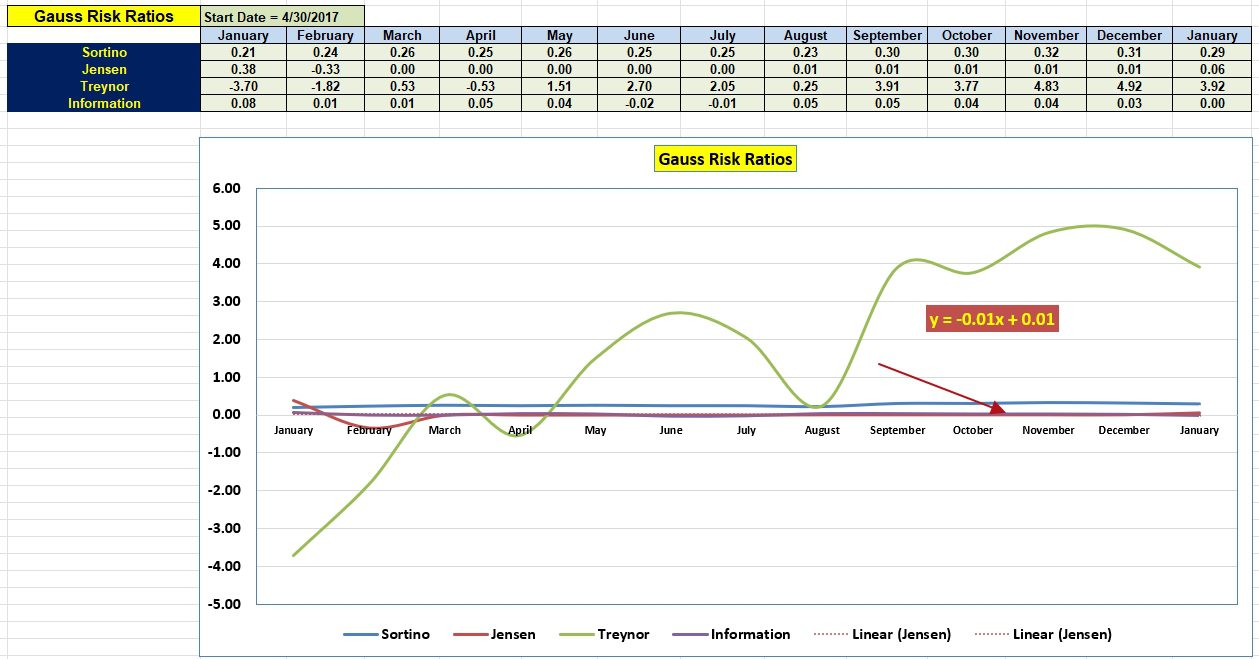
Assume it will be many months before the Gauss is operating with the new asset allocation plan. When the various ETFs are in balance the Gauss will be less risky as the beta will be lower due to holding SHV, TLT, and BIL. This will help to improve the Jensen Alpha reading.
Discover more from ITA Wealth Management
Subscribe to get the latest posts sent to your email.
You must be logged in to post a comment.