
Baltimore Crab Sculpture
After a few weeks since launch the Pauling is beginning to settle down into the Asset Allocation plan as envisioned. As with most portfolios I anticipate some additional evolutionary adjustments over the next year will occur. A few assets from the old model are currently oversubscribed or carry a higher percentage of the portfolio than the current model recommends. Fresh cash additions and dividends will permit investments in assets that are under represented. I explain below how I intend to work to keep the Pauling in balance.
The Pauling is a throw back to the initial days when I launched the ITA blog back in 2008. Asset Allocation portfolios were the standard fare in those days. Pauling is such a portfolio and it is built around the philosophy advocated by William J. Bernstein in his book, The Intelligent Asset Allocator. Dr. Bernstein revised this book at least twice and if this first book is too complex I highly recommend reading The Investor’s Manifesto: Preparing for Prosperity Armageddon and Everything In Between. This second book by Bernstein is a little easier reading.
For beginning investors, a one evening read is Burton G. Malkiel and Charles D. Ellis who co-authored The Elements of Investing. The first three chapters will tell you nearly everything you need to know about investing.
If any readers have read any of these books, I would like to hear in the Comment space below your reviews and general reactions.
Getting back to the Pauling portfolio, the ultimate goal is to keep each asset class within plus or minus 0.5% of the recommended percentage. I’ll explain how I am approaching this goal.
Pauling Asset Allocations
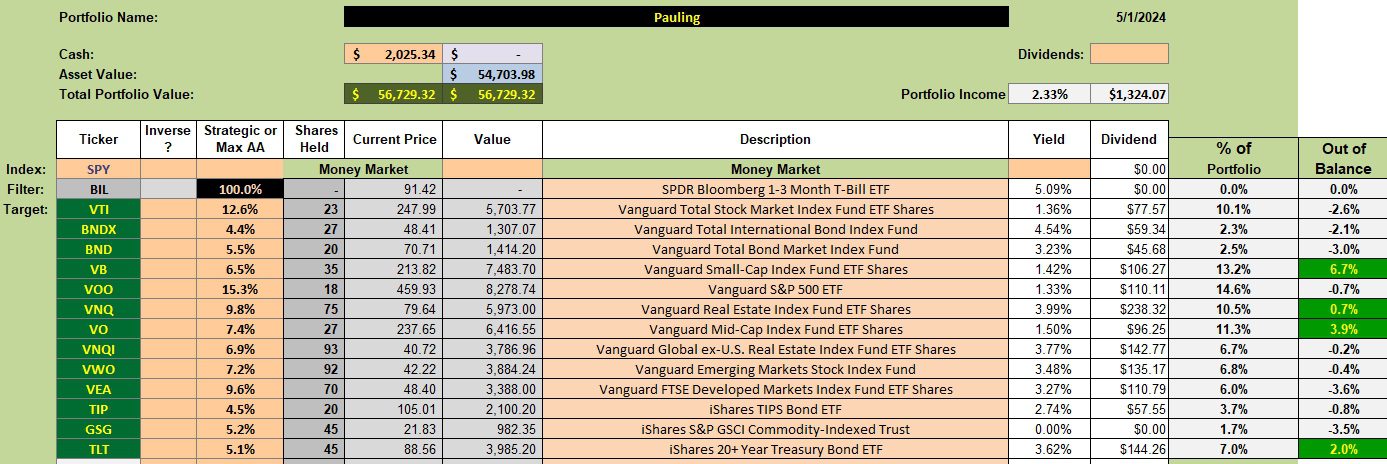
Below is a very important worksheet that is part of the Kipling spreadsheet. In this worksheet the asset allocation model is laid out. This includes both the securities to use and the percentage to invest in each ETF. As an investor you may wish to adjust these to fit your own goals and risk tolerance.
Over in the right-hand column we identify those ETFs or asset classes that are out of balance and by how much. I don’t pay attention to those that are oversubscribed such as VB, VNQ, VO, or TLT. Pay attention to those most below the recommended percentage such as VEA. More on this in the next screenshot.
Pauling Manual Adjustments
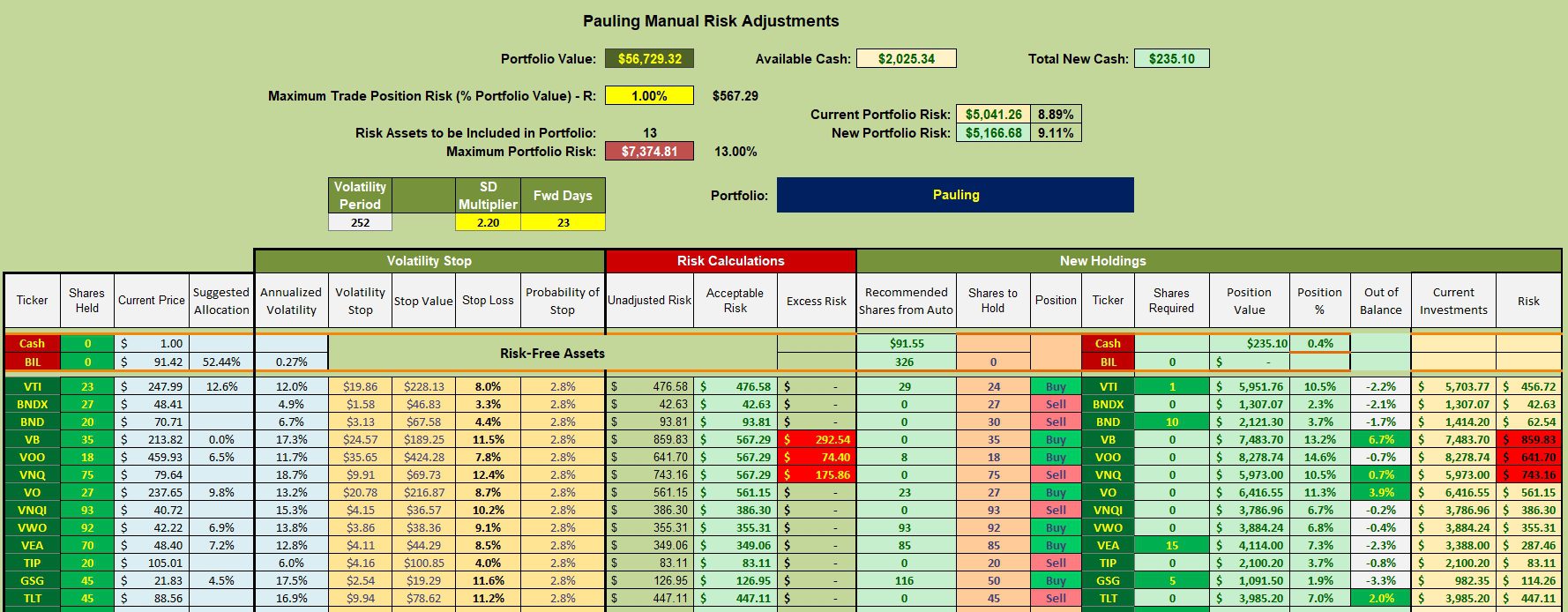
In this manual risk adjustment worksheet readers need to focus on two variables.
- Which ETFs are out of balance on the low end?
- Go back to the worksheet above and you will see the top three are: VEA, GSG, and BND.
- Now come back to the worksheet below and look for which of these three ETFs are listed as a Buy. Only VEA and GSG are recommended for purchase so concentrate on bringing those two ETFs into balance.
Conclusion: Concentrate on bringing the asset class or ETF that is most out of balance and recommended as a Buy back into balance. By applying this approach we are always seeking to keep the Pauling portfolio in balance by using fresh cash and dividends effectively.
Pauling Performance Data
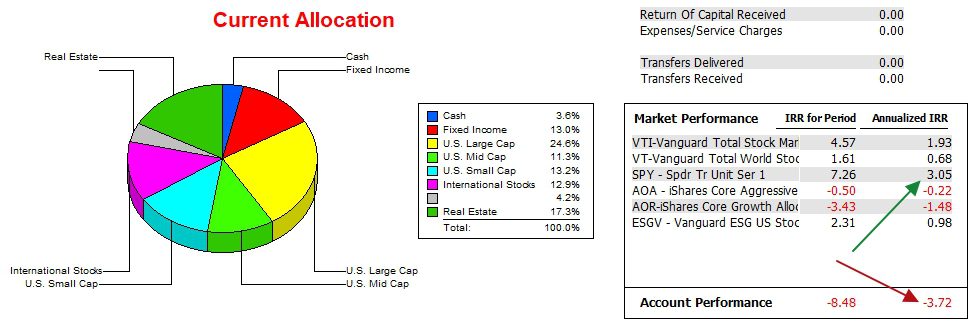
Since 12/31/2021 the Pauling continues to lag the SPY benchmark. Over time we will watch how this asset allocation model works and is it able to close the performance gap. The first goal is to overtake AOR and then move past AOA. This will take time as these potential benchmarks currently have significant leads over the Pauling.
Pauling Risk Ratios
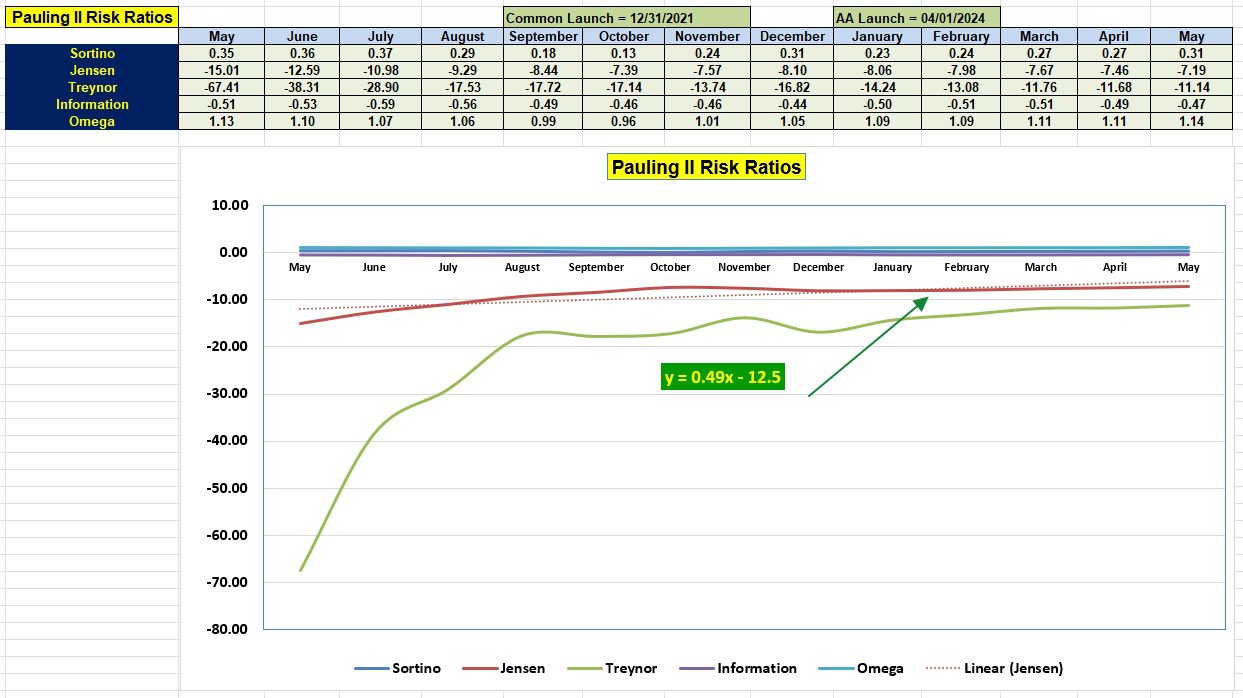
Tracking the Pauling performance and risk will be easier to follow by paying attention to the following data table. The two most critical metrics are the Jensen Performance Index and Information Ratio.
The good news is that the slope of the Jensen is positive. For the Asset Allocation model to prove itself, the slope of the Jensen needs to remain positive.
Tentative Asset Allocation Model
Discover more from ITA Wealth Management
Subscribe to get the latest posts sent to your email.
Hi Lowell. I’ve read most of his stuff and I consider him one of my favorite authors. I particularly like his three pillars to invest the psychological part is prominent. My understanding is that most of his stuff and I consider him one of my favorite authors. I particularly like his three pillars to invest the psychological part is prominent. My understanding is that he lives in Portland and so I’m surprised that you haven’t connected with him in some fashion. l
He must be a marvelous intellect since he is a neurologist, a gifted writer, and gives great investing advice. Thank U. John
Hi Lowell. I’ve read most of his stuff and I consider him one of my favorite authors. I particularly like his three pillars to invest the psychological part is prominent. My understanding is that most of his stuff and I consider him one of my favorite authors. I particularly like his three pillars to invest the psychological part is prominent. My understanding is that he lives in Portland and so I’m surprised that you haven’t connected with him in some fashion. l
He must be a marvelous intellect since he is a neurologist, a gifted writer, and gives great investing advice. Thank U. John