
Hamlet Square – Solvang, California
“A major part of any investment plan is portfolio asset allocation.” – Richard A. Ferri
Welcome to the Pauling II Asset Allocation portfolio. Expanding on the Tentative Asset Allocation model, the Pauling II will use fifteen (15) asset classes, recognizing there will be some overlap between VTI, VOO, VO, VB, and QQQ. Expanding from 10 to 15 ETFs will increase the percentage in U.S. Equities which is intentional. Once we have the portfolio up to speed and the asset allocation percentages are closer to the “recommended” values, I’ll drop the II and simply call this portfolio the Pauling. Until then I want to distinguish this fresh approach from the former Pauling.
Pauling II Investment Quiver
Below is the Asset Allocation investment quiver for the Pauling II. While the portfolio holds a few sector ETFs, I’ve not included them as TSLOs are set at a few percent below the current price and will soon be sold out of the portfolio. The other alternative is to sell them at market and reinvest according the the percentages laid out below. When the market opens this morning I’ll begin to set limit orders for all 15 ETFs.
The Strategic or Max AA percentages (third column from the left) are calculated by using a three-year volatility calculation and then applying what I call a Volatility Coefficient so the sum of 15 ETFs adds up to a value close to 100%.
Once a number of the ETFs are holding shares I’ll update the portfolio before the May review so readers can see the development of this portfolio. The long-term plan is to review the Pauling II on the first Monday of the month.
I’ve added a column, Out of Balance (second from the right) to make it easy to see which asset class or ETF is in most need of adding more shares. At the moment that would be U.S. Real Estate (VNQ) followed by Gold (GSG).
I’m less than excited to be holding 16.2% of the portfolio in Gold and Commodities, but those are two volatile asset classes.

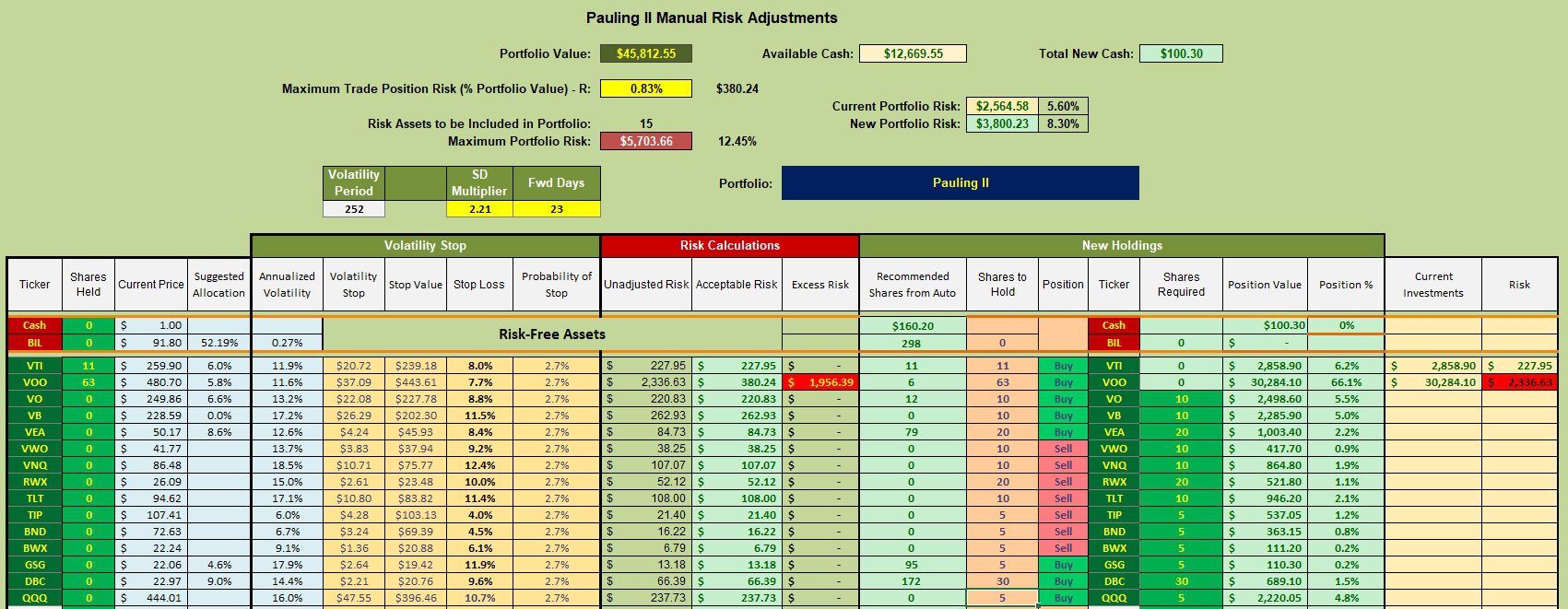
Pauling II Manual Risk Adjustments
The two primary holdings are currently VTI and VOO. I plan sell shares of VOO so cash is available to set up the broad asset allocation model. If the owner of this portfolio adds new cash or when dividends are declared, shares will be purchased for the ETF(s) most out of balance.
With a portfolio of this size I hope to be able to purchase shares in “blocks” of 5 shares. It will take some time to bring all the asset classes into balance so be patient.
Comments are always welcome.
Discover more from ITA Wealth Management
Subscribe to get the latest posts sent to your email.
Hi Lowell
I like your new Portfolio. Most of the ETFs are already in my quiver which I use with my Asset allocation. I don’t like RWX and would use VNQI instead which has a better 1,3,5, and10 year performance plus a lower exp ratio. VTI, VOO, and QQQ are very similar in size and performance and have similar holdings per Morningstar data. if I had to pick one, I would choose VOO.
Bob`
Bob P.,
Check out the revised investment quiver.
Lowell
Bob,
Thanks for the international bond suggestion. I will swap RWX for VNQI. I forgot about the Vanguard option. I’ve not made any new purchases so the change is easy.
If I select only VOO and remove QQQ and VTI, I will make an adjustment in the percentage for VOO as I want to increase the percentage in U.S. Equities. You have given me some ideas so thanks for your ideas.
Lowell
More changes are coming. For example, I will use BNDX for the international bond ETF. Also, I am doing some internal adjustments for portfolio percentages. To be explained later.
Lowell
PS I have a few shares invested for most of the asset classes – but not fully invested.
Lowell,
Are you thinking this is a buy/hold portfolio with annual or quarterly rebalancing based on the volatility changes if any?
Bob W.
Bob W.,
This is definitely a Buy and Hold portfolio. I plan to review and update the portfolio the first Monday of the month. If there are any monthly dividends I can invest them quickly. The volatility will change slightly each time the prices are updated. By using a three-year average, the changes will be minor from month to month.
The goal is to keep the asset classes within + or – 0.5% of the recommendations. As the portfolio increases in size this should become easier to accomplish. I don’t see rebalancing as a major problem.
Lowell