
Korean War Memorial – Washington, D.C.
Huygens is one of the income portfolios that is constructed around Closed-End-Funds. It is best to use this approach with tax deferred accounts as much of the growth is tied to dividends. This is a relative new investing model here at ITA and as such the model is under performance notice. In other words, I am closely monitoring how this model stacks up against other investing models. The Schrodinger is one such benchmark I consistently use as a reference.
Huygens Investment Quiver of CEFs
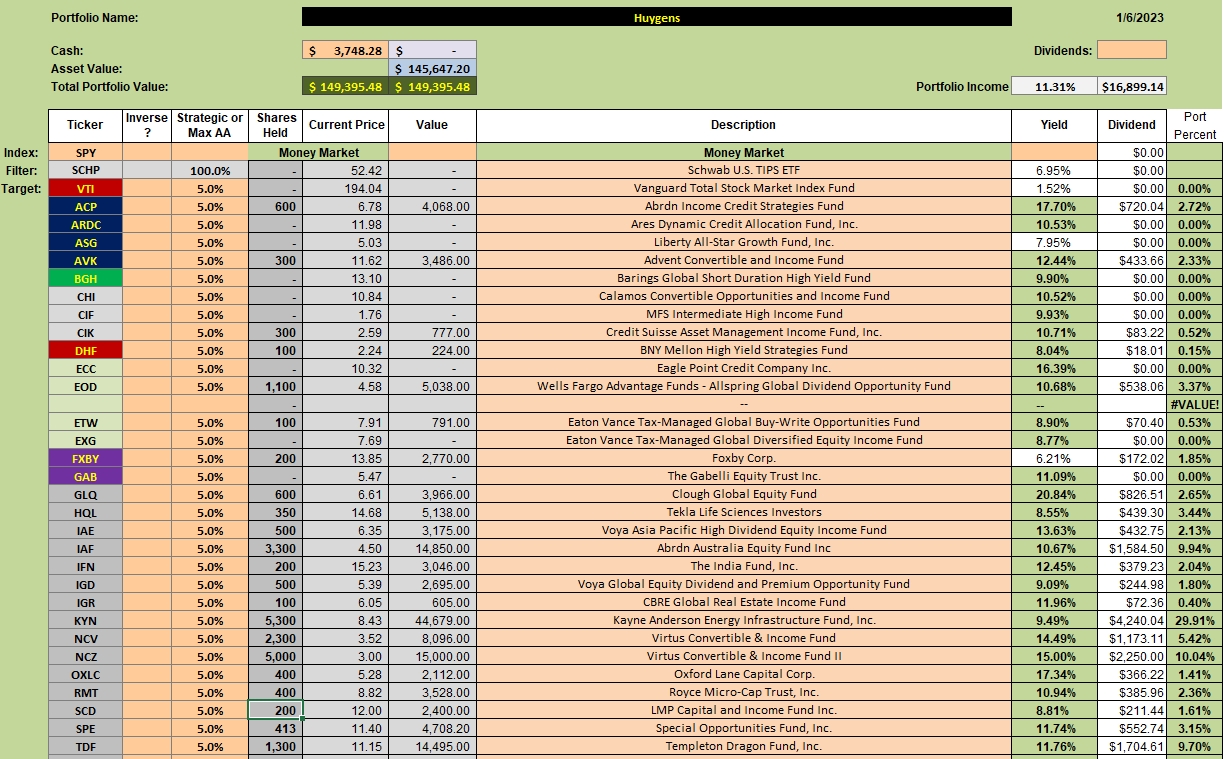
Below is the investment quiver for the Huygens and the current holdings. To remain in the portfolio the two criteria are:
- Throw off a dividend of 8% or higher.
- Be priced below its Net Asset Value. I use CEF Connect for my source of data.
ASG and FXBY are falling short of the dividend requirement. There is also a commission when dealing with FXBY so I would not include it in a future portfolio.
Huygens Performance Data
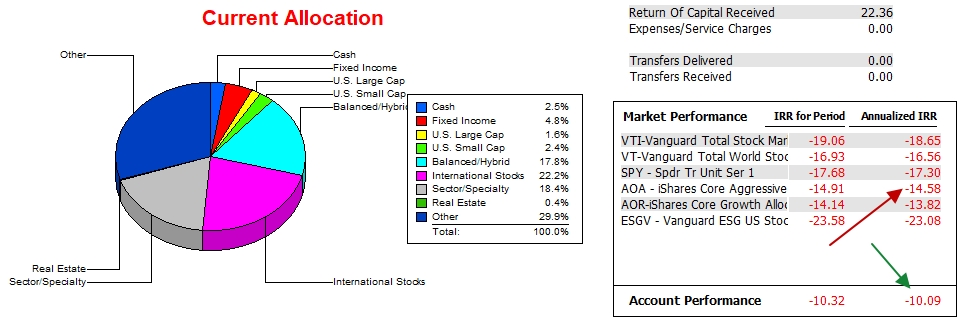
The following data runs from 12/31/2021 through this morning. During 2022 the Huygens outperformed all six benchmarks I track using the Investment Account Manager software.
Huygens Risk Ratios
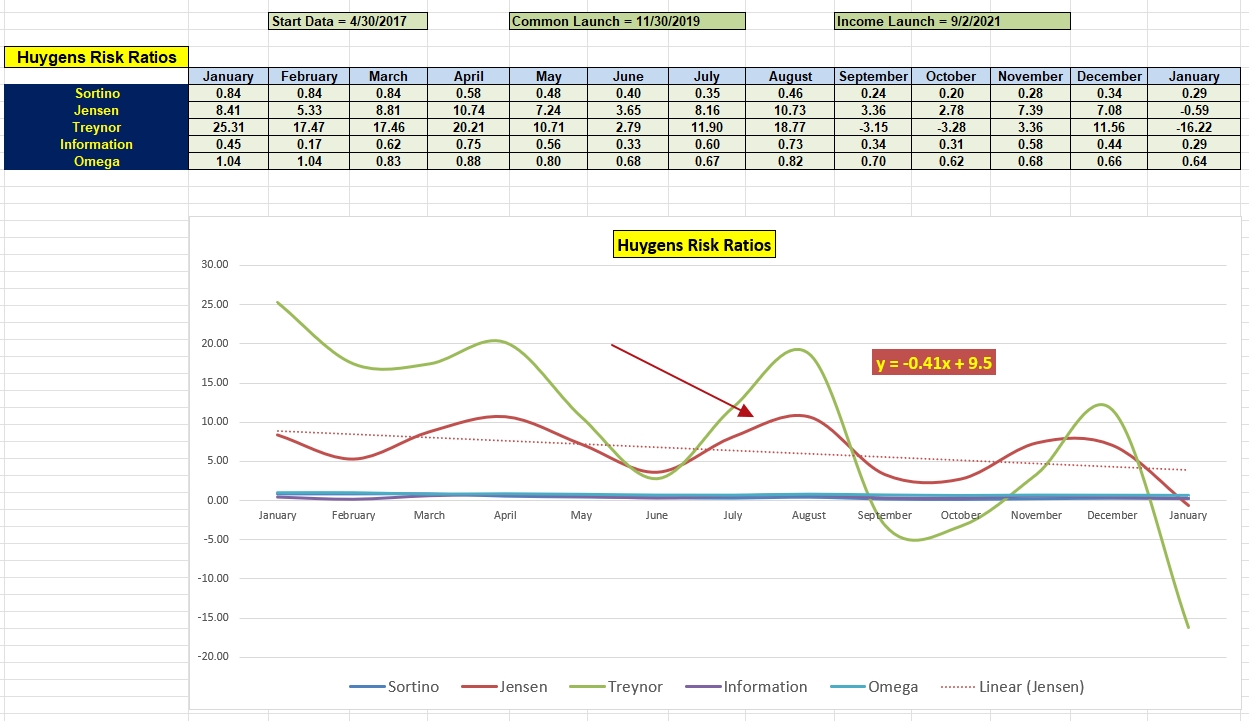
For the first time in over a year the Jensen dipped into negative territory. Part of the reason is due to the volatility of the portfolio, thus raising the beta to a value close to 1.5. This high value works against the Jensen. I’ll monitor the Jensen over the next few months as the Huygens is now on notice.
Discover more from ITA Wealth Management
Subscribe to get the latest posts sent to your email.
Lowell, help me out here. I have been pondering using the Huygens as a model for constructing an income portfolio. I will be interested primarily in using it for income and not be overly concerned with its capital appreciation although, of course, one has to be concerned about protecting the core investment.
As I understand it, you put trailing stops on all of the ETFs in the portfolio. This acts to reduce the risk (and obviously also reduce return) of this high-risk portfolio. When you say Huygens is “on notice,” what are you implying? Aren’t you protected against profound losses with the trailing stops? What am I missing? Thanks in advance.
“As I understand it, you put trailing stops on all of the ETFs in the portfolio. This acts to reduce the risk (and obviously also reduce return) of this high-risk portfolio. When you say Huygens is “on notice,” what are you implying? Aren’t you protected against profound losses with the trailing stops? What am I missing? Thanks in advance.”
Ernie,
I am not using TSLOs with the CEFs in the Huygens. I just watch the yield and check to see if the CEF is priced below its NAV.
By putting the portfolio “on notice” here is what I mean. I’m getting a bit fussy regarding performance and associated risk. Models that are not performing above the Schrodinger are those where I might make adjustments or change the investing model. I am also taking into consideration if the portfolio is outperforming the AOA benchmark. The Huygens certainly met that standard over this past year.
Hope I answered your questions.
Lowell
ITA Readers:
I did some updating comparing portfolio performance and the Huygens ranks #2 when checking on Annualized IRR data over the past year. For comparison, the Schrodinger ranks #2. The Schrodinger is up for review this week.
As for overall risk ranking, the Huygens is #8 while the Schrodinger ranks #10.
Lowell