
Lavender – Fall stage
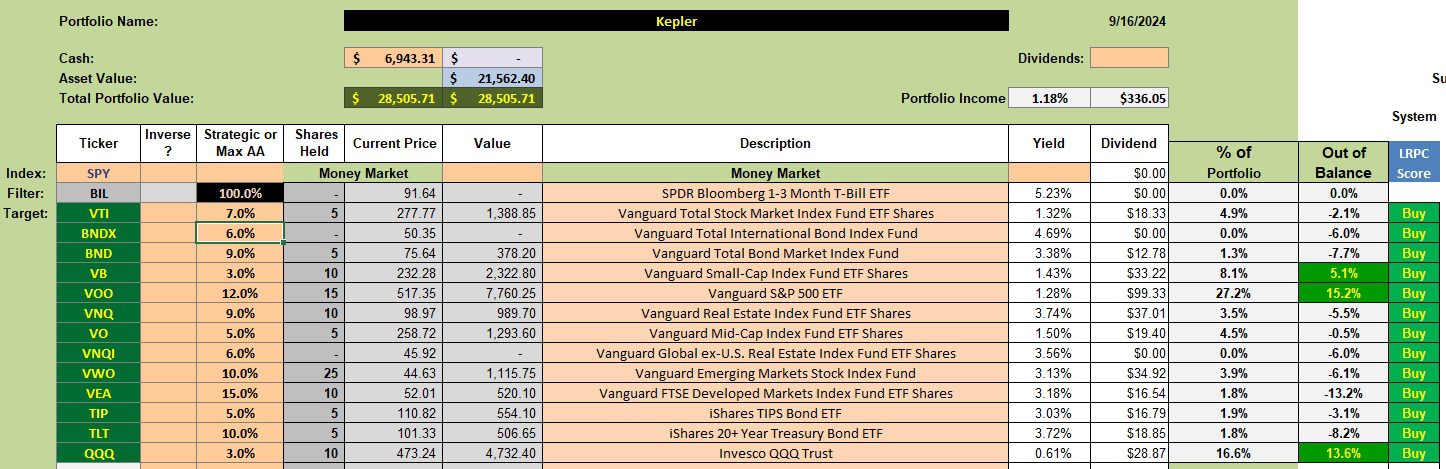
Yesterday I updated the Einstein, a portfolio very similar to the Kepler to be reviewed in this blog post. Both portfolios were recently switched to the Asset Allocation model and as such both portfolios need special attention when it comes to rebalancing. As readers can see in the first screenshot, the Kepler is heavy in U.S. Equities (VB, VOO, and QQQ). Rather than sell shares of those ETFs I’m counting on the owner of the Kepler to infuse new cash which will be used to bring asset classed below target back into balance. Depending on new cash and modest dividends, this will likely take several months.
Kepler Asset Allocation Model
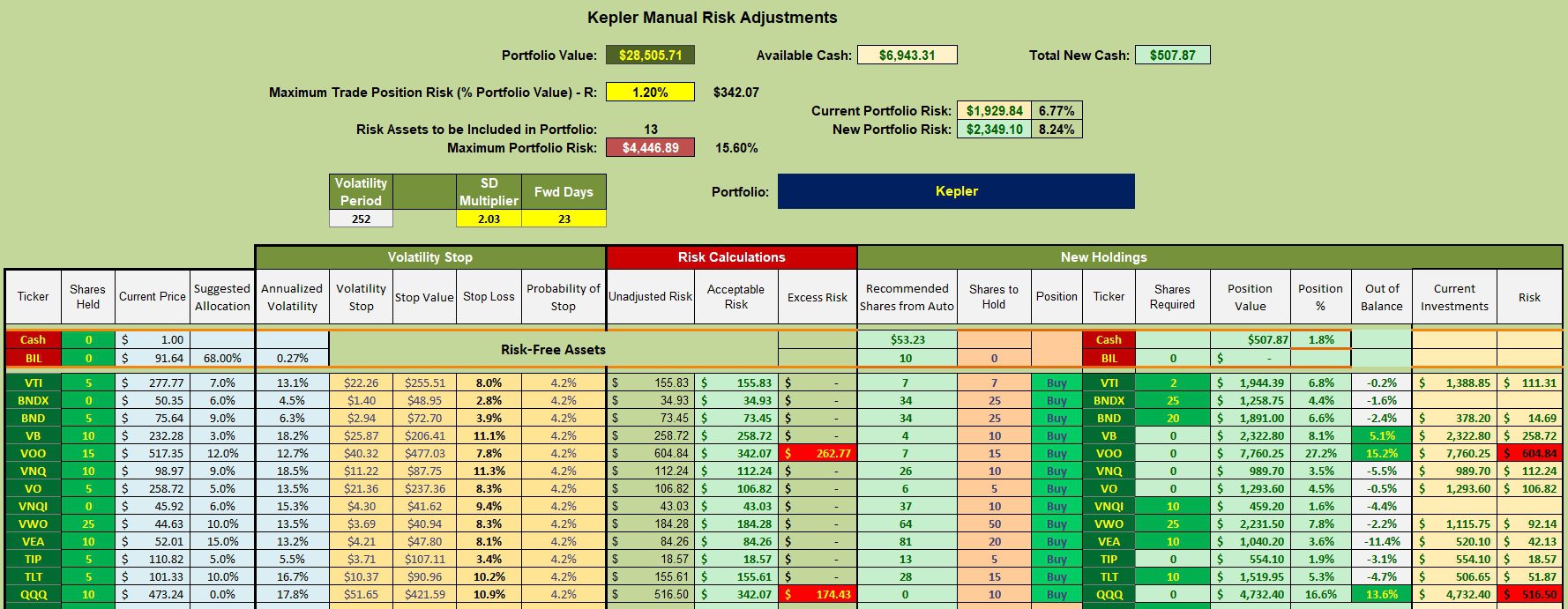
Below is the investment quiver of the Kepler and the current investment arrows or ETFs. Since VEA is most out of balance on the low side, I will concentrate on bringing Developed International Equities back into balance.
Kepler Rebalancing Adjustments
In the column titled Shares Required readers will see possibilities or a path to bring several asset classes into balance. One of the very first moves is to purchase shares of BNDX and VNQI as the Kepler currently does not hold any shares in either asset class. Limit orders are currently in place to pick up shares of both Exchange Traded Funds (ETFs).
Kepler Performance Data
New readers may ask why I use 12/31/2021 as a starting or launch data. It has to do with a few portfolio launched in early 2022 and I want a common starting point so I can compare performance and risk between the various portfolios.
Since 12/31/2021 the Kepler lags the AOR benchmark. The delta is not so great that it cannot be bridged in a year or so. It all depends on how the different slices of the stock market perform. The Kepler, as now constructed, is a portfolio “for all seasons.”

Kepler Risk Ratios
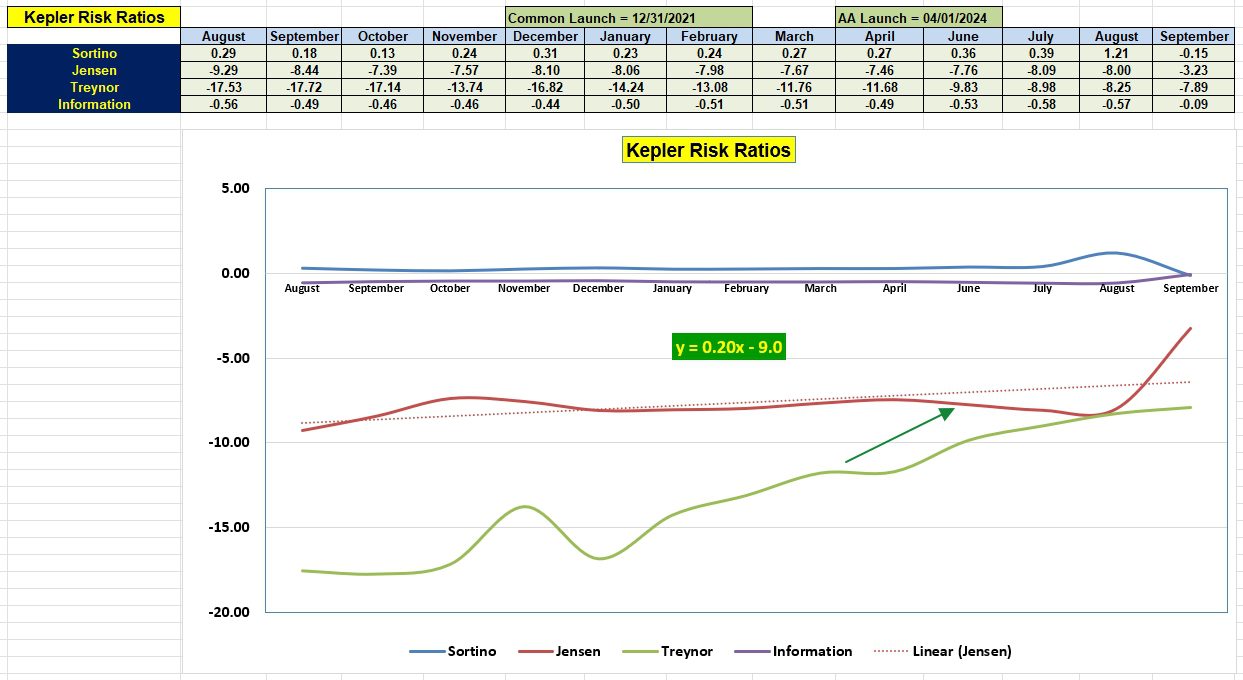
The Asset Allocation model is designed to reduce portfolio risk. As the months pass pay attention to the Jensen Alpha and the slope of this risk metric to see if the AA model meets this low risk goal.
Returning To Investing Roots: 5 August 2024
Discover more from ITA Wealth Management
Subscribe to get the latest posts sent to your email.
If one is looking for other examples of Asset Allocation portfolios I highly recommend Richard A. Ferri’s book, “All About Asset Allocation.” He lays out many different portfolios based on age and willingness to take on risk. The examples focus on percentages of different asset classes. It is up to the reader to ferret out the ETF or index fund that represents the recommended asset class.
Lowell
Lowell,
The Schwab Intelligent Portfolio approach appears to be the best path forward for my wife and me, we are retired and in our mid-70s. Given your recent observation that computer augmented portfolio management should become even more effective with the application of AI approaches, I found the following two articles to be interesting and wanted to share with you. I know my own limits. I do not have the education, skills, or abilities to directly apply these concepts for myself. However, I do speculate the managers of “intelligent Portfolios” would be very interested in these recent developments in the AI space as it applies to portfolio management. Here are the two article links:
OVERVIEW ARTICLE: https://www.quantamagazine.org/novel-architecture-makes-neural-networks-more-understandable-20240911/
KAN 2.0: Kolmogorov-Arnold Networks Meet Science: https://arxiv.org/abs/2408.10205
I am looking forward to your observations.
Best Regards,
– Lee
Lee,
The first article is particularly interesting. I have no idea if Schwab, or other financial companies are use AI to develop asset allocation oriented portfolio models. If they are not I think they are missing the boat. Schwab is large enough to hire bright minds to work on the problem.
One difficultly is that it takes years to see if a model works. Yes, one can back-test, but there are hazards in this approach as future events are not repeats of historical events.
From my experience with Schwab’s Robo Advisor or Intelligent Portfolio, they are doing something right as it ranks in the top quartile of portfolios I track and it performs very well with respect to the S&P 500, an excellent benchmark.
Perhaps other readers have comments they would like to add to Lee’s article references.
Lowell
Lee,
You may find this YouTube video of interest. Around the nine minute mark the fellow touches on using AI to help with portfolio development.
https://www.youtube.com/watch?v=ZETTaarKu8k
If I find others I will send them along. To other readers, provide useful links as to how AI may aid in the development of portfolio structure.
Lowell
Lowell,
Thank you for your reply and link. I will watch it closely, take notes, and report back.
We live in interesting times, times which I hope are positive.
– Lee