
Old Dodge Truck – Aurora, OR
Kepler is undergoing security changes as it has been under-performing for a long time. The portfolio could wait until after the second quarter dividends are available, but I want to use this review as a reference to see how the different closed-end-funds (CEFs) perform before and after second quarter dividends.
Kepler Security Holdings
Below are the current holdings for the Kepler. Annual dividends are currently above 10%. We need to see how this pans out over the next six months. During this time I hope to develop better screens as to which CEFs to use to populate the portfolio. Consider the Kepler to be a test portfolio for CEFs.
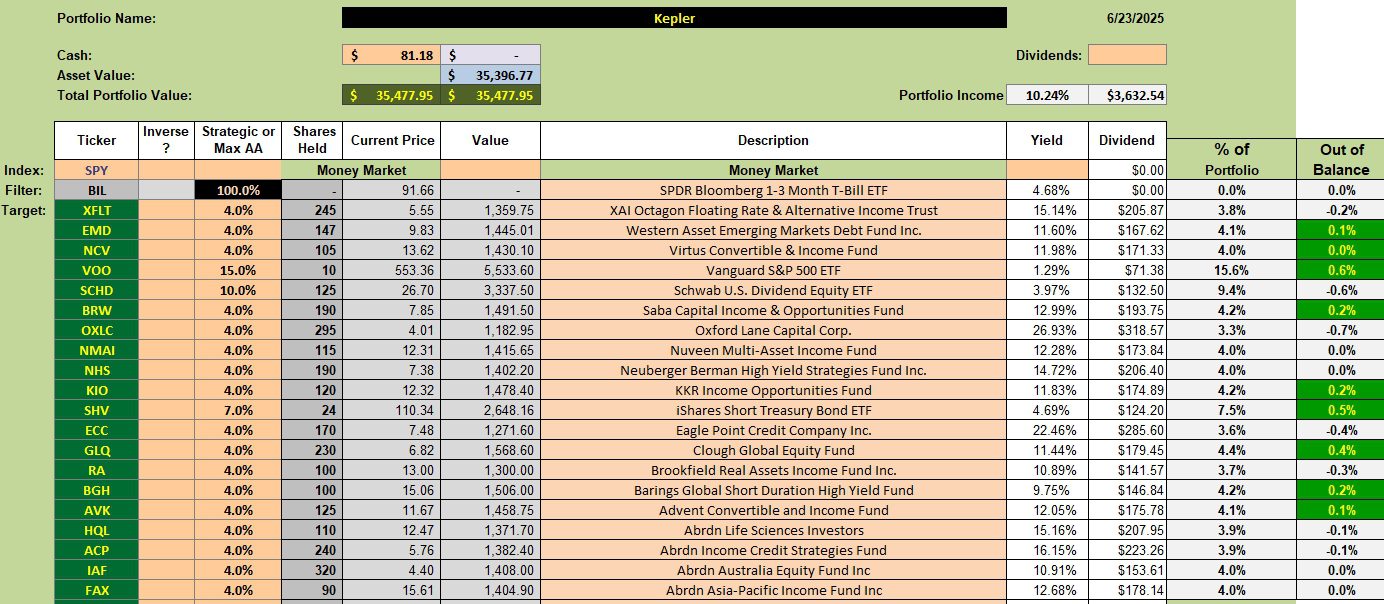
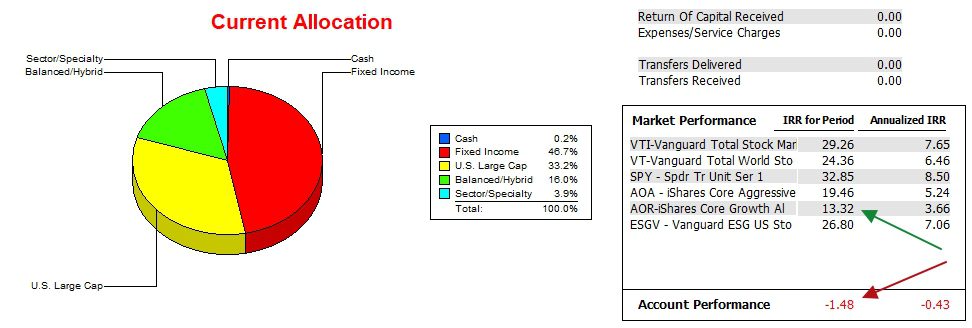
Kepler Performance Data
Since 12/31/2021 the Kepler lags all benchmarks by a considerable amount. At this point we need to watch the risk ratios to see if growth is positive or negative.
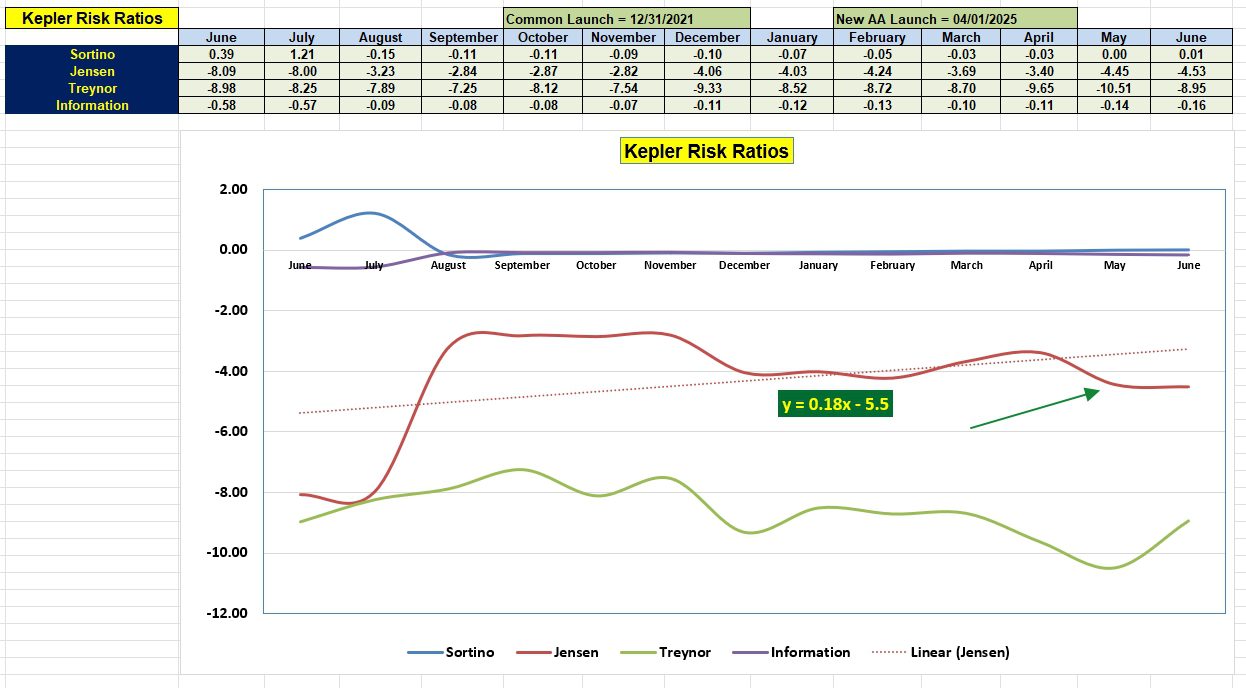
Kepler Risk Ratios
Based on the 2025 risk ratios the portfolio is performing a tad better than it was in 2024. However, June dipped from its May value when we closely check the Jensen Alpha metric.
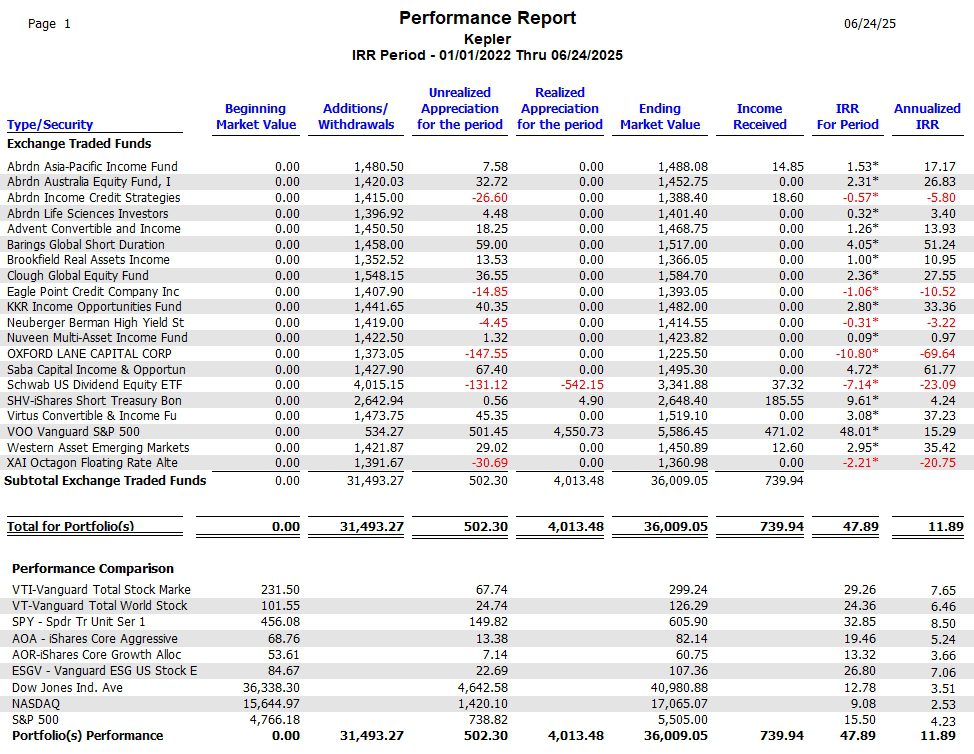
Closed-End Funds Performance
Checking the following table we see nearly all growth is coming from VOO, not any of the CEFs. While it is still very early to make any judgments, I will need to see more growth coming from the CEFs by the end of the year or after three quarters of dividends are paid. I will be satisfied if prices hold constant and the portfolio gains come entirely from dividends.
Comments are always welcome.
Discover more from ITA Wealth Management
Subscribe to get the latest posts sent to your email.
Lowell,
Remember that, if we are focussed on “income”, in the form of “distributions” from the fund, then it doesn’t really matter whether that “income/distribution” comes from investment income within the fund or “growth” within the fund. The “distributions” will include contributions from both components depending on the “asset class” of the Fund. Some CEF’s hold only “Credit Assets” (no equity) and distributions rely solely on net investment income within the fund – so we would not exppect to see much, if any, growth. Other CEFs focus on equity investments and rely primarily on “growth” to generate the income distribution – but the (averaged) gains are paid out monthly, so looking at fund prices, “growth” may still not be too obvious. There are, of course, “hybrid” funds that mix the sources of distribution generation and others that adopt “alpha seeking” strategies (e.g. selling Options against equity holdings).
For example, in my email this morning I received the following information from Voya Global Equity Dividend and Premium Opportunity Fund:
The Fund estimates that the distribution payable on June 16, 2025 is comprised of
approximately 38% net investment income and 62% return of capital.
In summary, be careful how you evaluate performance – don’t expect 10% investment income plus 10% growth income to be generated by the fund. I basically just try to look at distribution in relation to price and, if I’m picking up 10%+ in distributions and the price isn’t going down then I’m OK with that. Of course if price is going up at the same time, that’s even better. In bad times we may still pick up the 10%+ per month, but price may be going down giving us less than our 10% “real” return – but then (assuning that we are not withdrawing the distributions) we can re-invest at lower prices and dollar cost average down.
David
I appreciate your developing analysis of CEF and related fixed income alternatives. Thank you.
Lee