
Asian Architecture
If you are prevented from reading this blog post, register as a Guest and wait for me to upgrade you to the Platinum level. Registration is free to all who register as a Guest.
To learn more about the Sector BPI Plus model, check out this Seeking Alpha article.
Yesterday I posted a blog as to how to handle available cash if and when oversold sectors do not require all available monies. This morning I’ll explain to readers how I am taking these ideas a step further to protect capital. Now on to the analysis and update of the Pauling, a new Sector BPI Plus portfolio that has not been performing as well as expected, thus requiring the move to this unique investing model.
One more note. I frequently use Sector BPI and Sector BPI Plus terms interchangeably. The Plus was added when I “installed” the patch to close a potential weakness in this investing model.
Pauling Investment Quiver and Holdings
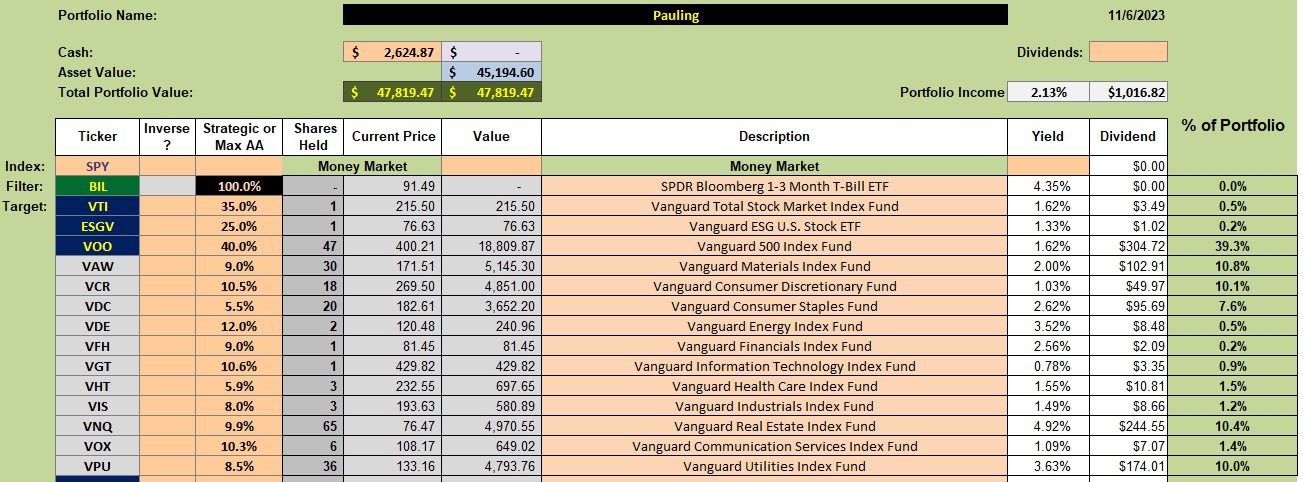
Below is the current investment quiver and holdings for the Pauling portfolio. In this portfolio I missed the opportunity to invest in Health (VHT), Communication (VOX), and Industrials (VIS) when they were oversold. Chalk this up to luck-of-review-day or in this case, unlucky.
Pauling Manual Risk Adjustments
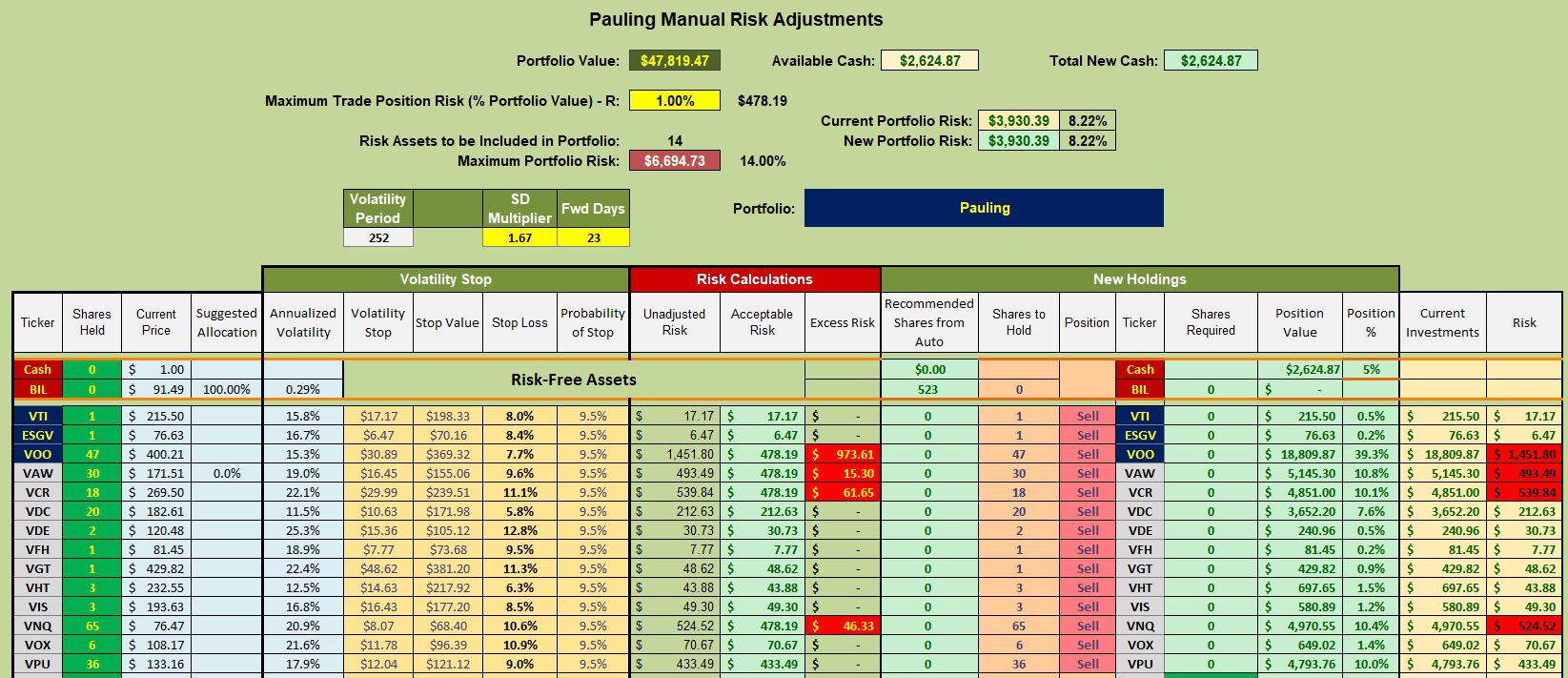
Only Staples (VDC) and Materials (VAW) were oversold in the most recent BPI data and both of these sectors are currently fully populated. Hence, no further risk adjustments are required for the sectors.
Since no Buy signals show up for any of the three equity ETFs (VTI, ESGV, or VOO) the cash will remain in the money market. To preserve capital, and this is a new addition to the Sector BPI model, I’ve placed a 5% Trailing Stop Loss Order (TSLO) under 45 shares of VOO. If sold, this will leave 2 shares remaining in the Pauling. When there is no Buy signal, based on recommendations from the Kipling spreadsheet, for any of the equities, place TSLOs under the bulk of shares held in the portfolio. When Buy signals show up, invest in the highest ranked equity ETF. I’ll explain further when this situation arises.
Pauling Performance Data
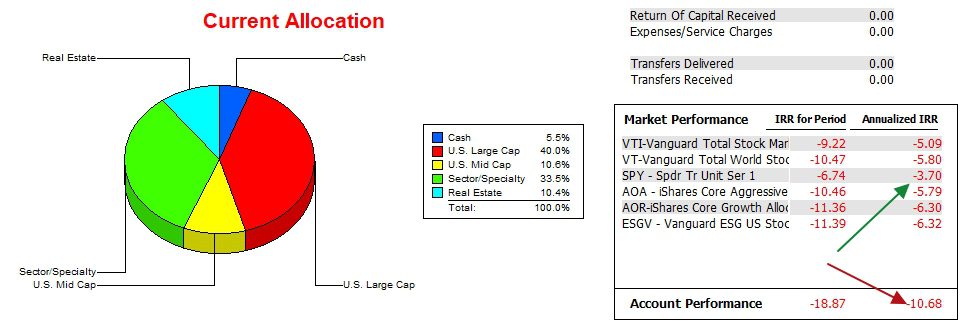
As mentioned in prior Pauling updates, this portfolio has been under performing its benchmark. Now we need to patiently wait to see if the change to the Sector BPI model turns out to be positive.
Pauling Risk Ratios
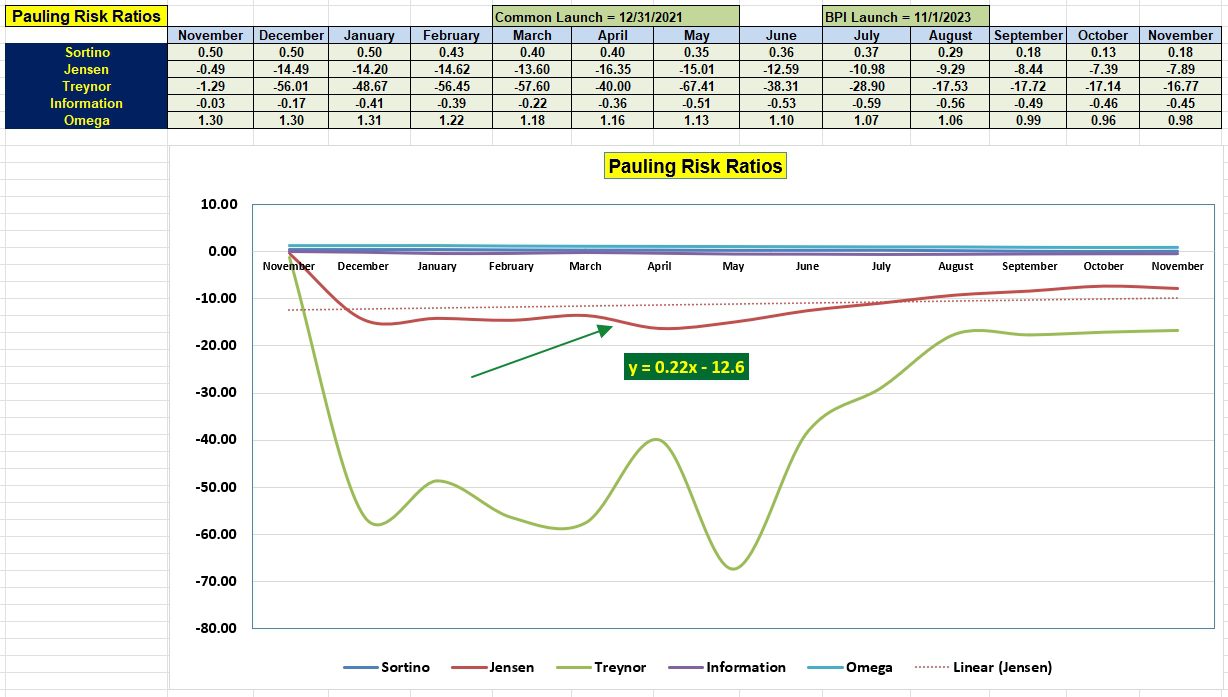
One place to see if the move to the Sector BPI model is beneficial is to watch the risk changes from month to month. I noticed that the risk-free short-term interest rate for SHV jumped from 3.93% up to 4.16%. This increase places additional downward pressure on the Jensen Performance Index.
This month the slope of Jensen moved from negative to positive. The Information Ratio improved a tad indicating the portfolio gained ground on the SPY benchmark. It is still too early in November to celebrate, but we will take any positive news we can extract from this under performing portfolio.
If you find the Seeking Alpha article of use, please send the link to potential interested readers.
Discover more from ITA Wealth Management
Subscribe to get the latest posts sent to your email.
You must be logged in to post a comment.