
Madeira (Portugal)
Last week I introduced my revamped Dirac Portfolio that will, roughly, follow the same systems/methodologies as the Rutherford-Darwin Portfolio but with a quiver dedicated only to US markets with no diversification outside of these markets. Risk management will be a little tougher because of trading restrictions resulting from the fact that these securities are held in a registered retirement account similar to a Roth IRA.
To date, activities in the portfolio look like this:
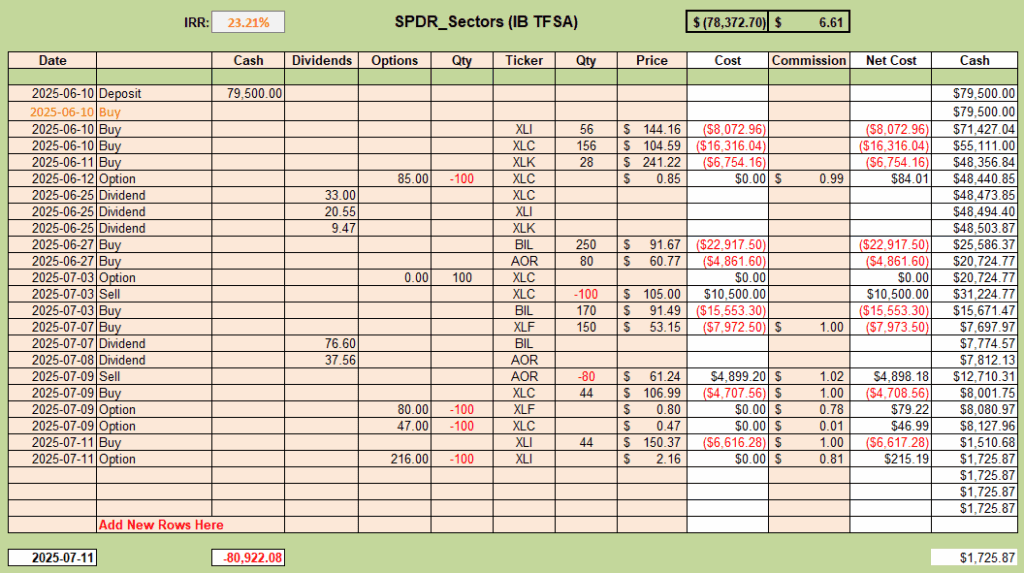
When I transferred positions from the original Dirac account to a new brokerage I was holding 80 shares of AOR (globally diversified equity/bond fund) but I sold these shares, after receiving the scheduled dividend, so as to focus solely on US assets. Apart from this, the only adjustments have been to add 150 shares of XLF (Financial sector ETF) to the portfolio and to sell Call Options against the shares held in XLC (Communications), XLI (Industrials) and XLF so as to generate credits and provide a small downside hedge. At this point, with technology remaining the strongest sector, I have not sold Options against this position, since to do so might adversely limit returns should technology remain strong. I will look for signs of weakness in this sector before hedging. After 4 weeks, the portfolio is showing a 23% Internal Rate of Return (IRR) – but this is not to be taken too seriously due to the short term existence of the portfolio and the “front-end-loading” of dividend distributions.
Checking on current rankings and recommendations from the Kipling workbook we see the following picture:
 where XLI and XLK remain the Buy recommendations with XLC and XLF as recommended Holds. Apart from, maybe, buying SPLG (broad market large-cap equities) on a small pull-back, there are no immediate plans to add to the current holdings. Options sold against XLC expire next week with Options on XLI and XLF expiring ~1 month later on 15 August. To date, $428 has been collected in premium credits and we wait to see how much of this will be kept. If we were able to keep ~$300 per month from the credits received through the sale of Options this would add ~5% per year of “alpha” to the portfolio.
Combined performance of the portfolio to date looks like this:
 and, as with the Rutherford-Darwin portfolio, this portfolio is showing extremely low volatility (risk) – at only 3.1% (although early days with limited history).
Discover more from ITA Wealth Management
Subscribe to get the latest posts sent to your email.
Leave a Comment or Question