
Oscar’s Eatery – Springdale, Utah or near Zion National Park
Kepler is the Relative Strength portfolio scheduled for review today. As readers will soon see, this portfolio is not up to snuff when it comes to performance. I’ll work with the BHS model for a few more months, but patience is running thin, particularly when models requiring much less work are performing much better.
Kepler Investment Quiver
The following investment quiver is built around asset allocation and the factor model. This combination covers nearly all the critical areas of investing, world wide.
Part of the lack luster performance is likely due to carrying so much cash, although this was helpful during the month of March when the portfolio actually gained ground on the benchmark.

Kepler Relative Strength Recommendations
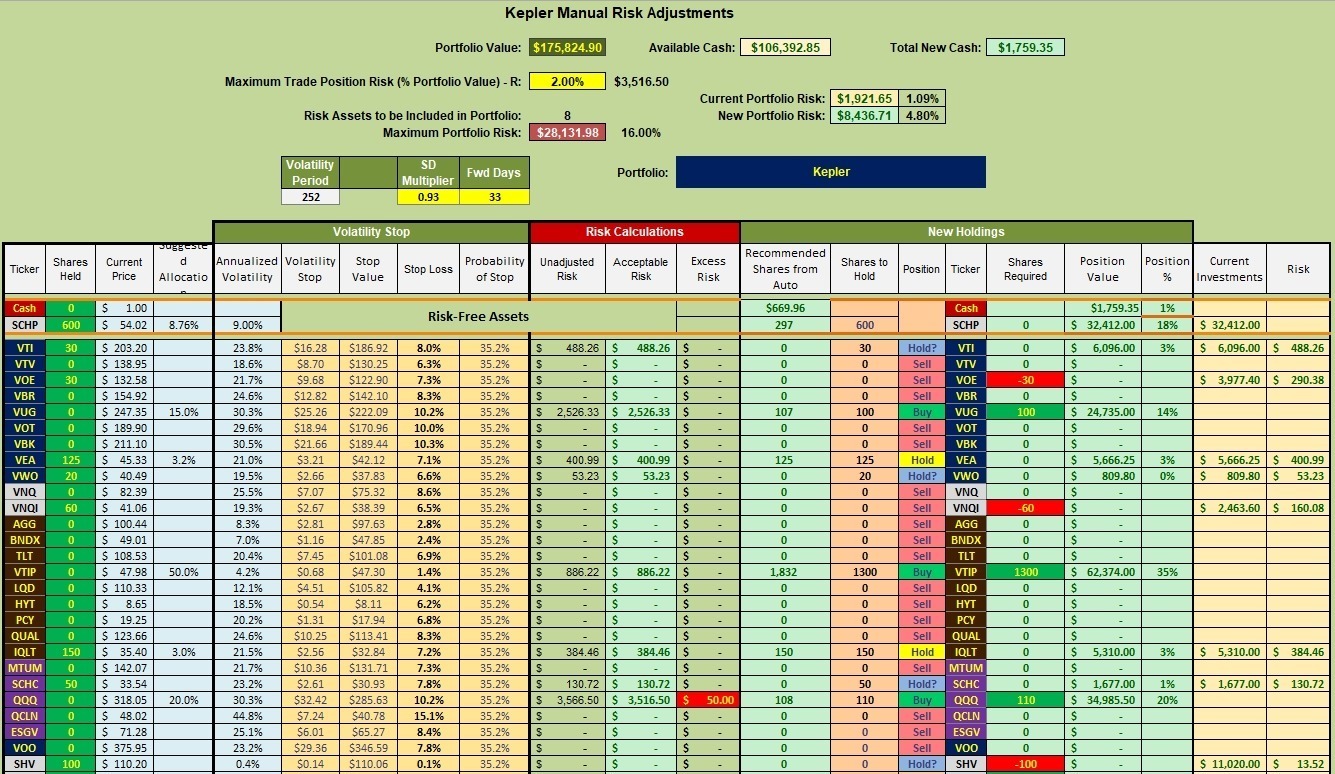
Using the “default” look-back combination of 60- and 100-trading days, Target Filter is set to No, BHS model, and a maximum of five (5) assets, the Kepler is recommending VUG, VTIP, and QQQ as a Buy. VEA and IQLT, already in the portfolio are a Hold (Yellow background). The blue-gray background Hold? designations for VTI, VWO, SCHC, and SHV are up to the discretion of the money manager.

Kepler Manual Risk Adjustments
Taking the above recommendations into account, the manual worksheet from the Kipling spreadsheet is where I make final decisions regarding the portfolio construction going forward. One of the first decisions is related to SCHP and VTIP as both are inflation protection ETFs. Instead of selling shares of SCHP which is currently holding more shares than recommended, I will continue to hold SCHP and not add as many shares to VTIP as recommended.
- I have a tight TSLO set for VOE.
- A purchase order is set for VUG.
- A TSLO is set for VNQI. As I recall it is set at 3%.
- Several limit orders are in to purchase shares of VTIP.
- Several limit orders are in place to purchase shares of QQQ.
Kepler Portfolio Performance
Over the past 15 months and 10 days the Kepler lags the SPY, AOA, and AOR benchmarks. Note that the right column is annualized data while the left column is Internal Rate of Return data for the specified period.
The 60% in cash should be reduced if the market declines slightly and a number of the TSLOs are struck. I just read yesterday where projected growth for the U.S. Economy will be around 0.4% for the year. If this is true, it will pay to hold a high percentage in cash over the coming months.

Kepler Risk Ratios
Short-term interest rates rose to 1.98% recently so that is having a negative impact on the Jensen and Sortino Ratios in particular.
Over the next few months the decline in the Jensen will need to cease. Otherwise I will move away from the Relative Strength model.

Portfolio Management In A Volatile and Bearish Market
ITA Portfolios: Summarizing Investing Approaches
Discover more from ITA Wealth Management
Subscribe to get the latest posts sent to your email.
Lowell,
I’m not going to give up on the Kipling BHS model. I have chosen not to use it in the near future given the state of the economy and market volatility. In fact, like you, I’m putting my toes in the water with your BPI approach. I suspect that once we get through the fed tightening and any kind of recession, the Kipling will again become useful. My main question about the BPI approach at that time will be whether or not any sectors will fall below the 30% threshold for buys as the economy improves.
~jim
Jim,
I have sector BPI data going back to 2012. For the seven large indexes that data goes back to 2005. The longest wait for a sector to fall back into the Buy zone was about two years. That is a long time to wait. Since 2014 the “average” wait time is 6 to 8 months before a sector moves into the oversold zone.
To stay invested one can use portfolios such as the Copernicus and Schrodinger as both are nearly fully invested at all times.
Lowell
“My main question about the BPI approach at that time will be whether or not any sectors will fall below the 30% threshold for buys as the economy improves.”
Jim,
When creating the hypothesis for a unique investing model one tends to see the positive opportunities while overlooking potential weaknesses. Your point above points out a weakness in the Sector BPI model.
I mentioned one possible solution in another Comment. A second solution to consider when all sectors or a majority are “cooling their jets” in the neutral zone is to go to the Dual Momentum recommendations and see if VTI or VEU is recommended for purchase. If not, then remain invested in the money market or short-term treasuries.
Watch this space as I work on enhancing the Sector BPI model with other portfolios, assuming I gain acceptance from the portfolio owners.
Lowell