
Sculpture to welcome visitors to Lake Oswego.
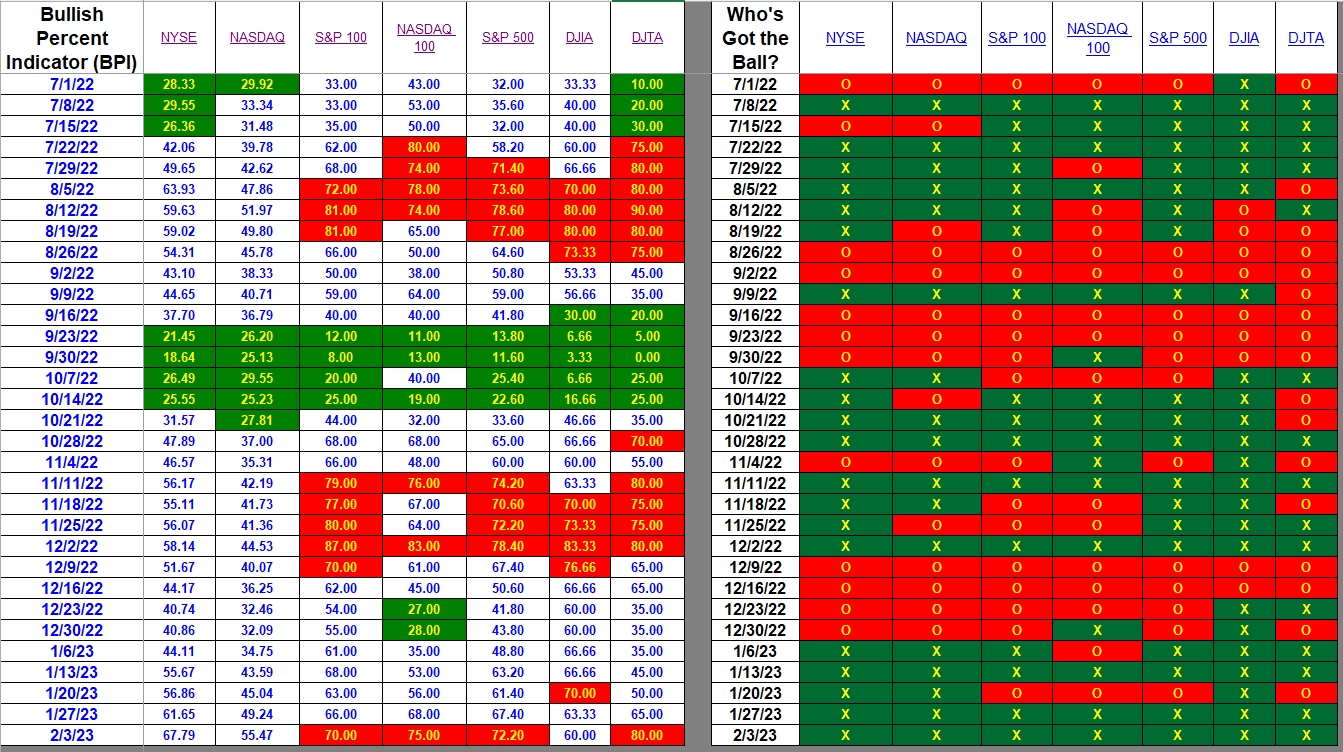
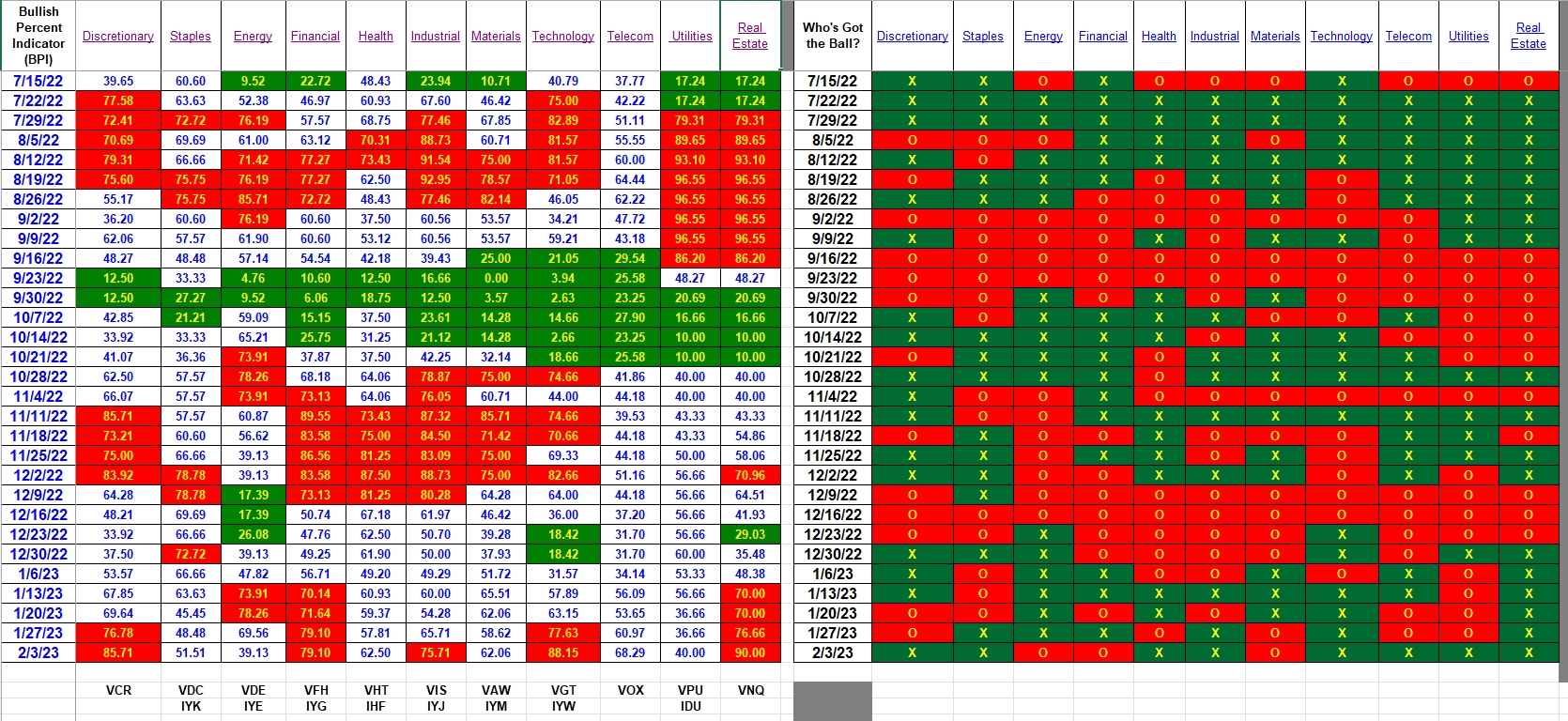
Based on Bullish Percent Indicator (BPI) data, this past week was a good week for U.S. Equities. The first table shows the broad strength when examining several indexes. The second table is the one we use to guide us in how we manage the Sector BPI portfolios.
Index BPI
All major indexes are bullish this week. The two indexes I pay most attention to (NYSE and NASDAQ) while bullish are not over-bought. This tells me that the market is driven by large-cap stocks while mid- and small-cap companies are lagging the large-cap companies. DJIA is the exception as it too is not over-bought.
Sector BPI
In the following table I pay most attention to the percentages on the left side. Five of the eleven are over-bought and if your Sector BPI portfolio is holding any of these sectors, place TSLOs on those ETFs. On Friday there was a time when Telecom (VOX) moved into the over-bought zone. When I observed this move I set a 3% TSLO to sell VOX out of those portfolios holding Telecom. If you did not already set a TSLO, then hold off doing so as VOX is back in the “neutral” zone.
Note how low Energy and Utilities are. I’ll keep an eye on these two sectors as we may see a buying opportunity this week.
As the Sector BPI model is quite new, I am looking for weaknesses in this approach. I can foresee a situation where over-bought conditions have the investor out of sector ETFs and the market continues to rise. I’ve yet to come up with a plan to counter this condition. If readers have a good idea, please share it in the Comments section provided below.
Explaining the Hypothesis of the Sector BPI Model
Carson Portfolio Update: 18 November 2022
Discover more from ITA Wealth Management
Subscribe to get the latest posts sent to your email.
Lowell,
Yes this is something we have to keep an eye on. My VNQ position got sold with a 3% TSOL after it moved above 70% but then continued to rise above my sell point. This is the potential problem with any TSOL strategy. Unfortunately if we make the trigger point too great we probably loose any profit. With the 3% trigger I still had a 5% profit so maybe that is the appropriate set point..
Bob W.
Bob,
I experienced a similar fate. This is only one problem with the Sector BPI Model.
One issue or problem that concerns me even more is a situation where multiple sectors hit the over-bought zone, are then sold due to hitting the TSLO limit, only to be followed by a strong bull market leaving one holding cash or a short-term treasure while the market marches higher. I can see this happening.
The Buy and Hold Schrodinger is useful as a good benchmark one can use for comparison.
This brings one back to the argument for portfolio diversification. The Schrodinger, Copernicus, Dual Momentum portfolios of McClintock and Pauling should “counter” the drawbacks of the Sector BPI portfolios.
Lowell