
Tower Bridge – London
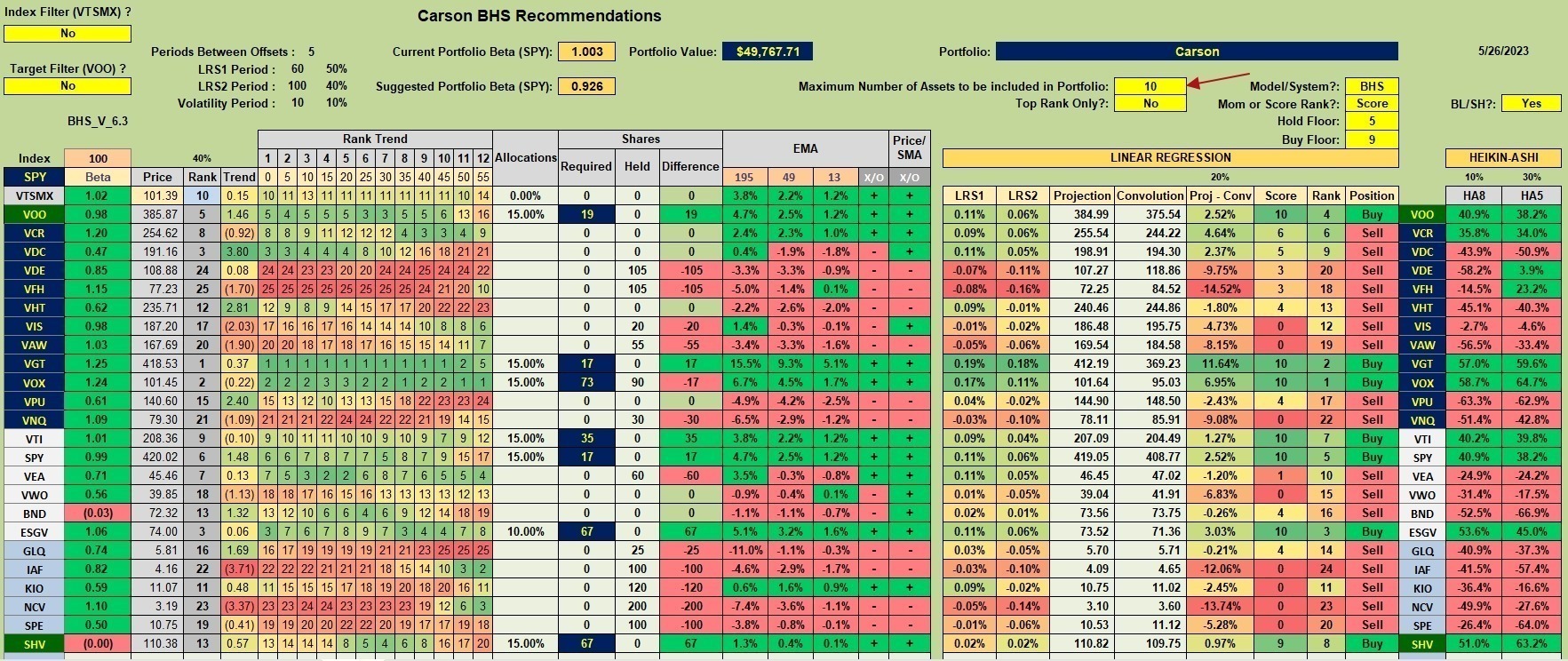
As mentioned in the most recent blog post, I’m tweaking the Sector BPI Plus investing model ever so slightly. If you move down to the second screenshot you will see that I added SPY and ESGV as additional U.S. Equity options. As with the Copernicus I now have VOO, VTI, SPY, and ESGV as U.S. Equity options when Dual Momentum™ is called into action. DM is only activated after all the sector recommendations are filled to capacity.
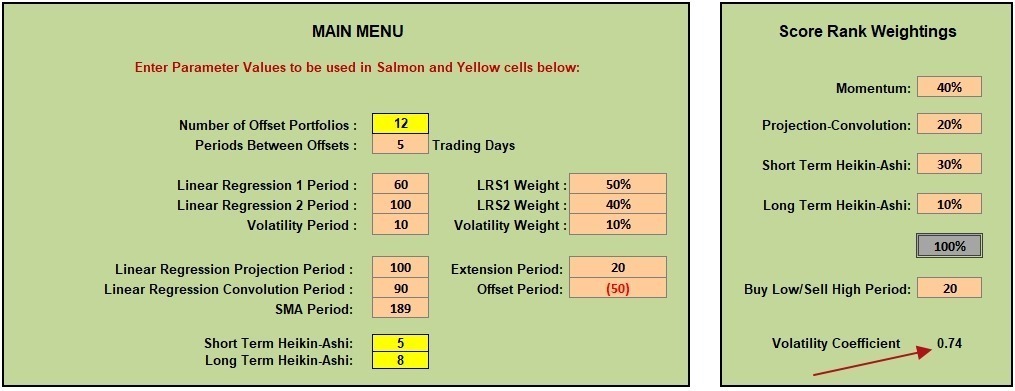
In the first screenshot (Menu) I will explain how I determine how many shares of sector ETFs to purchase.
Carson Menu
I rarely include the Menu worksheet from the Kipling as I rarely make any changes to this worksheet. For the Sector BPI portfolios I’ve added something I call Volatility Coefficient. Currently this is set to 0.74. What this coefficient does is allow the Sector BPI manager to adjust how many shares of a given sector to include in the portfolio.
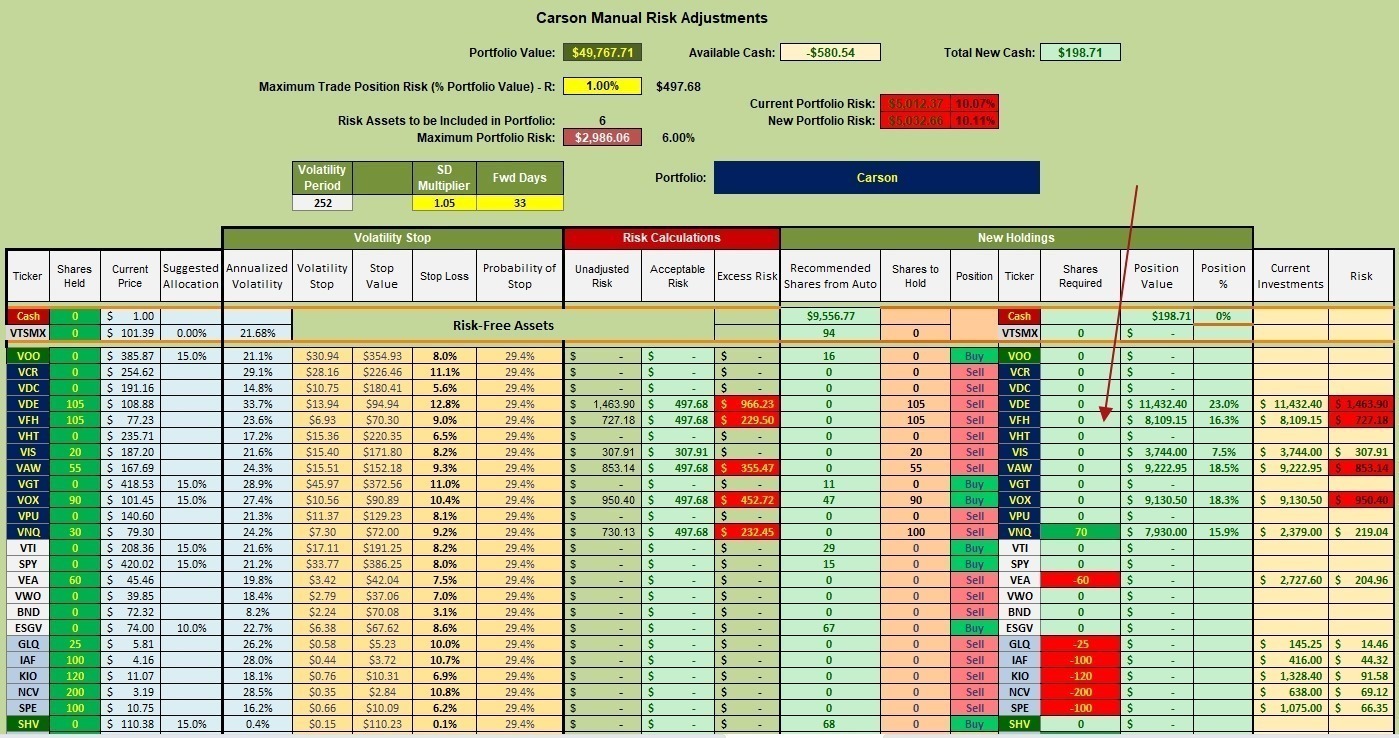
What I do is adjust the volatility coefficient such that the maximum number of shares in the most volatile sector to be 25% of the total portfolio. Check the 5th column from the left in the third screenshot below. That is the manual risk adjustment worksheet. The most volatile sector is Energy (VDE) with a three-year volatility percentage of 33.7%. Since I want Energy to occupy no more than 25% of the total portfolio I multiply 0.74 x 33.7% = 24.9% or very close to 25%. The remaining sectors fall into line when using the same volatility coefficient.
Carson Security Recommendations
Based on the last BPI data, Energy and Real Estate are the two recommended sectors for purchase. Technology is a sell, but we do not hold any shares in Technology (VGT) so we pass over that recommendation.
Not shown in the following worksheet are the share recommendations for VDE and VNQ. We want 24.9% or 25% in VDE and 17.9% or 18% in VNQ. If cash remains after filling Energy and Real Estate we pick up the highest rated ETF found among the Dual Momentum options. As of this posting, VOO, with a rank of 4 is the DM ETF of choice. Cash must be available to purchase any shares of VOO.
Carson Manual Risk Adjustments
Keep in mind we are first filling the Sector BPI recommendations. Adding 70 more shares of VNQ will bring the percentage of the total portfolio up to 15.9% of the total portfolio or two percentage points shy of the recommendation. VDE already holds 105 shares or 23% of the total portfolio. This is close enough to 25% of the total portfolio as we are out of cash even after selling off the CEFs.
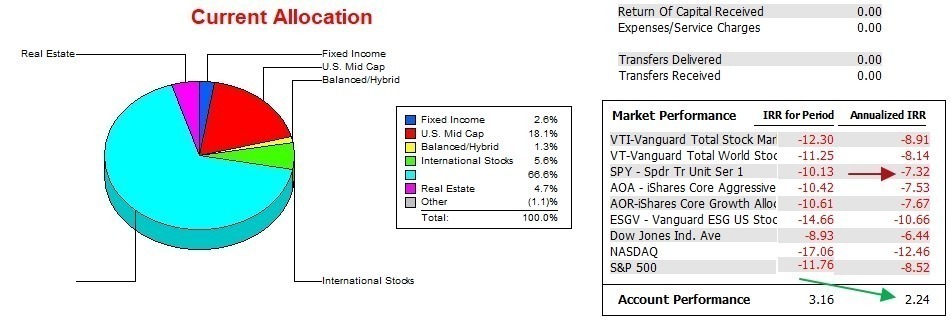
Carson Performance Data
After 17 months of data the Carson continues to lead the S&P 500 as well as all other possible benchmarks. The goal is to stay ahead of SPY, VTI, AOA, and AOR. Those are the four possible benchmarks the Carson focuses on.
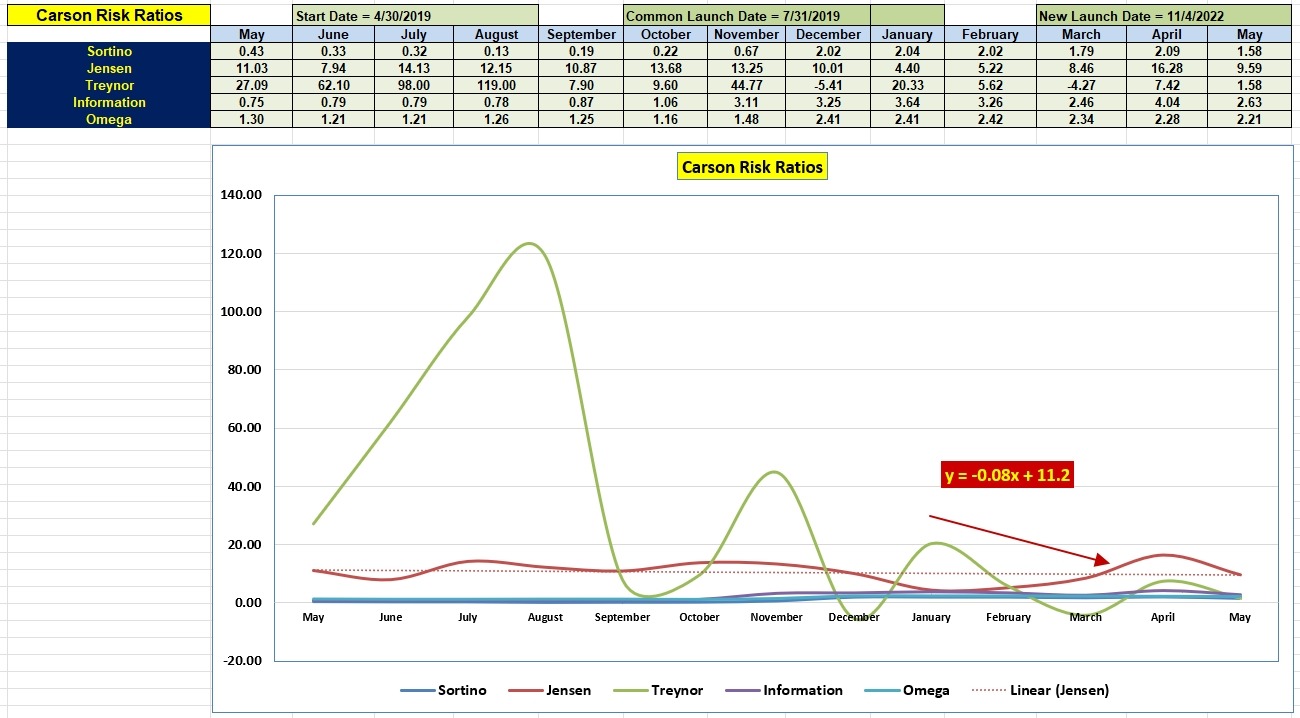
Carson Risk Ratios
Based on risk calculations, the Carson is performing extremely well. Both the Jensen and Information Ratios are very high. The next goal is to see the slope of the Jensen turn positive. When the Jensen is already very high it is extremely difficult to maintain a positive slope for the Jensen Performance Index (many times referred to as Jensen Alpha).
Buying Guidelines For BPI Model Portfolios: 9 December 2022
Tweaking Sector BPI Plus Model: 20 May 2023
Carson Portfolio Update: 18 November 2022
Discover more from ITA Wealth Management
Subscribe to get the latest posts sent to your email.
Excellent presentation of the reasoning and process, exactly what I was concerned about a few days ago. Thank you. – Lee
Lee,
Thank you.
One advantage of keeping precise records is that one can examine results and make changes when apparent weaknesses show up.
Lowell