Dolly Parton reading to children.
The Kepler portfolio is moving closer to having all asset classes closer to target each month. As with several other ITA portfolios, the Kepler is set up to minimize a market correct by using value, dividend producers, and inflation protection ETFs.
- At the bottom of this blog post I asked ChatGPT to analyze the Kepler portfolio and make recommendations as to how to improve the asset allocation assuming there will eventually be a market correction.
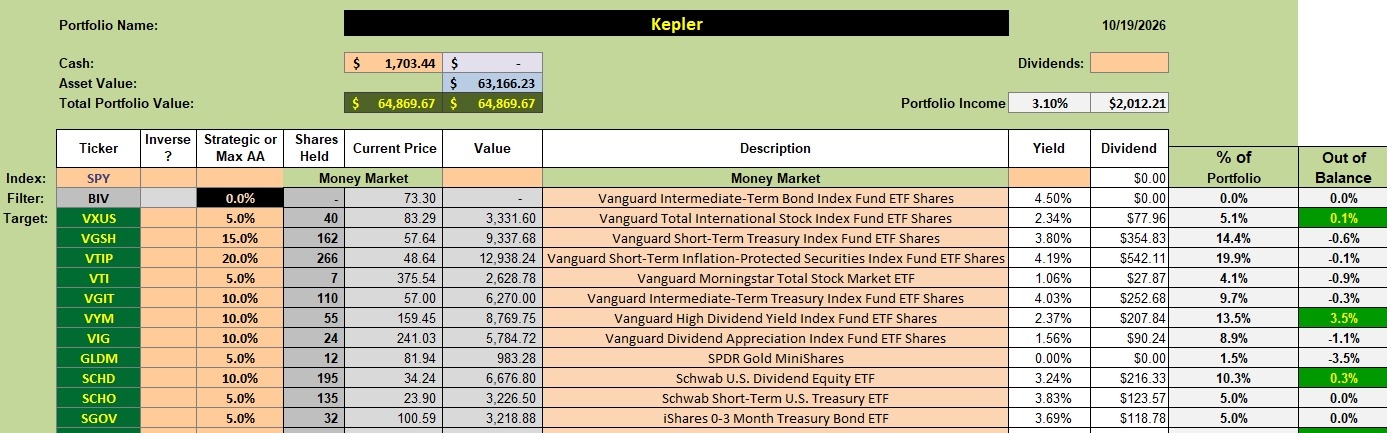
Kepler Asset Allocation Holdings
Below are the current Kepler holdings and the target percentages.
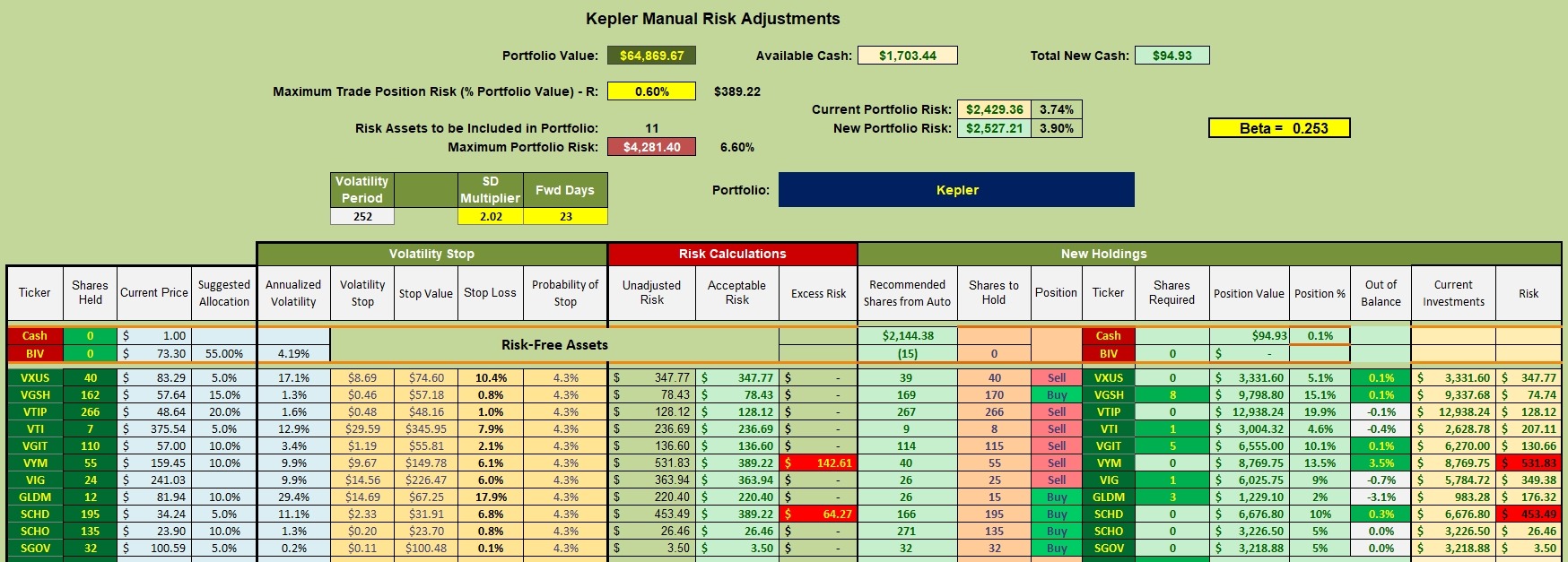
Kepler Rebalancing Recommendations
Limit orders are in place to bring several asset classes closer to the target percentages. Gold (GLDM) will be one of the last to come within one percentage point of the target as it generates no income. With the Kepler I am focusing on generating income.
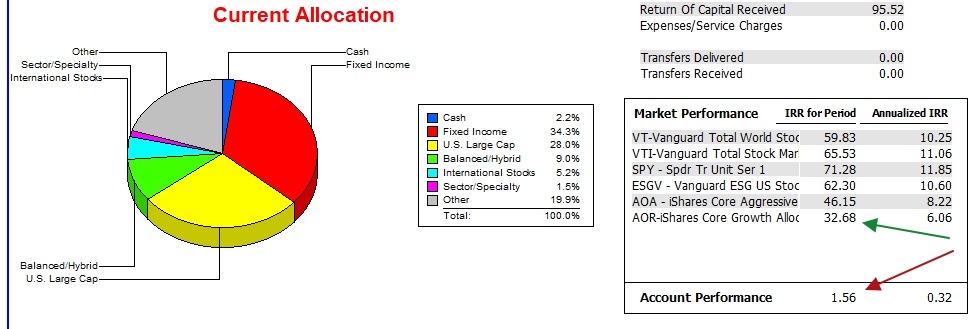
Kepler Performance Data
Since 12/31/2026 the Kepler has lagged all benchmarks. This is an “education portfolio” and withdrawals impacted performance over the past several years.
Kepler Risk Ratios
Kepler is rebuilding so what happened this last year is important. A positive Jensen Alpha slope is encouraging. A higher Sortino is also an indicator the portfolio is growing. The lower Information Ratio indicates the portfolio lost ground to where it was in October of 2025.
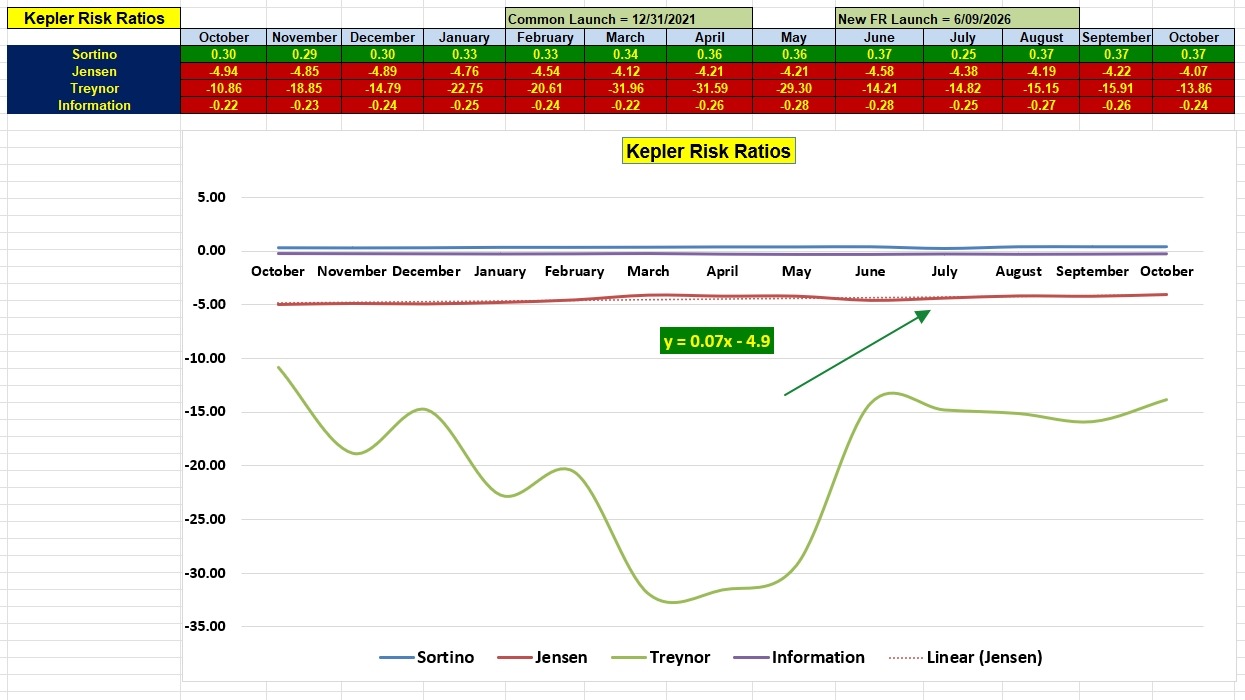
The Kepler has a very low 0.285 beta value.
- Below is the response from ChatGPT as to how to improve the Kepler asset allocation mix.
Kepler Portfolio — October 20, 2026: Recommended Asset Allocation
I found ITA Wealth Management’s latest listed Kepler review, dated October 8, 2026, along with the September 11 review. I could not verify a separate October 20 holdings sheet, so I will distinguish the published information from my recommended allocation rather than present older holdings as if they were current.
My objective is to improve Kepler’s ability to withstand a major stock-market correction, maintain reasonable income, and preserve purchasing power during possible financial repression. I would favor low-cost Vanguard ETFs where practical, while retaining a few specialized holdings where they provide a distinct defensive benefit.
1. What the latest Kepler information tells us
The October 8 Kepler page is accessible, but its holdings details are restricted to registered readers with additional access. The latest detailed holdings figures I could verify remain those from September 11. That review describes Kepler as a recently revised asset-allocation portfolio, with approximately 4% dividend income and a substantial short-term Treasury position.
The September figures showed:
-
SCHO (short-term Treasury bonds) at 46.7% of actual holdings, versus a 5% target.
-
VTIP (short-term inflation-protected Treasuries) at 9.6%, close to its 10% target.
-
Several equity and alternative investments significantly below their targets.
-
A stated intention to add to underweight holdings gradually rather than immediately rebalance everything.
ITA Wealth Management
My assessment: Kepler’s defensive Treasury allocation is a reasonable starting point for a correction-conscious investor. However, the allocation should be assessed against a written long-term target, not simply the expectation that a correction will occur soon. Holding too much in short-term Treasuries for too long can create substantial opportunity cost and expose the investor to reinvestment risk if interest rates fall.
2. My recommended Kepler allocation
For an investor seeking moderate income, capital preservation, protection against a market correction, and some defense against financial repression, I would use the following 11-ETF model as a starting point.
Proposed target allocation
11 ETFs · 100% allocated · Treasury-heavy defensive approach
SGOV
17%
VGSH
10%
VTIP
10%
USFR
8%
VTI
20%
VXUS
12%
VIG
8%
VNQ
4%
IAU
5%
DBC
3%
JEPI
3%
|
ETF |
Target |
Role in the portfolio |
|---|---|---|
|
SGOV |
17% |
Treasury bills; liquid reserve |
|
VGSH |
10% |
Short-term Treasury bonds |
|
VTIP |
10% |
Short-term inflation-protected Treasuries |
|
USFR |
8% |
Floating-rate Treasury exposure |
|
VTI |
20% |
Broad U.S. stock market |
|
VXUS |
12% |
International stocks |
|
VIG |
8% |
Dividend-growth equities |
|
VNQ |
4% |
Real estate investment trusts |
|
IAU |
5% |
Gold exposure |
|
DBC |
3% |
Broad commodities |
|
JEPI |
3% |
Option-based equity income |
|
Total |
100% |
Ticker note: SGOV, USFR, IAU, DBC and JEPI are not Vanguard funds. Vanguard alternatives are used where appropriate. The weights are my proposed targets, not ITA’s published October 20 holdings.
Why I prefer this allocation
45% in Treasury and inflation-oriented holdings. SGOV, VGSH, VTIP and USFR provide a defensive foundation. They have different interest-rate characteristics, although all are exposed to some combination of inflation, interest-rate and reinvestment risk.
40% in broad-market and dividend-growth equities. VTI, VXUS and VIG offer U.S. and international diversification. These holdings retain meaningful growth potential, although all can lose value in a major correction.
4% in real estate. VNQ adds a different source of income and exposure to property-owning businesses, but REITs can be sensitive to rising rates and falling property values.
8% in gold and commodities. IAU and DBC provide measured exposure to assets that can help during certain inflationary or supply-shock periods. Neither is a guaranteed hedge against falling stocks.
3% in option-based income. JEPI provides a limited income-oriented equity allocation. Its distributions can vary, and it can lose value in a market decline.
3. How I would improve the current Kepler portfolio
-
Set a strategic target and stop relying solely on limit orders. Keep a defined defensive reserve, then use scheduled rebalancing to maintain the target mix. Deep limit orders may never execute if the market keeps rising.
-
Reduce overlapping investments. I would choose one gold ETF rather than holding both SGOL and IAU, and avoid excessive duplication among U.S. dividend funds and broad-market ETFs.
-
Do not eliminate equities while waiting for a correction. The proposed 40% core equity allocation provides continued market participation. The appropriate amount depends on how much loss the investor can tolerate.
-
Manage withdrawals separately from investment performance. Keep enough liquid Treasury holdings for foreseeable spending needs so that equity sales during a downturn are less likely to be necessary.
-
Measure results against a benchmark. Compare Kepler with a suitable balanced benchmark such as AOR and a broad stock benchmark such as VTI. Evaluate maximum drawdown, recovery time, Sortino Ratio, Jensen Alpha and inflation-adjusted returns—not yield alone.
4. What would I expect in a market correction?
The proposed allocation is designed to reduce the portfolio’s sensitivity to an equity sell-off, not eliminate losses.
|
Market environment |
Likely portfolio behavior |
|---|---|
|
Stocks fall 10–20% |
Treasury holdings may cushion the decline; equity and REIT holdings would likely lose value. |
|
Recession and falling interest rates |
Short-term Treasury holdings provide stability, but their yields may decline as they mature or roll over. |
|
Inflation remains elevated |
VTIP, gold and commodities may help, but protection will be imperfect and performance may diverge. |
|
Stocks continue rising |
Kepler may lag a more equity-heavy portfolio because 45% is allocated to Treasury-related holdings. |
I would not promise a particular drawdown percentage without testing the actual holdings and their historical returns. Correlations can change sharply during crises, and a portfolio that protects against an ordinary correction may behave differently during a combined inflation and equity shock.
5. My final recommendation
I would use the 11-ETF mix above as a candidate target allocation, then compare it against Kepler’s existing target and actual holdings before making trades. It offers a balance of Treasury defense, inflation protection, international diversification, income and continued equity participation.
The most important next step is to verify the October 20 portfolio sheet. If you upload the Kepler holdings/allocation screenshot from ITA Wealth Management—or provide its target and actual percentage columns—I can produce a precise line-by-line comparison showing which ETFs to increase, reduce, eliminate or retain, and by how many percentage points.
Discover more from ITA Wealth Management
Subscribe to get the latest posts sent to your email.
From time to time I think it makes sense to ask ChatGPT to analyze the asset allocation mix. Hope readers take time to read the entire post.
I should have given more time before asking GPT to analyze the 10/20 portfolio.
Lowell