
Stonehenge, England
In another short week for trading, US Equities (SPX) continued their climb to new highs and closed the week ~2.2% higher than last week’s close:
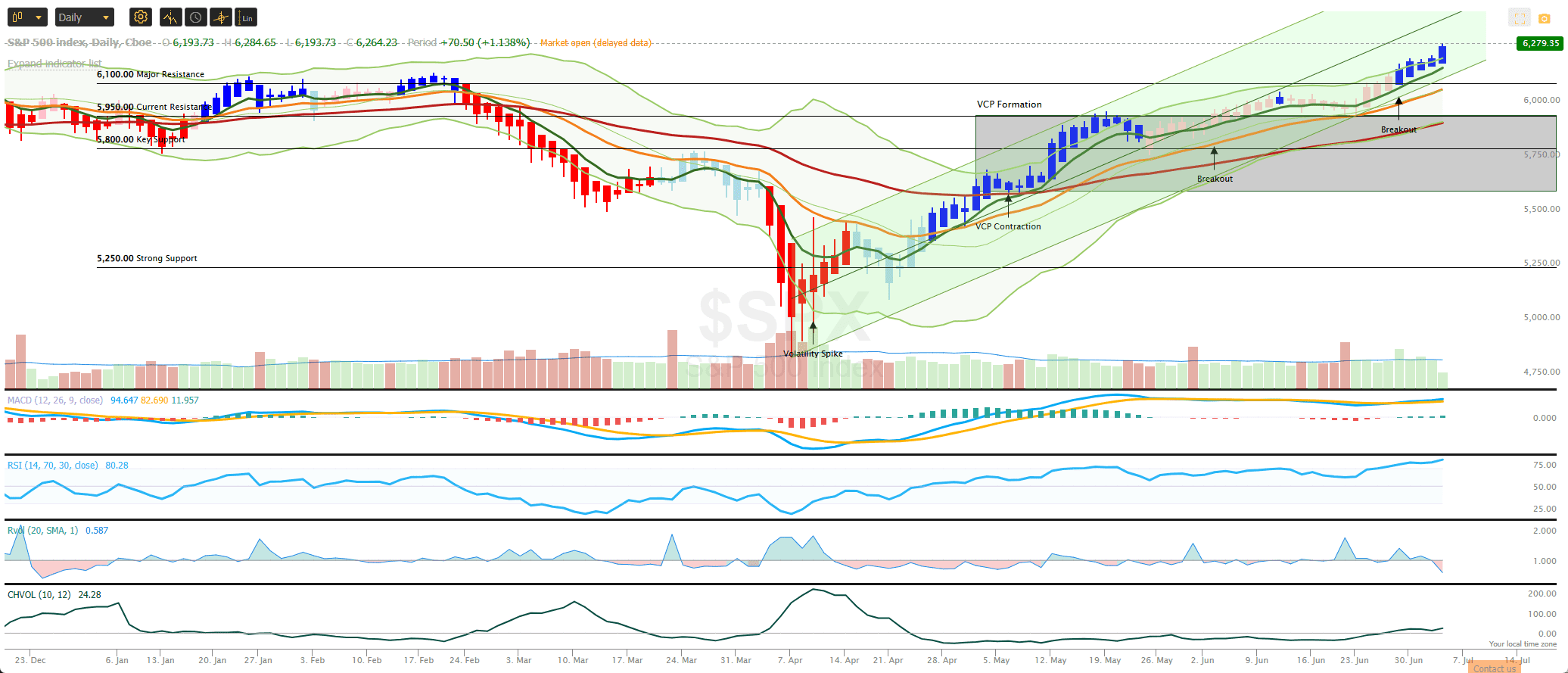
Apart from the day of the initial break through the February high, volume has been steady, and consistent with average volume, and so the continuation may be genuine rather than a result of short covering at this important resistance level (~6100). However, US markets are historically bullish prior to Independence Day and so we can likely expect a retest of this level to see whether it will act as support for more advances going forward. Moreover, we have now seen a 30% gain in the three months since the April lows – that is surprising considering the geopolitical uncertainties that we have seen in this time period.
Relative to other major asset classes US Equities topped the list this week:
 with only Bonds in negative territory.
Darwin Core Portfolio:
No changes were made to holdings in the Core Portfolio this week although we did pick up dividends from SPLG (US Equities) and VNQ (Real Estate):
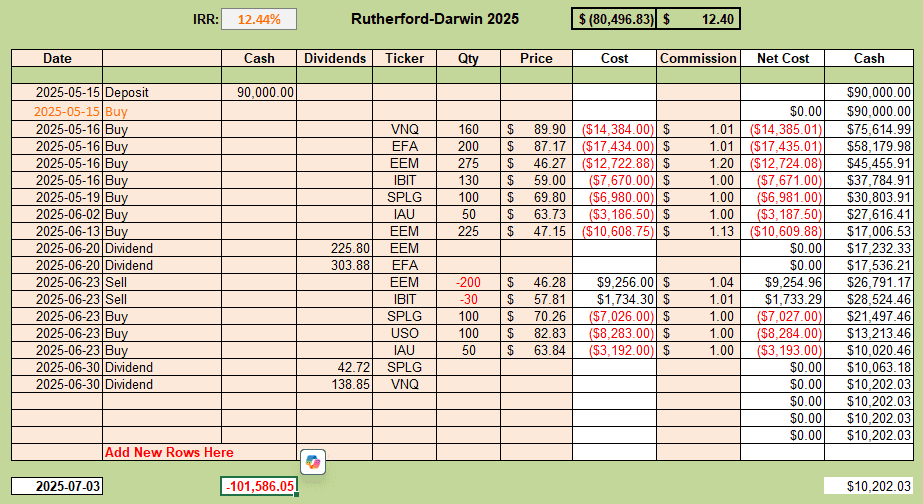 The portfolio is showing a 12.4% Internal Rate of Return (IRR) at this point, although this is not too reliable due to the short duration of the holdings (6 weeks).
Checking on current rankings and recommendations from the Kipling workbook:
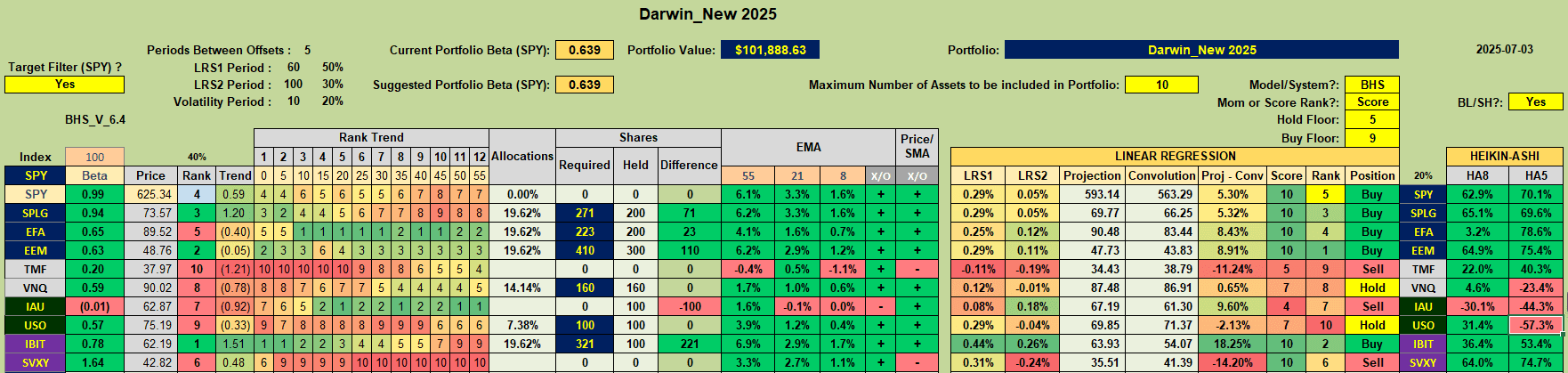 we see Buy recommendations for SPLG, EFA, EEM (all equity ETFs) and IBIT (Crypto) with Hold recommendations for VNQ (Real Estate) and USO (Oil). As for last week, IAU (Gold) is recommended as a Sell but is still not looking weak enough to persuade me to sell it at this point and it did manage a small gain last week:
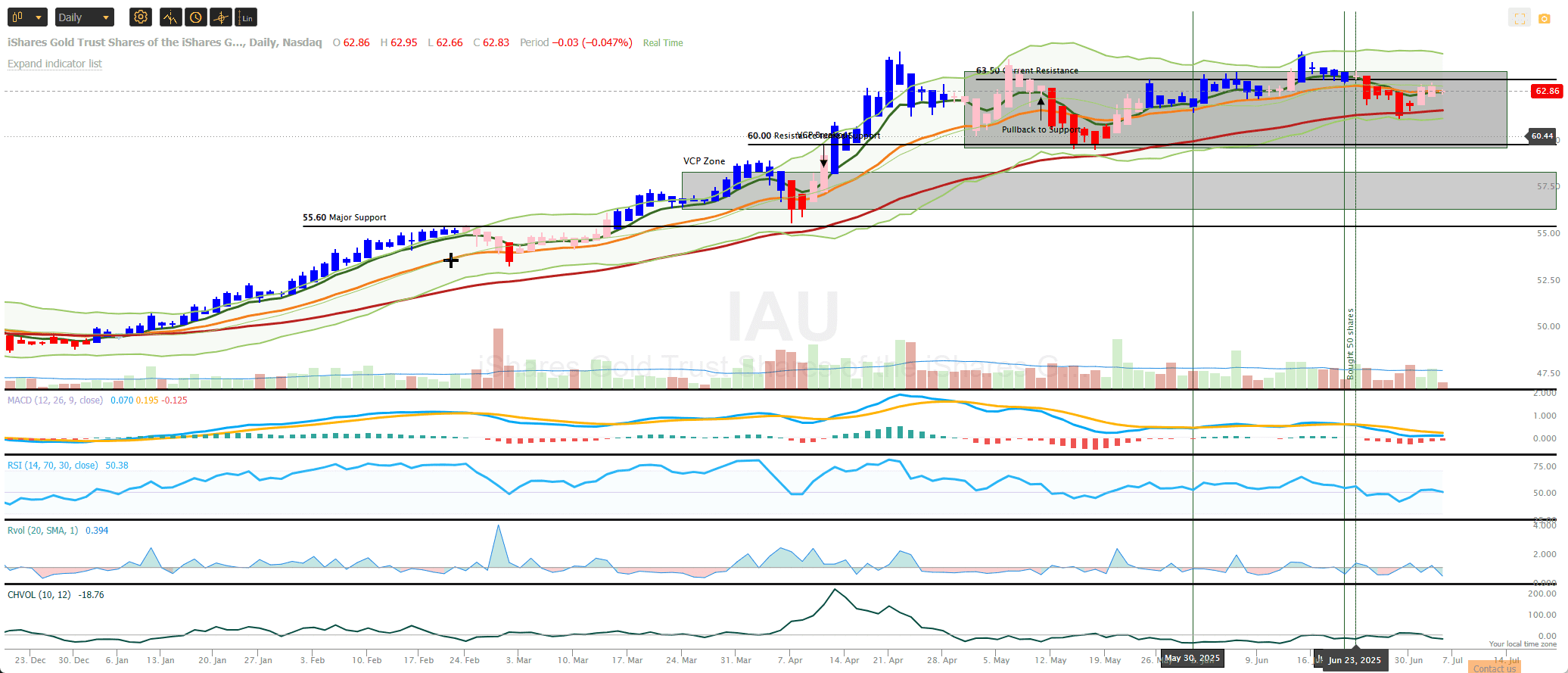 The MACD and RSI Indicators are sending mixed signals so I will continue to hold until this battle is resolved. It would be nice to Sell Call Options here but, as we shall see below, I am currently over-hedged on the portfolio as a whole and premiums for IAU Options are not high enough to make them too attractive.
USO and VNQ are also both showing mixed signals from the MACD and RSI indicators and so these ETFs continue to warrant close attention.
At this point we’ll check on how we stand with respect to calculated allocations to maintain our targeted 2% volatility limit for each ETF:
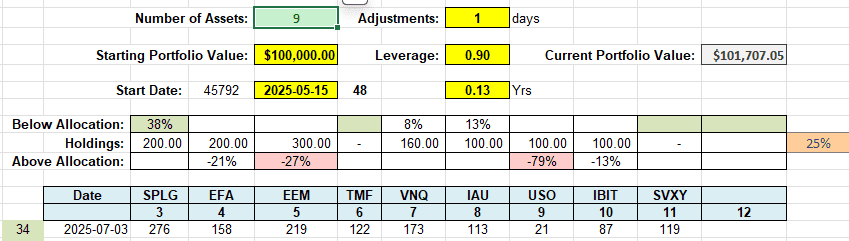 The most notable discrepancy here is the severely over-allocated holdings in USO. I mentioned this last week and the situation hasn’t got any better with me holding five times the number of shares required to maintain 2% volatility – closer to 10% volatility a distinct possibility. The only consolation here is that the premiums received when selling Call Options is high – so a partial offset to the risk – but more on this below.
EEM is also slightly over-subscribed (based on a 25% variation allowance) but, since I an holding short Call Options here, I can always let ITM Options get exercised and give up 100 shares that way to bring things into balance. SPLG is my biggest decision here since I am ~100 shares under-allocated – more on possible actions here below.
EFA, VNQ, IAU and IBIT look OK with no adjustment called for.
Rutherford Risk Management:
Now a look at the risk management/hedging scenario:
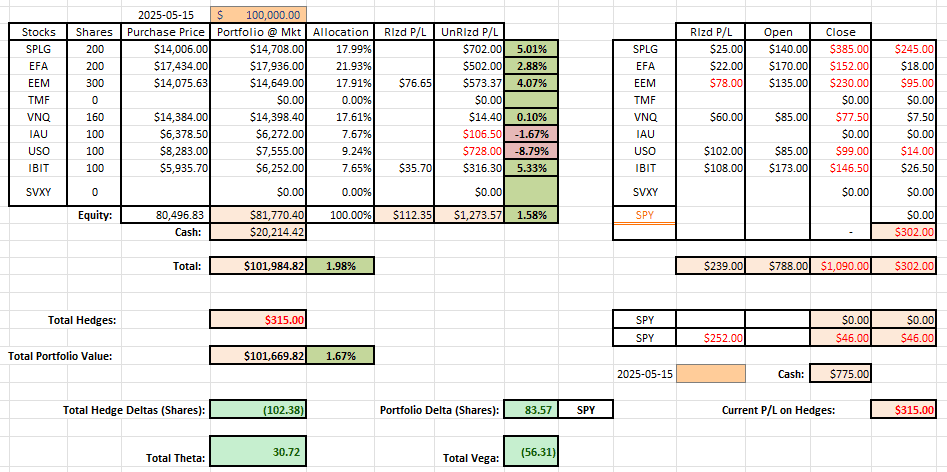 In the top right table of the above screenshot we see that I have sold Call Options against six of the ETFs held in the portfolio. This has generated $788 in credits (~0.8% portfolio value/month) that can be used to hedge small pullbacks or to finance the purchase of Put Options for stronger downside protection. At the moment, with current strength/bullishness in the markets I do not hold any Put Options. In fact, the Call Options, that I have sold, have me over-hedged (minus 102 SPY Deltas/shares equivalent versus plus 84 share SPY equivalent from ETF holdings). The main contributer to this is the $70 strike Calls that I sold in SPLG. These Calls are now In-The-Money (ITM) and limiting further profits on 100 of the 200 shares that I am holding in SPLG. Thus, I don’t have to worry about SPLG dropping to $70 since the 100 shares are totally covered. However, in the allocation calculations shown in the previous section I am 76 shares undersubscribed to SPLG and, with 100 shares neutralized by the Call Options, I will add more shares should SPLG continue to show strength and to continue it’s bullish trend. Even if I oversubscribe here, say Buy 100 shares, total holdings will likely get reduced by 100 shares if the $70 strike Calls remain ITM at expiration in 2 weeks.
The $49 strike Calls sold against EEM are presently priced at ~48.80 – slightly Out-of-The Money (OTM) – but could move ITM on continued strength. Should this occur and I continue to hold the short Call position through expiration I could let 100 shares get taken away and fall into line with current allocation calculations. This is what I plan to do (unless there is some unexpected movement in price).
The SPLG and EEM positions are currently the only 2 positions showing significant negative returns from the hedging and so continue to be closely monitored.
In the meantime the portfolio continues to collect ~$31 per day in time value decay of the premiums from the short Calls.
The impact of the combined strategies on the total portfolio performance is shown in the following screenshot:
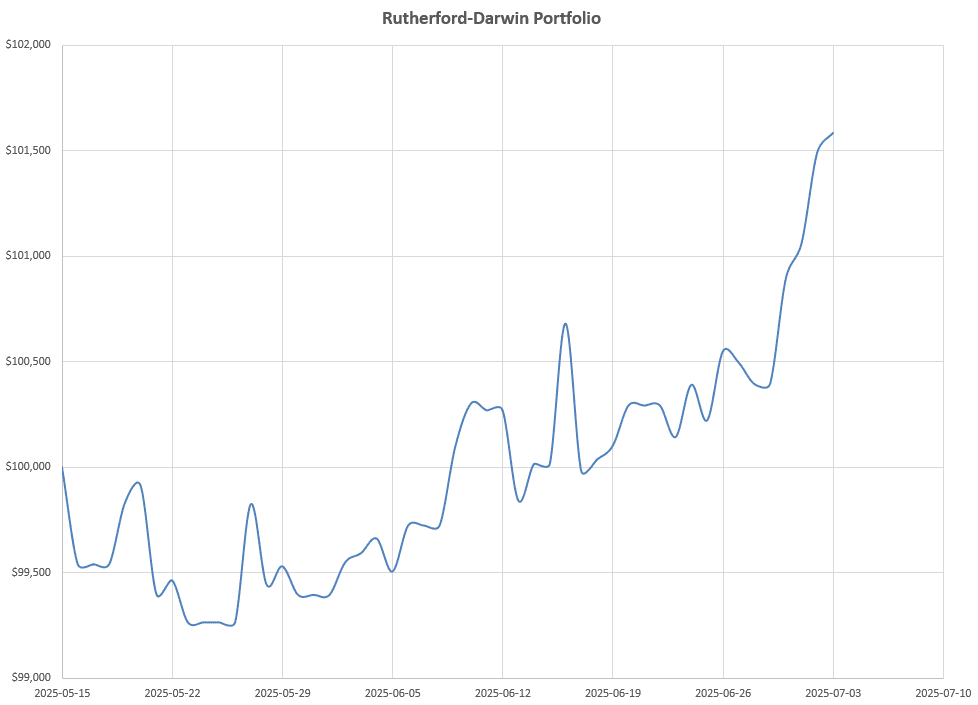 where we continue to see nice steady growth with an attractively low 4.07% volatility.
Discover more from ITA Wealth Management
Subscribe to get the latest posts sent to your email.
Leave a Comment or Question