
Time trial – Alpenrose Velodrome
Schrodinger is a “do nothing” portfolio in the sense that it is on automatic pilot after it is set up with Schwab. This portfolio is managed by computer and is built around the principle of Asset Allocation, a long standing investing model designed for diversification. Schwab calls these portfolios, “Intelligent Portfolios.”
The Schrodinger stock/bond ratio is 80/20. Bond is defined as the percentage in fixed income plus cash. Schwab always carries quite a bit of cash in these portfolios and this is the one criticism of this style of investing. Right now Schwab is not adding more shares. Either the cash value is insufficient or the computer modeling reasons the market is too high.
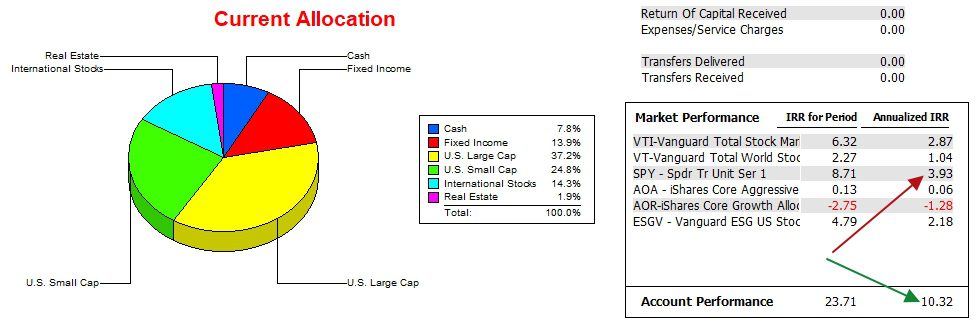
If you check the pie chart below you will see that 14.3% of the portfolio is invested in International Equities. I asked Schwab to concentrate the portfolio in U.S. Equities and this is why the International Equities percentage is as low as it is. Historically, U.S. Equities outperform International Equities and that is why I want the scales to be tilted in favor of U.S. Equities.
Schrodinger Asset Allocation Portfolio
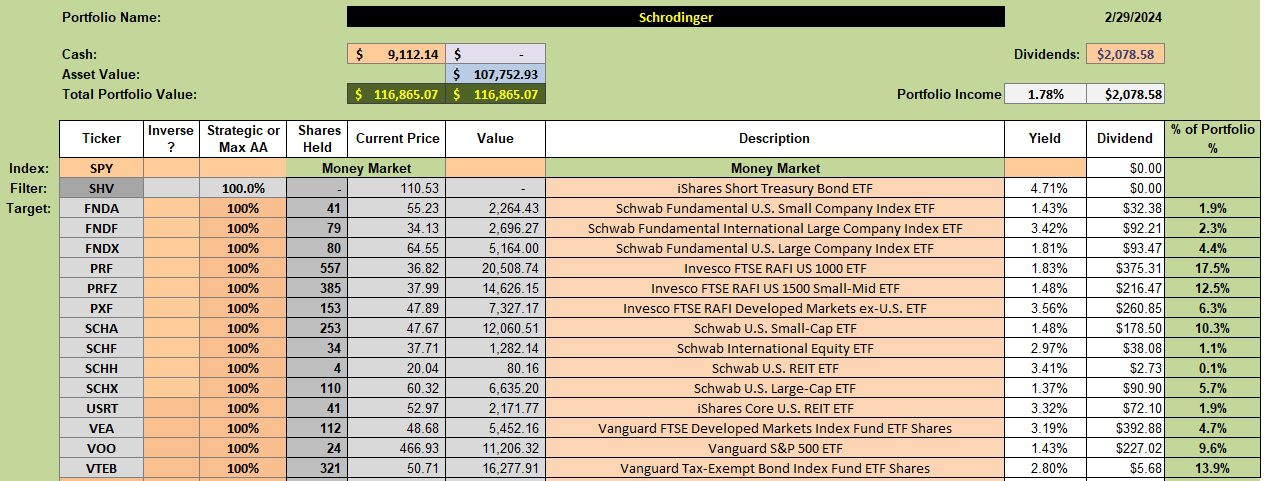
Below is the current Asset Allocation for the Schrodinger. Holdings below 3% of the portfolio do not contribute all that much to the overall performance, but I have no control over these percentages. SCHH, as an example, is what I call a shard ETF. I am puzzled by the rationale to hold both SCHH and USRT in the same portfolio.
Schrodinger Performance Data
Since 12/31/2021 the Schrodinger outperformed the S&P 500 (SPY) by a little over 6 percentage points when annualized. The actual percentage difference is much greater when the IRR for Period is examined. The gap between the Schrodinger and AOR is huge.
A good question to ask yourself is – If a passive computer managed portfolio performs this well, why fuss at all with any other investing style? The Schrodinger was set up to answer the question, “Who Will Manage the Family Portfolio When I Die?”
The single reason I can think of for going with a different investing model is one of capital preservation. The Schrodinger and Copernicus portfolios are not designed to protect capital. The portfolios using the Sector BPI model are set up to protect capital. Young investors need not worry about capital preservation and that is why I highly recommend investing approaches such as the Copernicus and Schrodinger as both fit the needs of young investors.
For older investors investing some money with a Schrodinger management style provides a portfolio reference or benchmark. Suppose an individual has a portfolio of individual stocks. Is that portfolio outperforming a Schrodinger style portfolio or are you just kidding yourself? Setting up an appropriate benchmark is essential if one is a serious investor. Otherwise you are playing a game of entertainment.
Schrodinger Risk Ratios
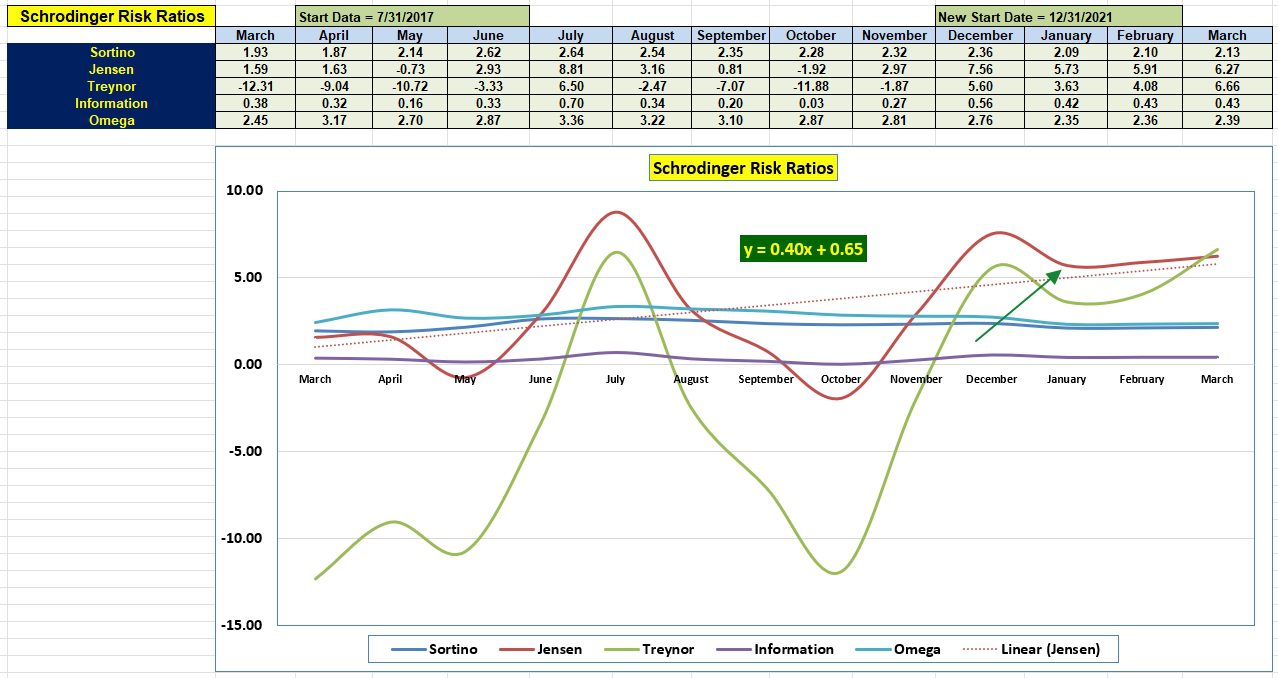
How well is the Schrodinger performing when risk enters the calculations? Quickly speaking, very well. All risk metrics with exception of the Omega Ratio are higher than they were a year ago. The Jensen Alpha (also goes by Jensen Performance Index) is very high and the slope of the Jensen is positive.
The Information Ratio is a head to head comparison with the SPY benchmark and that value is also positive. This is an excellent record for a passively managed portfolio.
Below are examples of two different investing models for readers to check out.
Copernicus Portfolio Review: 29 December 2023
Gauss Sector BPI Portfolio Update: 3 January 2024
Discover more from ITA Wealth Management
Subscribe to get the latest posts sent to your email.
You must be logged in to post a comment.