
“Painting” generated in the style of Edward Hopper.
Schwab rebalanced the Schrodinger a few days ago which motivated this review. For new readers, the Schrodinger is a Robo Advisor portfolio or one managed by computer. The investor does absolutely nothing other than set up an Intelligent Portfolio with Schwab and then save as much as you can as early as you can. Computers do the rest. I highly recommend investors include this model as a possibility to manage part of the family portfolio. Check the data and see if you don’t agree.
Schrodinger Asset Allocation
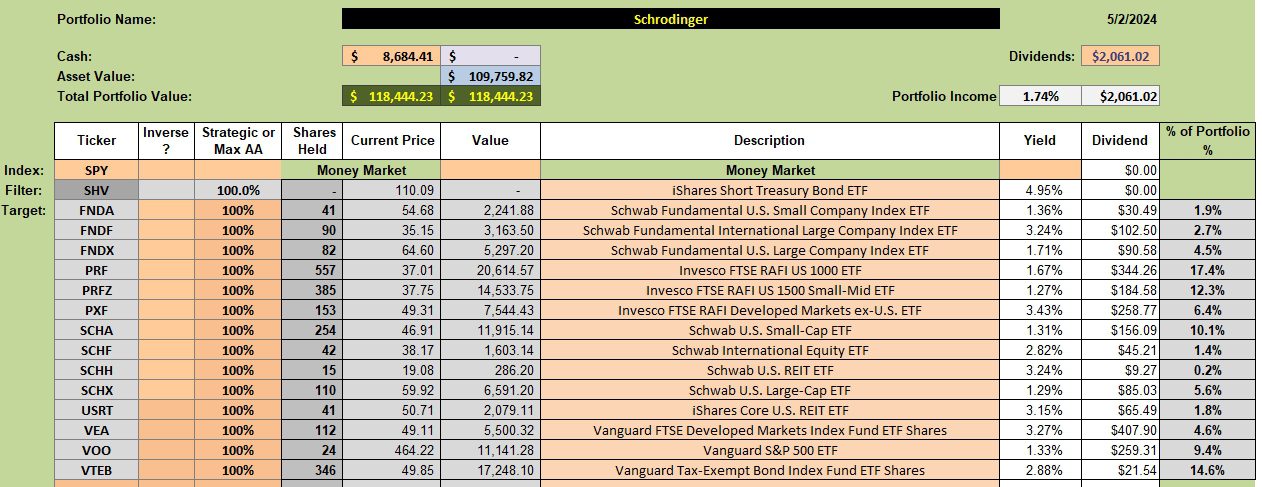
Below is the current asset allocation for the Schrodinger. I have the stock/(bond-cash) ratio set to 80/20 so it is an aggressive portfolio. Investors working with Schwab can set their own ratio.
Schrodinger Performance Data
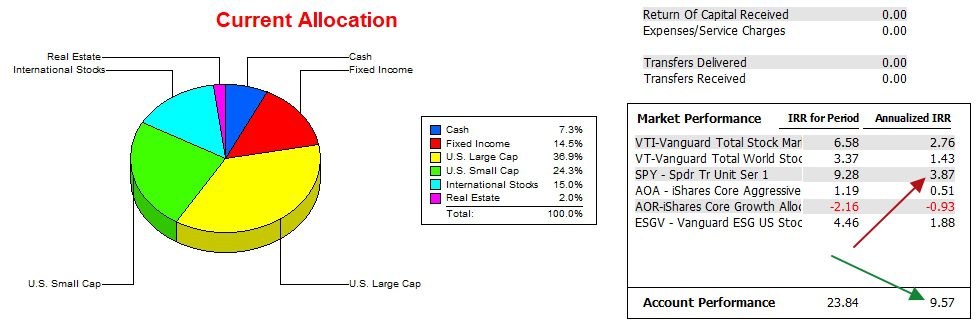
Since 12/31/2021 the Schrodinger has outperformed the SPY benchmark by a wide margin of 9.6% to 3.9% annualized. Only VTI is close to the Schrodinger performance over this period.
Schrodinger Risk Ratios
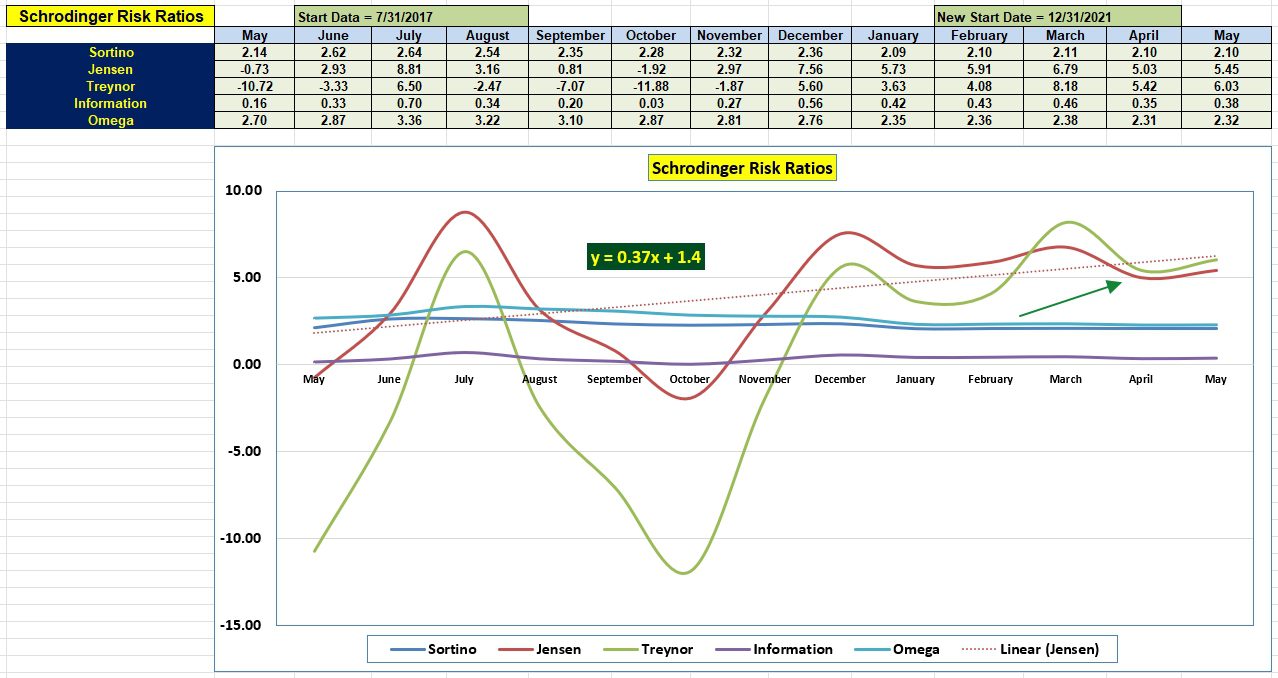
While it is very early in May, the Jensen is making progress, but is a far cry from the high water mark from last July. The takeaway is the positive slope (0.37) for the Jensen Alpha. Any positive value for the Jensen is a success.
Discover more from ITA Wealth Management
Subscribe to get the latest posts sent to your email.
Lowell,
I use the Schwab Robos with all my great-grandchildren and recommend them for my grandchildren who are still in the working/parenting part of life!
Bob W.
Bob,
Good recommendation. I hope your Robo accounts are performing as well as the Schrodinger. Right now the Schrodinger ranks number 3 on both performance and risk. Hard to argue with a portfolio that requires the investor to do nothing except continue to save and add money.
Lowell
Hi Lowell,
I’m examining the ETFs being used in the Schrodinger portfolio. There’s a lot of overlap with regard to ETFs for the asset classes. For example, the US large cap space is covered by four funds: FNDX, PRF, SCHX and VOO. What is the rationale for this kind of coverage? FNDX is a value-tilted large/mid cap fund (note: when you examine the index mechanics makes it look like an actively managed fund), PRF is a large cap value index fund, SCHX is a total market fund (which will weight large caps highly), and VOO is an S&P 500 fund. And the expense ratios (except for VOO–FNDX is 0.25% and PRF is 0.39%) are higher than other such offerings (VTV, for example).
I get the point this portfolio is machine-generated, but apparently parsimony is not programmed into the selections!
Craig
Craig,
I too have questions as to the makeup of the Schrodinger. There were times when the portfolio allocation carried only a few shares of an ETF, which made little sense.
Regardless, the portfolio has performed quite well when compared to the benchmark or potential benchmarks.
In the makeup of the Huygens and Pauling I also have overlap. For example, VO and VB will overlap with parts of VTI.
Lowell
Lowell,
How often do the Robo advisors change allocations? (quarterly, … ?)
Craig
Craig,
Rarely. I just looked up when the last sale occurred and it was 10/27/2023. Change generally happens when the owner of the portfolio adds new cash and/or when dividends are declared. When these events happen the computer adds or reallocates shares. Sales might occur once a year.
At the end of the second quarter dividends will show up and I expect to see new shares added to some assets in the Schrodinger. I doubt we will see the sale of any shares.
Since the Schrodinger is greater than $50,000 Schwab will tax manage the portfolio. This is a free service.
Lowell
Hi Lowell,
I know this point is off in the weeds, but bear with me.
In these discussions, Jensen’s alpha is weighed very highly as compared to other metrics. Why is that? The underlying assumption in this alpha calculation is the CAPM model correctly captures market behavior. In reality, it only captures about 2/3 of the variance in the markets. I would think the Fama/French 5-factor model, which captures about 95% of market variance, would be a large improvement on CAPM.
Your thoughts?
Craig
Craig,
I think of the Fama-French Five-Factor model as a way to populate a portfolio with investments (size and value being two) that historically will outperform the market.
The Jensen Alpha or Jensen Performance Index is designed to measure portfolio risk. I give more weight to the Jensen in my overall weighting system as it encapsulates four critical measurements. They are: 1) IRR of portfolio. 2) IRR of benchmark. 3) Portfolio beta. 4) Yield from a “risk-free” short-term U.S. Treasury.
Conclusion: I see the Fama-French investing model differs from how Jensen is used.
Do you see this differently?
Lowell
Lowell,
I’m just kinda thinking out loud 🙂
There’s a white paper by Benjamin Felix at PWL (https://www.pwlcapital.com/resources/five-factor-investing-with-etfs/) which delineates the shortcomings of CAPM. My perhaps too-simple thinking is one can swap a factor-based model for CAPM’s prediction, and come up with a higher fidelity result, by massaging Jensen’s alpha equation.
I could be way off here.
Craig
We could call it “Herr’s Alpha” 🙂
The portfolio would need to generate Alpha before using such a presumptuous name as “Herr Alpha.” I’m good with Jensen Alpha or just Alpha.
Lowell
“There’s a white paper by Benjamin Felix at PWL (https://www.pwlcapital.com/resources/five-factor-investing-with-etfs/) which delineates the shortcomings of CAPM. My perhaps too-simple thinking is one can swap a factor-based model for CAPM’s prediction, and come up with a higher fidelity result, by massaging Jensen’s alpha equation.”
Craig,
If you are interested in Factor Investing I recommend reading “Your Complete Guide to Factor-Investing” by Berkin and Swedroe. I think Swedroe is the primary writer.
You may be interested that Quality investing, one of the five-factors was discovered by Robert Novy-Marx a former student of mine. Marx had one of the top minds I ever worked with in the area of physics.
Back to Swedroe. The Factor based investing book recommends specific ETFs one might use to put together a portfolio. The Huygens and Pauling asset allocation investment quivers are not too far off a Fama-French factor style portfolio. One could tilt the portfolios more toward value by using VOE and VBR instead of VO and VB.
Lowell