
Sally Lunn’s Bakery, Bath, England
With Options in XLC (Communications) expiring on Friday (18 July) I made a few adjustments to the Portfolio:
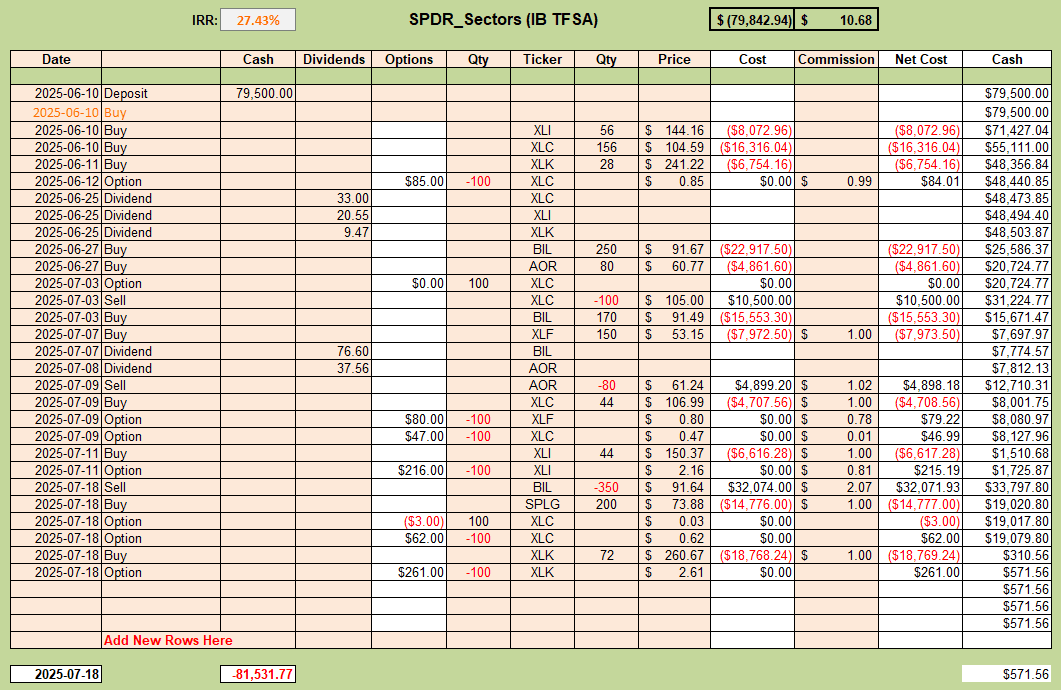
and, checking the Kipling workbook for rankings and recommendations, I was looking at this:
 with SPLG (S&P 500 Large Caps), XLI (Industrials) and XLK (Technology) showing as suggested Buys and XLC and XLF (Financials) as recommended Holds. With the exception of SPLG, all these ETFs were already held in the portfolio, so I also added 200 shares of SPLG (S&P 500 Large Caps) to the mix.
Current calculated allocations required to maintain a 2% volatility risk level for each ETF are shown in the following screenshot:
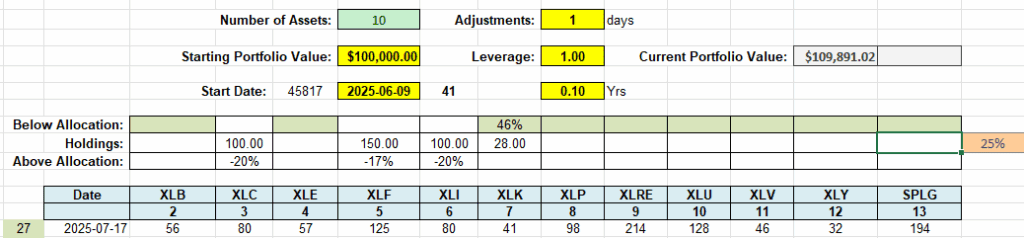
Technology (XLK) has been driving the S&P 500 higher but I was only holding 28 shares so I could not sell any Options on that ETF. Since only 40% of available funds was invested, and cash was available, I therefore chose to buy 72 additional shares (bringing total holdings to 100 shares) of XLK and to sell a Call Option, at the 260 strike price, expiring next week (25 July) for 2.61 ($261) to bring in some credits. This leaves me with a Covered Call position in XLK, with a “Delta” of 0.43, equivalent to holding 43 shares of XLK. This is close the the recommended holding shown in the above screenshot to maintain a 2% volatility/risk level. The Option is slightly In-The-Money (ITM) so, unless price drops a little, I will have to roll the Option before expiration or let the shares get taken away from me.
The $108 Strike Call Options in XLC, expiring on 18 Jul (last Friday), that I had sold, were trading very close to the strike price so I bought them back and sold a Call Option at the same strike price but expiring 2 weeks later (1 August) for a net credit of 0.59 ($59). This leaves me with a Covered Call position in XLC, with a “Delta” of 0.70 – equivalent to holding 70 shares of XLC. Again, as we can see above, this is close to the calculated allocation required to manage volatility/risk to 2%.
My Risk Management/Hedge positions presently look like this (table on right):
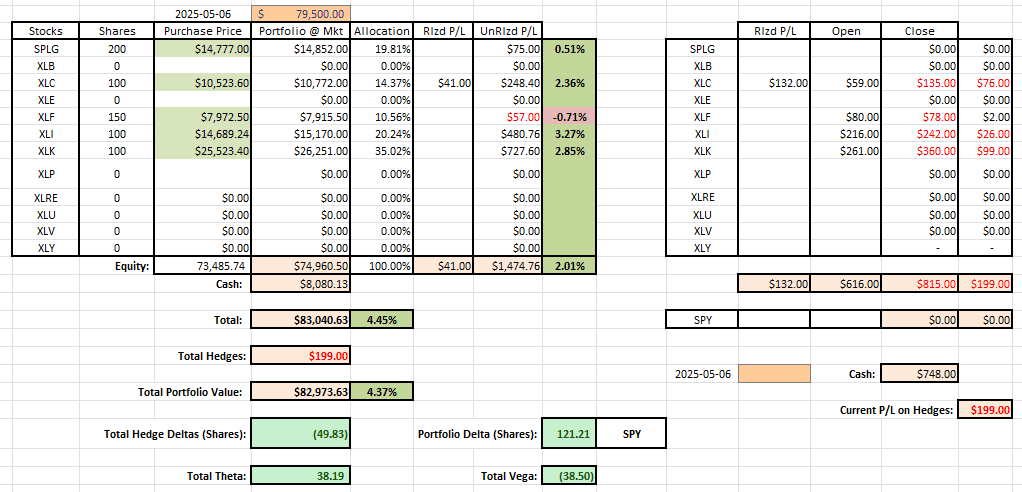 with Call Options sold against all ETFs with the exception of SPLG. The ETF holdings have a portfolio delta equivalent to holdings 121 shares in SPY (benchmark S&P 500 ETF) and these are hedged to the extent of ~50 shares through the sale of the Call Options. To date, I have received $748 in credits from the sale of these Options that can be kept as “income” or used to buy stronger downside protection should it look as though the market is making a correction.
As mentioned above, before the purchase of the SPLG and XLK shares, only 40% of available capital was invested (due to the 2% volatility target chosen to manage risk) but, with the recent adjustments, 75% is now invested.
As we see in the top screenshot, current Internal Rate of Return is showing an annualized 27.4% – but this is after only 4 weeks, so not to be taken too seriously.
 I mentioned at the outset that the objective was to see whether we could match the performance of the broader S&P 500 market (at least in terms of risk-adjusted returns) and the above screenshot shows performance to date. Returns are lower than if we had just held the benchmark SPY ETF – but, then again, only 40% has been invested, so the performance still looks relatively good, with the advantage of seeing a lower volatility of 3.02% compared to 7.64% for SPY (the index). This leads to a higher Sharpe Ratio (8.9 vs 7.3) or better risk adjusted returns – but it’s still too early to believe that these ratios can be maintained and we’ve been in a bull market for the past month – over longer periods anything greater than 2 would be considered very good.
Discover more from ITA Wealth Management
Subscribe to get the latest posts sent to your email.
Leave a Comment or Question