
Wildlife Safari – Whinston, Oregon
Pauling is one of several Asset Allocation portfolios launched in early April of this year (2024). In an effort to reduce taxes I avoid selling appreciated Exchange Traded Funds (ETFs). This strategy slows down the rebalancing process. Rebalancing takes place when fresh cash is deposited or dividends are declared.
For Asset Allocation portfolios valued below $100,000 I consider an asset class to be in balance when it is within one percent of the target percentage. For portfolios over $100,000 I narrow the in-balance percentage to + or – 0.5%.
Pauling Asset Allocation Investment Quiver
Below is the investment quiver and current holdings for the Pauling. Instead of selling shares of asset classes that are over target by more than one percent I focus on the asset classes that are below target by the greatest percentage. More on this strategy later.
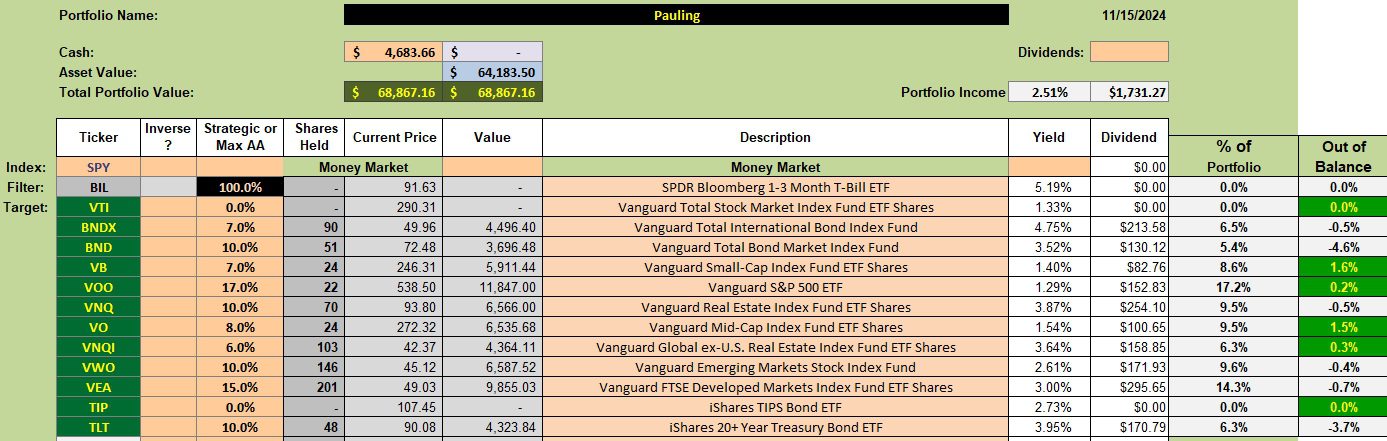
Pauling Rebalancing Recommendations
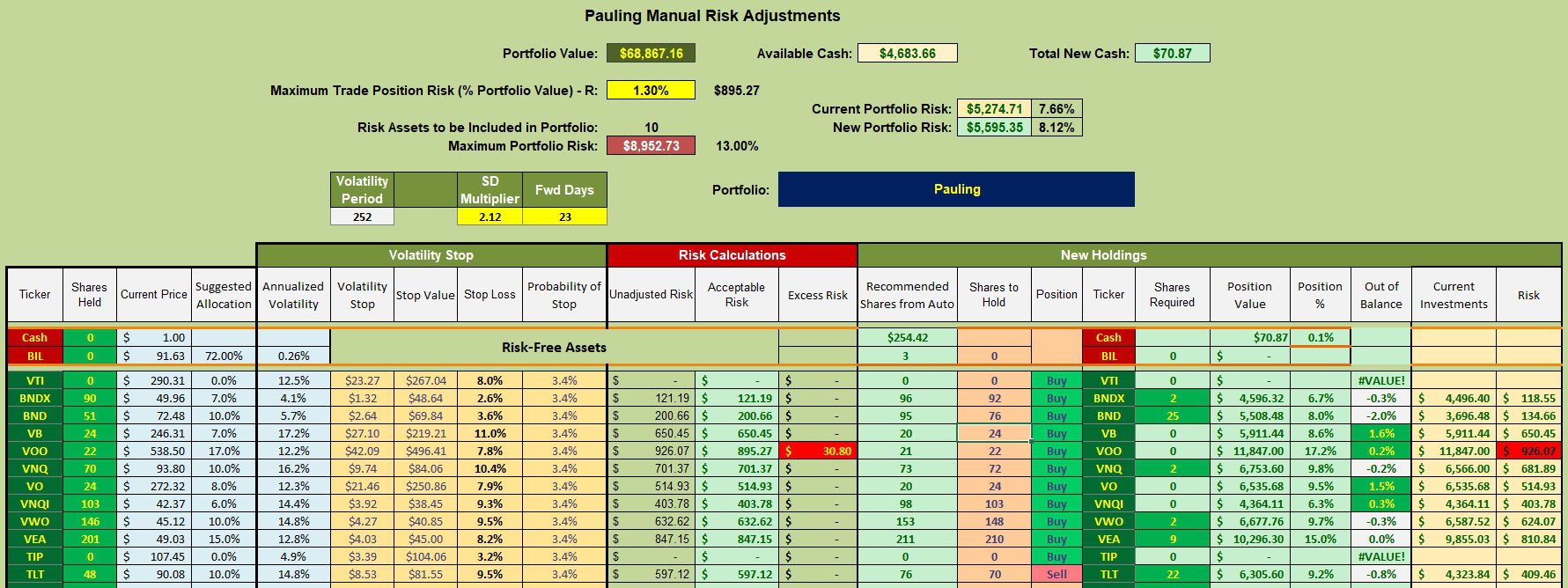
In the sixth column from the right readers will see the number of shares allocated to bring the asset class closer to balance or the recommended target percentage. If new cash is added in December I will place additional orders for BND as bonds are most out of balance. The Pauling is getting close to having all the asset classes in balance.
There are several strategies one can use to keep a portfolio in balance.
- Rebalance once a year. Sell shares more than one percentage point above target and use that cash to purchase shares of asset classes below target.
- Rebalance each quarter of every six months. This involves more trading and will incur more taxes.
- Analyze the portfolio once a month and add shares to asset classes most under target. Prices will changes so there is bound to be at least one asset class under target after one month of market activity.
I am using strategy #3 in an effort to reduce the tax burden.
The incoming administration is behaving in a fashion that the U.S. Government needs to be trashed. This behavior will most likely unsettle stock and bond markets. Therefore, we need to be on high alert with our investments. One possible way to protect capital is to use Trailing Stop Loss Orders or simply place limit orders under each holding. We have nearly two months to observe how stock markets (both domestic and international) react to erratic behavior. TSLOs are not ideal, but it is a way to protect capital.
Without telling readers what to do, I am in the process of setting TSLOs under many equity holdings.
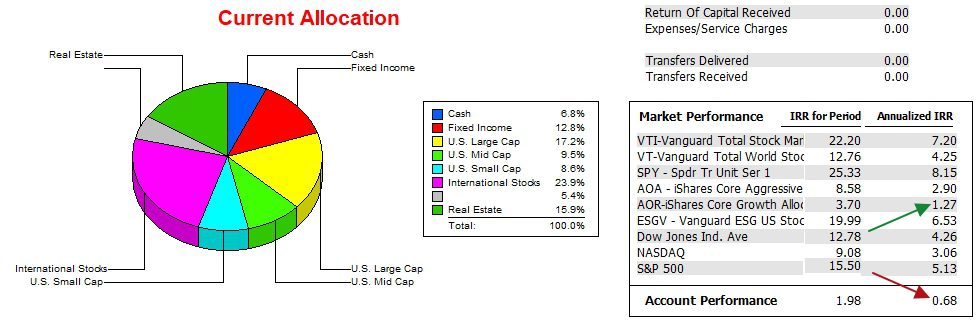
Pauling Performance Data
Since 12/31/2021 the Pauling lags all the possible benchmarks listed in the following screenshot. The gap between AOR and the Pauling is sufficiently small that it can be closed over the next year. This is assuming market behavior will not deviate to far from the norm.
When checking the return of SPY readers see why I recommend investing in the S&P 500 for the young investor with years ahead to let the market do its work. The Copernicus is the portfolio where I am employing a strategy of investing in ETFs that mirror the S&P 500.
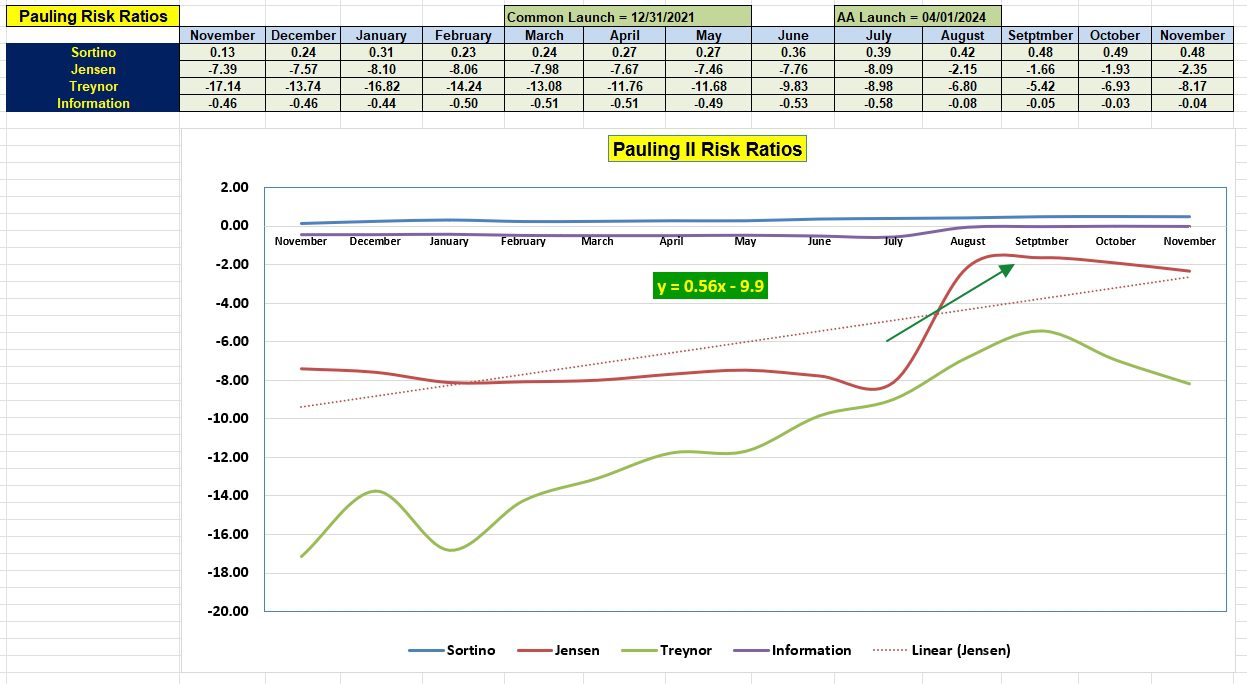
Pauling Risk Ratios
When comparing November 2024 values with November 2023 numbers, we see great improvement. However, the Pauling is not doing so well over the most recent three to four months. Rather than focus on month to month data, check out the slope of the Jensen Performance Index. That is the most encouraging bit of information from the following table.
More data is needed to evaluate the Asset Allocation model as seven to eight months of operation is far too short a time period. The Schrodinger is built around the Asset Allocation model so it is a better test of this approach to investing.
Share the https://itawealth.com website with your friends and family.
Discover more from ITA Wealth Management
Subscribe to get the latest posts sent to your email.
You must be logged in to post a comment.