
Chepstow Castle, Wales, UK
After gapping up higher on Monday, it was all downhill for the rest of the week with US Equities closing ~ 4% lower than last week’s close:
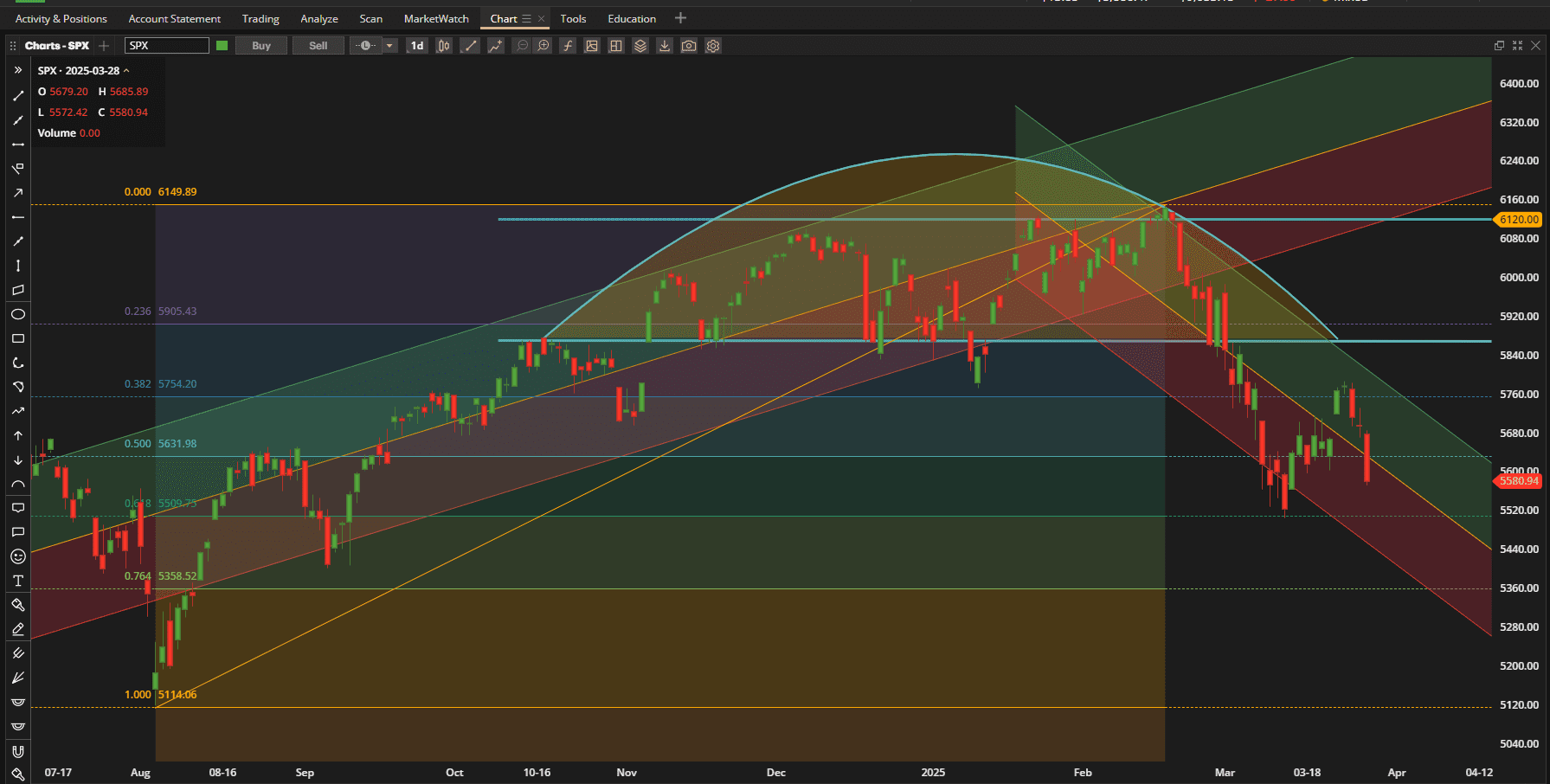
With Monday’s strong move higher it looked as though we were going to test the “neckline” support at ~5860 in the SPX (S&P 500 Index) – but 3 days of weakness now looks as though we will probably retest the recent lows at ~5520 (61.8% Fibonacci retracement from the highs) before seeing whether this support level holds or whether we will see further declines to at least the 5360 level or even last August’s lows at 5120. That would be 16.75% decline. As illustrated in the above screenshot we have gone through a rounding top over the past 5 months and have clearly broken out of the Uptrend Channel and looking quite weak following a strong Bull market in the 12 months from November 2023.
In terms of performance relative to other major asset classes:
 equity markets did not fare well with rotations into Bonds and Commodities. Only cryptocurrencies saw a larger decline – although SVXY, the inverse Volatility ETF, saw large losses as Volatility increased, as expected, with the strong decline.
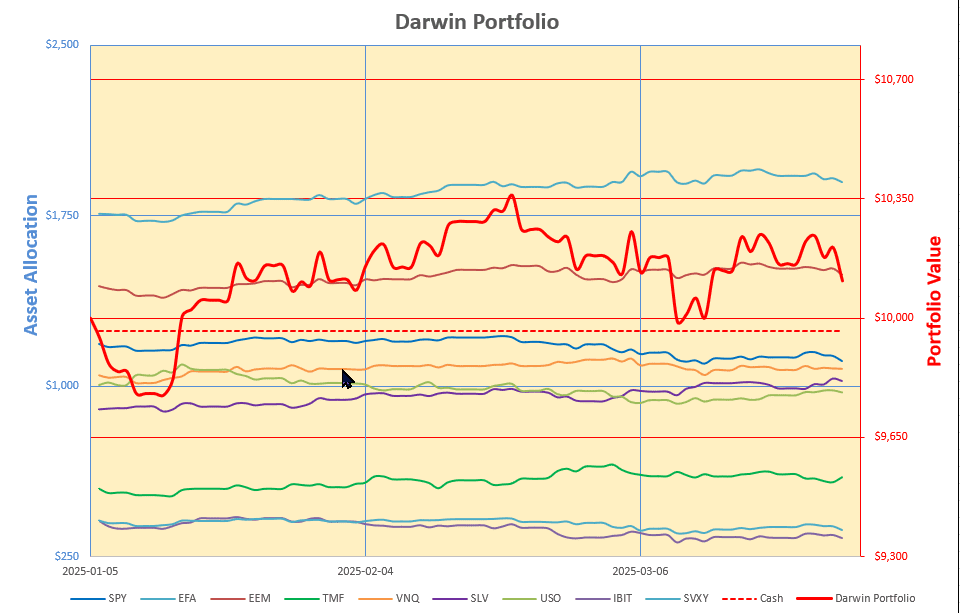
The Rutherford-Darwin Portfolio weathered the storm reasonably well since 70% of the funds are allocated to “Risk-Free” T-Bills and the diverse “Buy-And-Hold” Darwin portion of the portfolio saw only a modest decline:
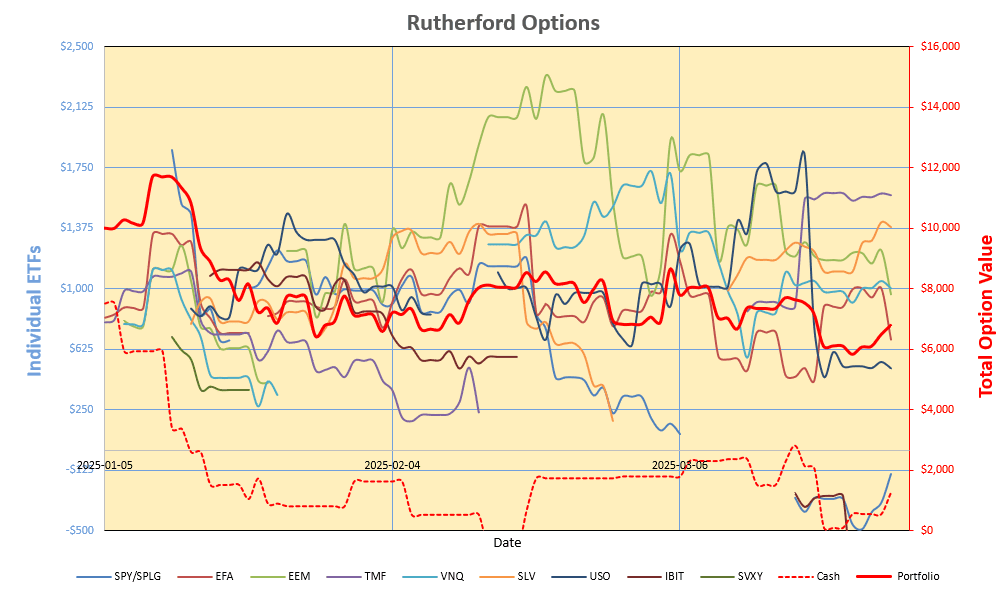
 Following my change in Strategies used to manage the Rutherford Options portion of the portfolio (to include the sale of Option Premium) the volatility of this portion of the portfolio has dropped significantly (although it is still higher than the Darwin Stock portion of the portfolio) and looks like this:
When this is all put together the total portfolio performance looks as follows:
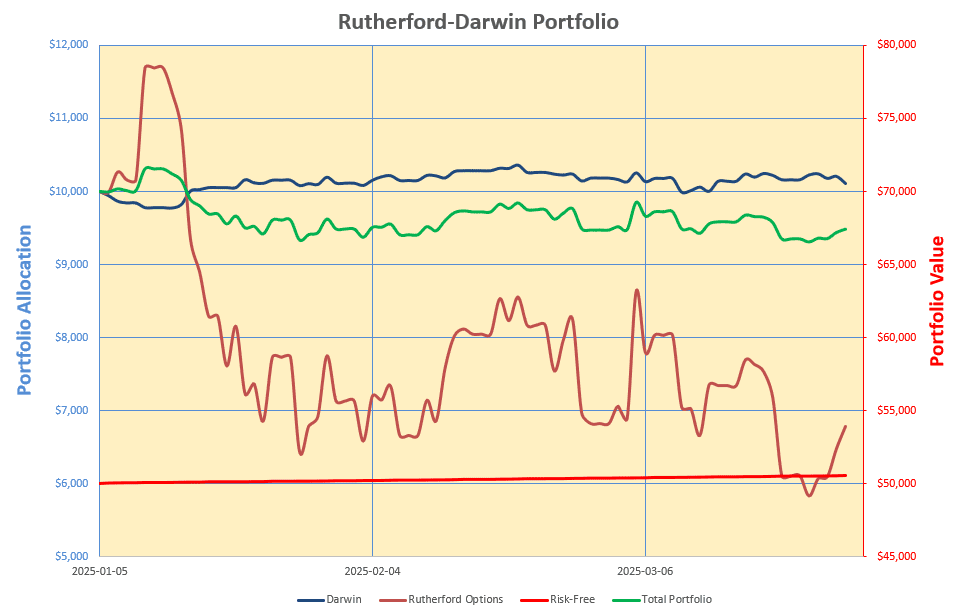 with the portfolio being down ~4% compared with a decline of ~10% in US Equities over the same period. So, although I am disappointed in the performance of the Option portion of the portfolio, it has been a tough volatile market and I hope that I now have it “tamed” a little going forward.
My apologies for being a day late with this review, but keeping a record of positions/strategies now being adopted in the Options portion of the portfolio has had me busy modifying a new Excel workbook to track the trades in such a way that I hope to be able to better report on performance in the future. I am still working on this but I think I’m getting close to having something workable and useful.
Last week I mentioned that I would be rolling positions in EFA, EEM, USO and VNQ for which I am using “Diagonal” Spreads as the strategy of choice. The short term Options that were expiring on Friday were all rolled to next week’s expiration with 3 of the 4 Options expiring worthless allowing me to keep the premiums received through the sales and replacing them with new Options (and more premiums). VNQ was closing slightly In-The-Money so I had to pay a few dollars to buy this back before selling a new position.
The “new” position now looks like this:
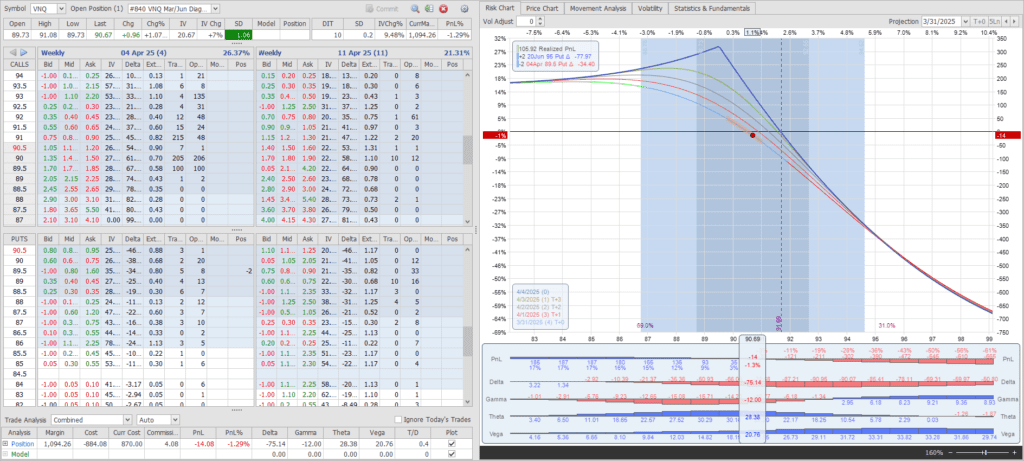 and is bearish with $89.50 Puts, that were sold, expiring next Friday (4 April). This position currently has a 69% probability of being profitable (assuming no further adjustments) – so a high probability position.
The following screenshot shows a summary of the trades in the “Diagonal” portion of the Options portfolio:
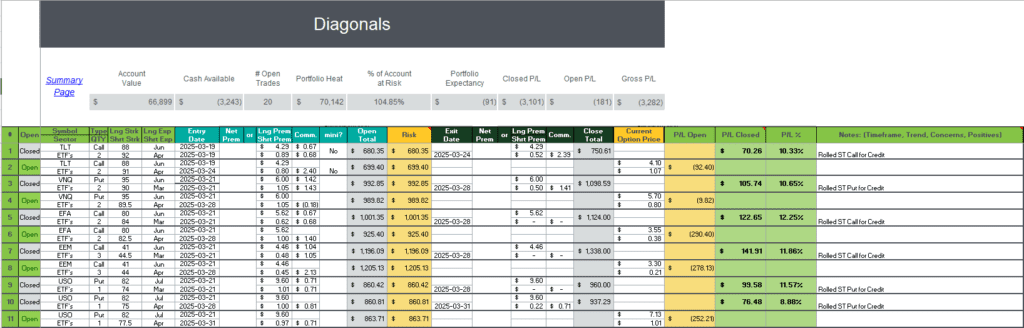 Notice that the legs of the Spreads that were rolled were all rolled for a credit – that, in turn, reduces the risk on the position by the same amount. I can possibly roll every week until the expiration of the Long Options expring in June/July.
In order to provide strategy diversification in the Portfolio I also have “Vertical” Spreads in TLT, IBIT, VOO (representing US Equities) and SLV. Since the expiration on the Long and Short Legs of these spreads is the same I shall not be selling Options weekly and replacing with an Option with a different expiration but I may roll Options to a different strike in the same expiration. The following screenshot shows trades to date in this portion of the portfolio:
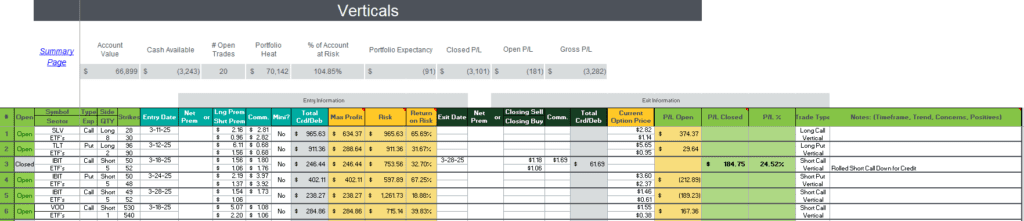 Note that I have rolled one leg in the IBIT position for a credit and reduction in risk.
This portfolio obviously needs far more attention than the average “investor” is likely to be prepared to devote to it – but, over the next year, I hope to show that it can generate attractive returns with defined risk. As noted last week, the relatively tame movement of ETFs does not make the acquisition of long-only Options a high probability strategy.
Discover more from ITA Wealth Management
Subscribe to get the latest posts sent to your email.
You must be logged in to post a comment.