
Niagara (Horseshoe) Falls, Canada
After last week’s sell-off, US markets bounced back this week, closing ~2.5% higher than last week’s close and looking to retest the all-time highs at ~6450 in the SPX (S&P 500 Index):
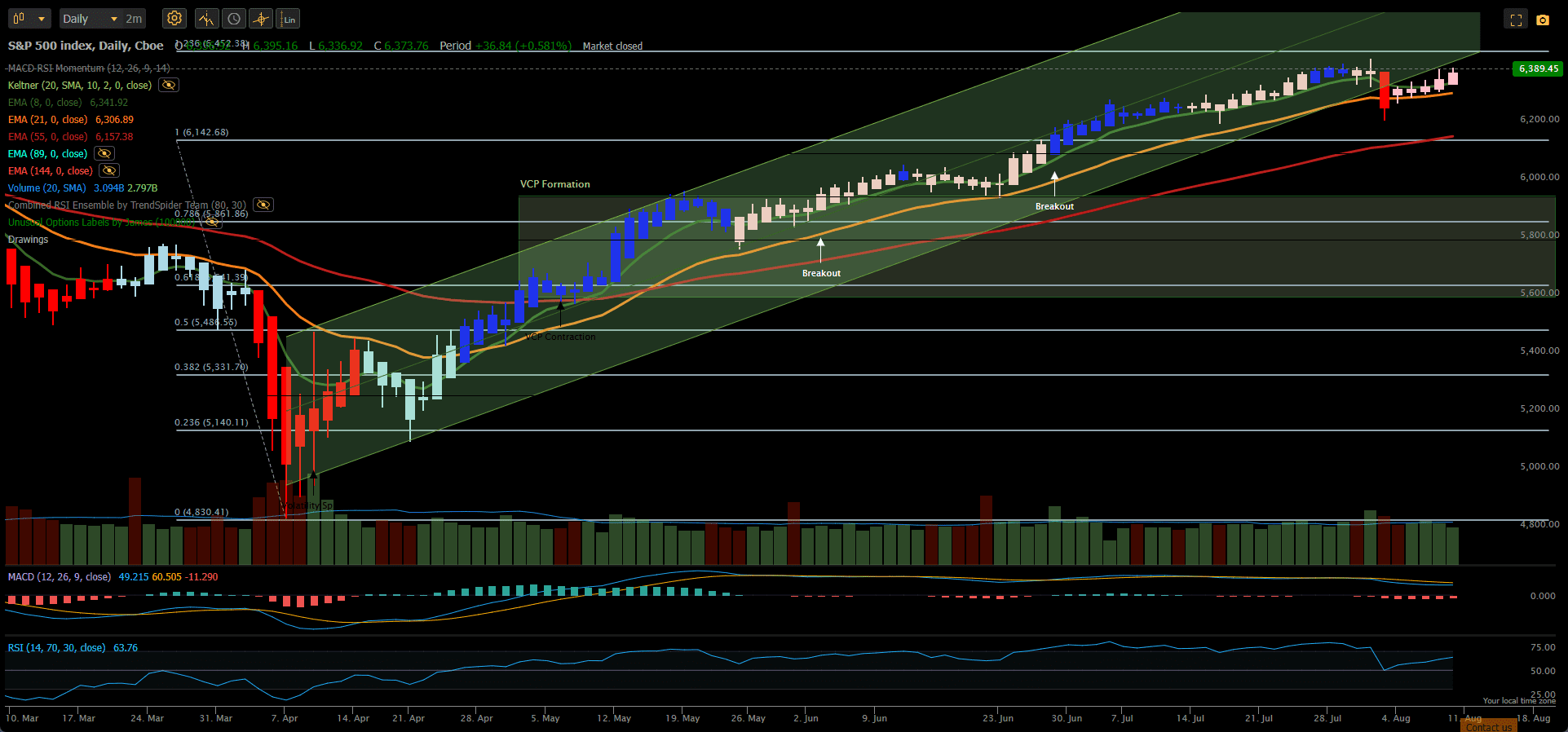
We are now in a consolidation phase with mixed signals from the MACD and RSI indicators. Moving averages, while still aligned bullishly, are flattening and signalling a weakening of momentum. The bullish trend channel is not well defined since there are no strong higher low pivot points so it is not clear whether prices may have dropped out of the channel. This may become clearer if/when we retest the 6450 potential resistance area.
When it comes to relative performance:
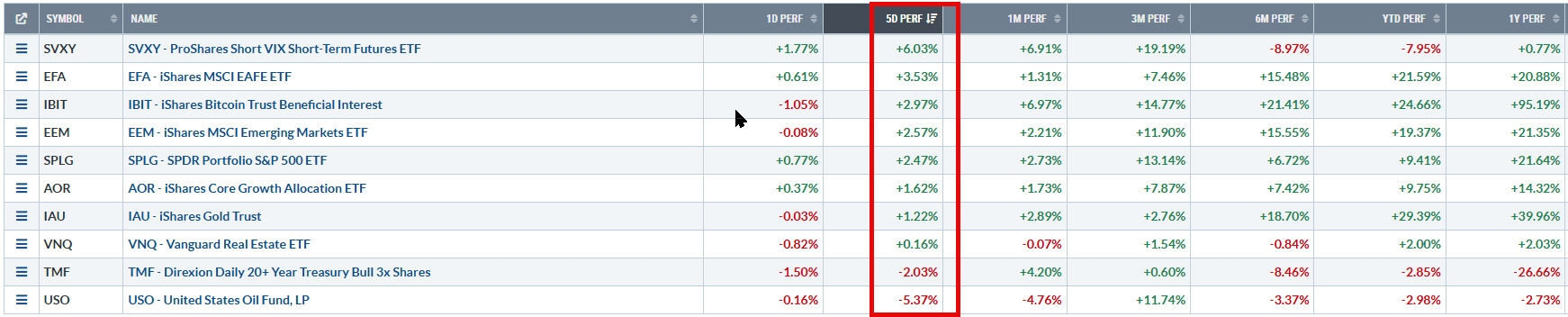 US equities ended in the center of the pack being outperformed by other global equity markets (EFA and EEM). Commodities (Oil) and Bonds were the weakest asset classes.
On Monday I reduced my position in VNQ, that has been treading water for a while, by selling 60 shares and leaving 100 shares that can be hedged by covered Calls. With weakness in developed markets (EFA) and Oil I also rolled down my short Call Options to lock in profits and generate more credits.
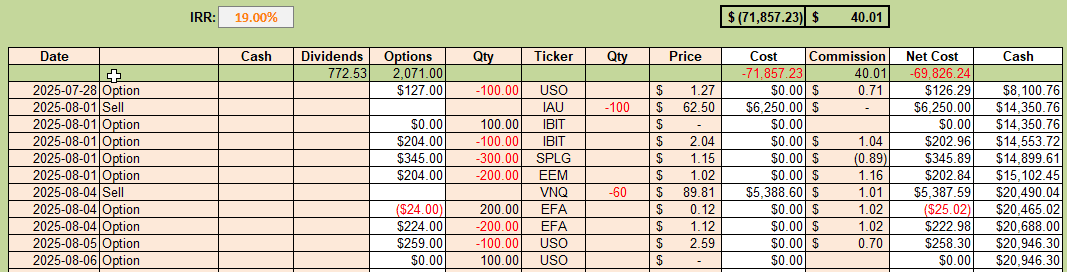 My hedged portfolio positions now look like this:
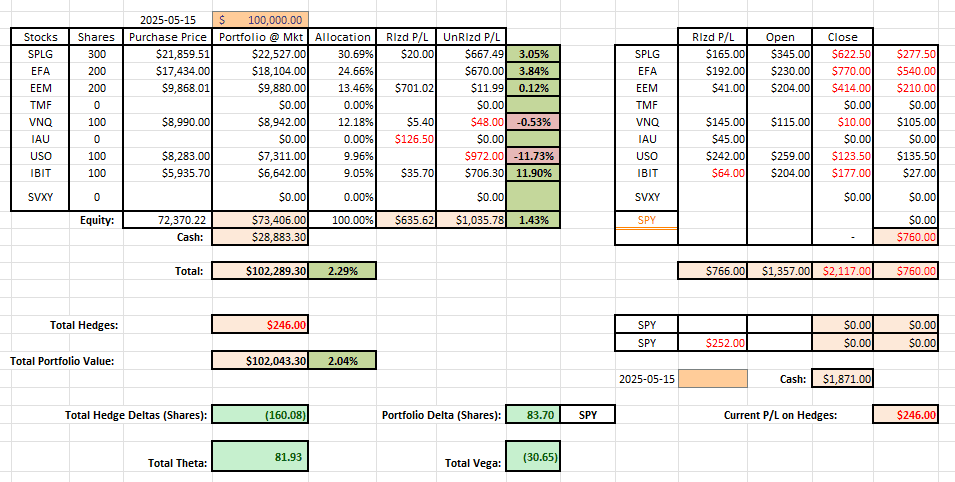 which is heavily over-hedged – minus 160 SPY-equivalent shares from Option hedges versus plus 84 SPY-equivalent shares from the share holdings. However, decay in time value of the Options is generating $82 per day in profits. I also have ~$1,800 in Cash to buy deeper insurance should I need it.
The Option hedges expire next week (15 Aug) so I will be rebalancing at the end of the week. With market strength this past week the hedges have dampened portfolio performance somewhat with Options moving In-The-Money (ITM) and limiting upside potential. Of course, this will benefit us next week should markets pull back. However, if we break through the 6450 barrier I may exit some of the hedge positions earlier than Friday.
Performance to date looks like this:
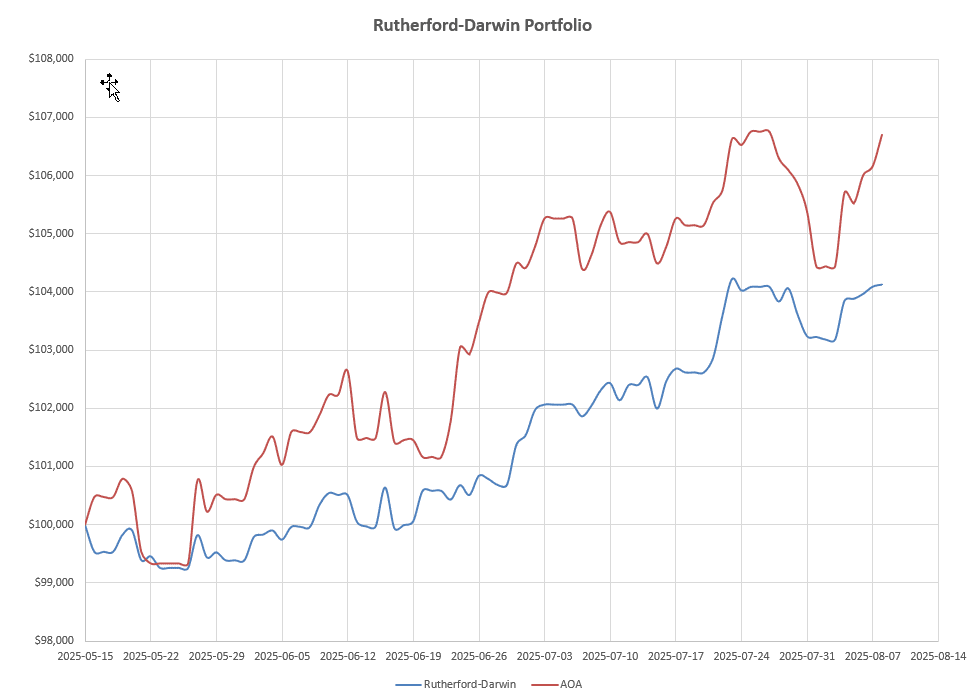
where we can clearly see the flattening of the equity curve resulting from the over hedging. Performance of the portfolio is compared with a 100% investment in the AOA International Aggressive 80/20 Equity/Bond Fund.
The low volatility levels that I have been reporting were worrying me – since they seemed too low – so I checked my spreadsheets and realized that I had been including week-end and holidays where there is obviously a zero daily return. Having corrected this, the revised volatility is slightly higher at 5.01% for the portfolio and 8.52% for the AOA benchmark – so the portfolio is still slightly outperforming the benchmark on a risk-adjusted basis – Sharpe ratio of 3.8 for the portfolio vs 3.0 for the benchmark Fund.
If we check the rankings and recommendations from the Kipling workbook we see the following:
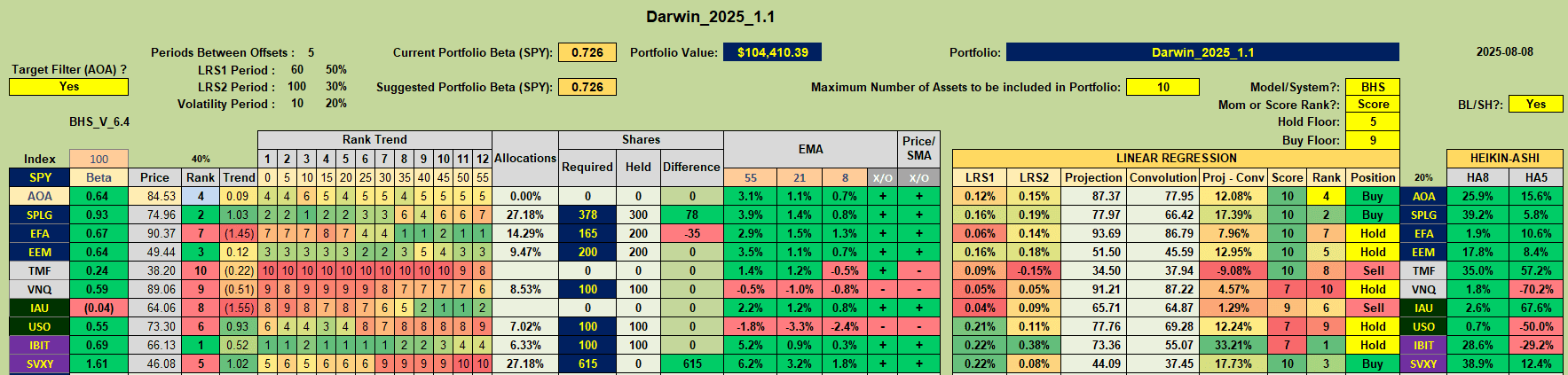 with Buy recommendations for SPLG (US Equities) and SVXY (Inverse Volatility), Sell recommendations for TMF (Bonds) and IAU (Gold) and Hold recommendations for everything else. Despite the Buy recommendation for SVXY I am reluctant to buy into this right now since it is an inverse ETF (benefiting when volatility drops) at a time when volatility is already relatively low – the expectation would be that volatility is more likely to rise going forward (that would likely be the case in a pullback) than to fall further. Volatility is far more predictable than stock prices.
Calculated allocations for risk parity and 2% targeted volatility for each ETF currently look like this:
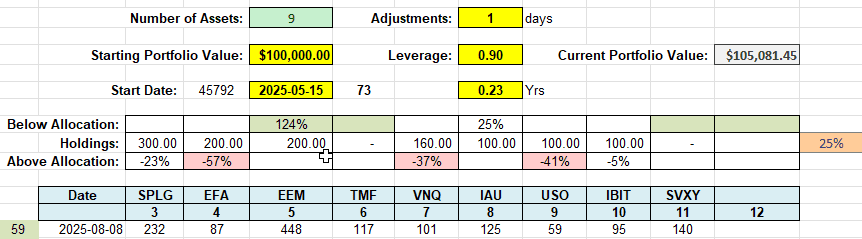 with the holdings for the over-allocated assets being effectively reduced as a result of the covering from Call Option sales:
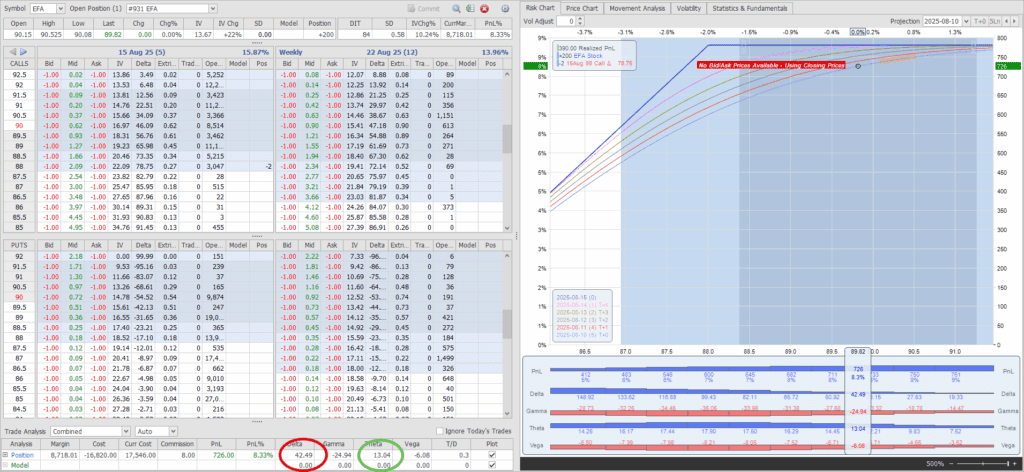 The sale of the $88 strike Call Options in EFA reduces the equivalent share holding to 42 shares (red Ellipse) – so, actually ~50% below the calculated required holdings rather than ~50% above. These “Delta”/Equivalent share positions are dynamic and move both with price movement and time movement. Should price pull back from here the Delta/Equivalent share position will increase. EFA is presently also earning ~$13 per day in time decay (Green Ellipse).
Discover more from ITA Wealth Management
Subscribe to get the latest posts sent to your email.
Leave a Comment or Question