
Canby scarecrow
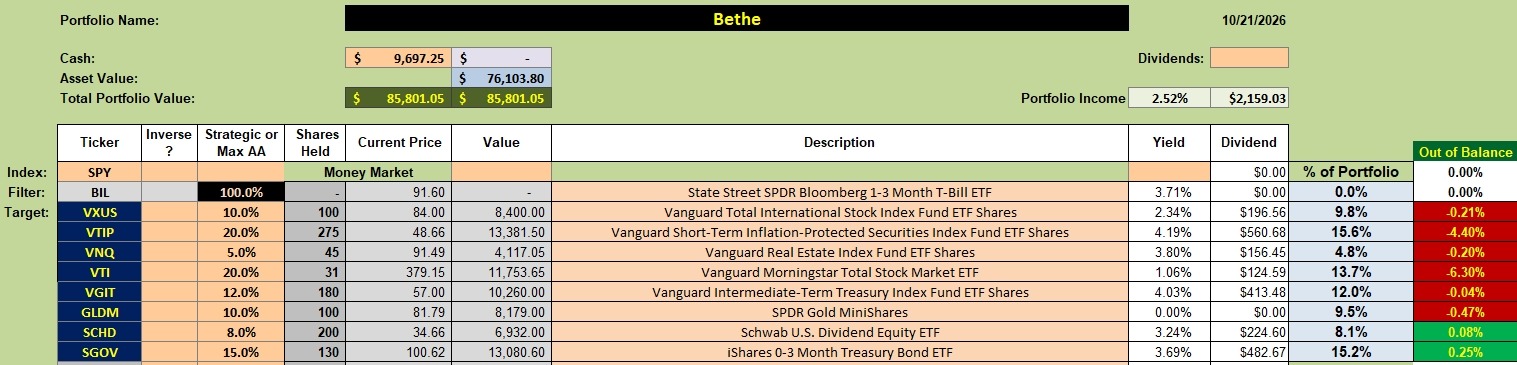
The Bethe portfolio is rounding into shape based on the recommendations laid out at the bottom of this post. One change from the ChatGPT recommendation is that I am holding on to a 5% share or asset allocation of Real Estate (VNQ).
Bethe Asset Allocation Holdings
Below is the simplified holdings for the Bethe portfolio. VTIP and VTI are still well below the “in balance” percentages. Since VTIP is an income generator, I want to bring that ETF into balance as soon as possible.
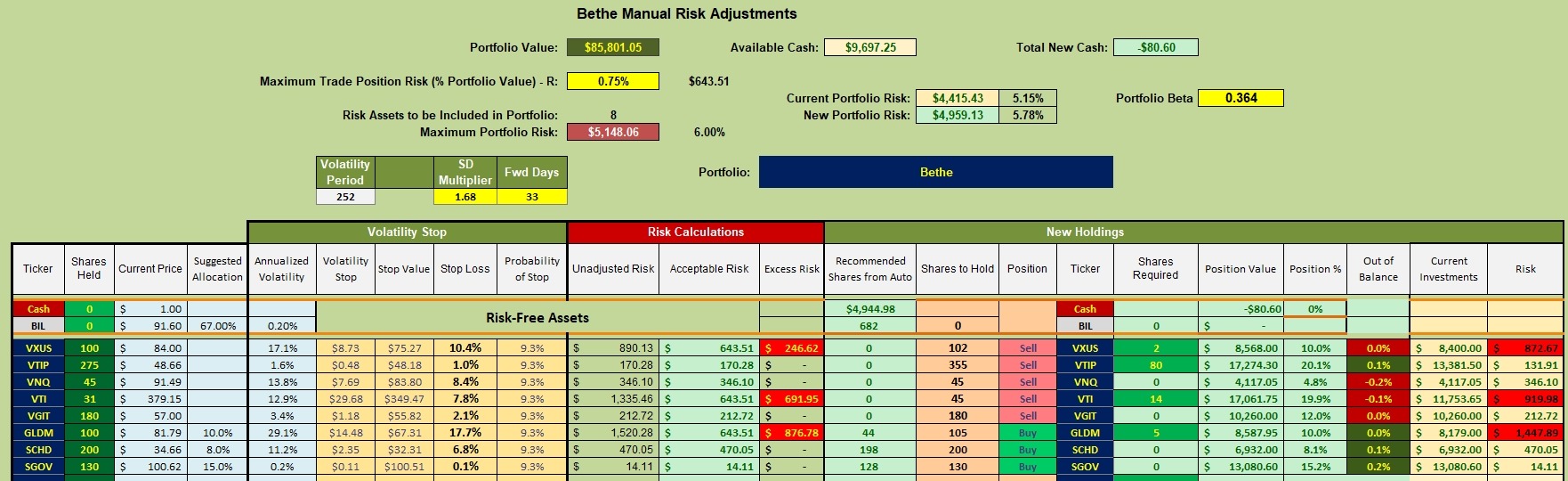
Bethe Rebalancing Recommendations
Limit orders are in place to add more shares of VXUS, VTIP, VTI, and GLDM. Limit prices are close to the current prices so several of these orders should be struck before the November review.
Bethe Performance Data
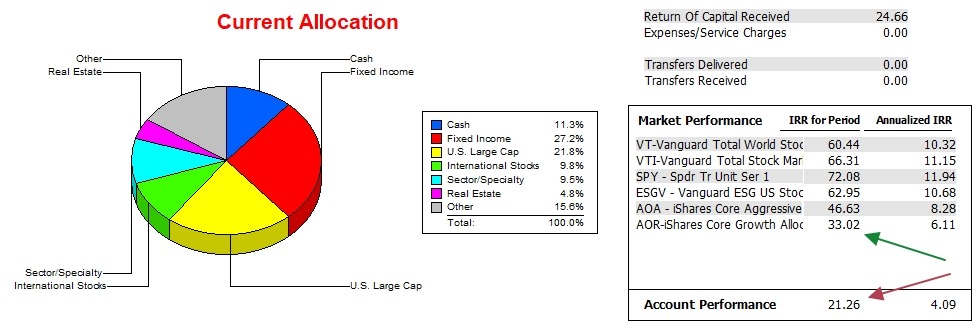
Bethe continues to lag all benchmarks. Future growth depends a great deal on what kind of correction is in the future. Yesterday I came across an analysis of how markets perform following a mid-term election. Going back to 1950, the market, following mid-term elections goes up by an average of over 15% the following year. Will 2027 follow this trend or will we see a divergence from the average? What this study did not incorporate was the value of the Shiller CAPE and Buffett Indicator after a mid-term election.
Bethe Risk Ratios
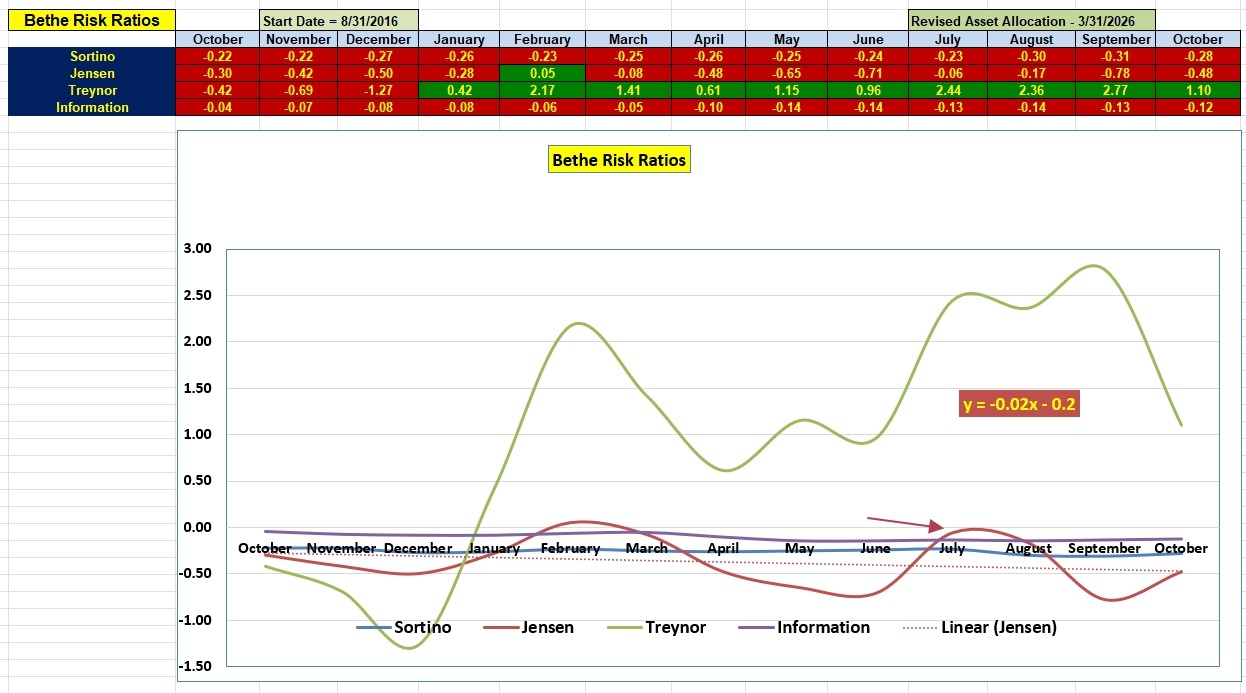
All four risk ratios are lower than they were a year ago with exception of the least important of the four, the Treynor Ratio.
A bit of good news is that the Jensen Performance Index and the Information Ratios are both higher than they were in September. One month does not make a trend so we need to watch how these two risk values perform over the next several months.
I asked ChatGPT to analyze the above portfolio (using the old asset allocation mix) and make recommendations to improve the asset allocation setup. Here is the response from ChatGPT. I already made several changes to the portfolio based on the following recommendations.
Bethe Portfolio Analysis: September 25, 2026
Objective: Improve the Bethe Portfolio’s asset allocation using low-cost ETFs to prepare for a potentially overvalued stock market, a severe market correction or recession, and financial repression.
My conclusion is that the Bethe Portfolio already has several good defensive characteristics. However, I would improve the balance between dividend-paying stocks, inflation protection, short-term Treasury securities, and longer-term growth assets. I would also reduce the portfolio’s dependence on overlapping U.S. dividend ETFs and establish a more deliberate strategy for protecting purchasing power.
The recommendations below use the holdings reported by ITA Wealth Management on September 25, 2026, rather than assuming the portfolio has changed since that date.
1. What the September 25 portfolio looks like
The September 25 Bethe Portfolio review reports an 11-ETF allocation, with cash held separately. The portfolio’s stated annualized income yield was approximately 3.13%, and its reported market beta was 0.368.
Reported allocation targets and approximate actual weights on September 25, 2026
| ETF | Investment role | Target | Actual |
|---|---|---|---|
| VXUS | International stocks | 20% | 19.2% |
| VGSH | Short-term Treasuries | 10% | 10.1% |
| VTIP | Short-term TIPS | 20% | 20.2% |
| VTI | Total U.S. stock market | 5% | 0.9% |
| VGIT | Intermediate Treasuries | 5% | 7.7% |
| VYM | High-dividend U.S. stocks | 5% | 4.7% |
| VIG | Dividend-growth U.S. stocks | 10% | 10.0% |
| BIL | 1–3 month Treasury bills | 5% | 5.0% |
| GLDM | Gold | 5% | 1.0% |
| SCHD | U.S. dividend stocks | 10% | 14.6% |
| SCHO | Short-term Treasuries | 5% | 6.1% |
Weights are rounded from the published spreadsheet image. The portfolio’s separate cash balance was approximately $436, or less than 1% of its reported $82,772 total value. Actual weights may differ slightly because of rounding.
The source identifies VTI and GLDM as the two most underweight investments. SCHD is materially overweight, and the stated plan was to rebuild underweight positions using dividends and new cash rather than immediately selling excess SCHD shares.
2. What I would change
VYM, VIG, and SCHD all hold U.S. equities, with some overlap in their underlying companies. They offer different selection strategies, but owning all three at substantial weights does not provide as much diversification as the number of tickers suggests. I would retain VIG and SCHD at modest weights and give VTI a larger role as the core U.S. stock holding.
BIL and VGSH provide liquidity and relatively low interest-rate sensitivity. SCHO has a similar short-term Treasury role, so holding both SCHO and VGSH creates unnecessary duplication. I would consolidate that exposure and retain a dedicated Treasury-bill reserve for spending needs and opportunities after a correction.
VTIP is a useful component because it holds short-term Treasury Inflation-Protected Securities (TIPS). I would retain it, with a smaller additional allocation to broad TIPS through SCHP if appropriate. This provides exposure to inflation-adjusted principal without relying exclusively on nominal Treasury bonds.
GLDM was approximately 1% of the portfolio against a 5% target. Gold can diversify exposure to currencies, real interest rates, and confidence in government finances. I would consider a 7–10% allocation for a portfolio explicitly concerned about financial repression, recognizing that gold can also experience substantial declines and produces no income.
3. Recommended low-cost ETF allocation
I would use the following as a revised strategic allocation for an investor who wants to limit the impact of a severe correction while retaining some long-term growth and income. It is a proposed model, not a reconstruction of the portfolio’s existing target spreadsheet.
Proposed Bethe defensive allocation
11 ETFs · 100% allocated · Designed for capital resilience and purchasing-power protection
Equities
35%
50%
10%
5%
| ETF | Target | Purpose | Approx. expense ratio |
|---|---|---|---|
| VTI | 15% | Broad U.S. equity growth | 0.03% |
| VXUS | 10% | International diversification | 0.05% |
| VIG | 5% | Dividend growth and quality | 0.05% |
| SCHD | 5% | Dividend income and quality | 0.06% |
| VGSH | 10% | Short-term government bonds | 0.03% |
| VGIT | 10% | Intermediate Treasury exposure | 0.03% |
| VTIP | 15% | Short-term inflation protection | 0.03% |
| SCHP | 5% | Broader TIPS exposure | 0.03% |
| BIL | 10% | Treasury bills and liquidity | 0.14% |
| GLDM | 10% | Gold and monetary-risk diversification | 0.10% |
| VNQ | 5% | Listed real estate exposure | 0.13% |
| Total | 100% |
Expense ratios are approximate reference figures, not verified live quotes. Confirm current prospectuses before trading. GLDM is a gold-backed commodity trust, not an income-producing stock or bond ETF.
The allocation uses low-cost funds for the core holdings and reduces the number of overlapping positions. It also increases the strategic gold weight while retaining international stocks, dividend income, and a meaningful Treasury reserve.
Why these percentages?
-
35% equities: Enough exposure to participate in long-term growth, but less reliance on stock-market returns than a conventional growth portfolio.
-
50% Treasuries and TIPS: A substantial defensive allocation, divided between liquid short-term holdings, intermediate Treasuries, and inflation-linked bonds.
-
10% gold: A deliberate hedge against some monetary and currency risks, rather than an attempt to predict gold prices.
-
5% real estate: Exposure to property-related income and assets, while recognizing that REITs can fall sharply in a stock-market selloff.
The weighted expense ratio of this proposed mix is approximately 0.06% annually, based on the approximate figures above. Actual costs can change, and transaction costs, taxes, and fund tracking differences are separate considerations.
4. How the proposed allocation addresses financial repression
Financial repression generally refers to policies that keep government borrowing costs artificially low relative to inflation, often through regulation, monetary policy, or captive demand for government debt. If inflation exceeds the yield on nominal bonds, the purchasing power of those bond holdings declines.
| Risk scenario | Potential portfolio protection | Important limitation |
|---|---|---|
| Severe equity correction | Treasury bills, Treasuries, and a lower equity allocation | Gold and real estate can also fall; Treasuries do not guarantee a gain |
| Persistent inflation | VTIP, SCHP, gold, real estate, and equities | TIPS adjust to inflation with a lag and can lose market value when real yields rise |
| Low real yields on government debt | Gold, international equities, and real assets | None provides a guaranteed hedge against government policy |
| Recession and falling interest rates | Treasuries and high-quality dividend-paying businesses | Intermediate Treasuries are more sensitive to interest-rate changes than Treasury bills |
| A prolonged bull market | VTI, VXUS, VIG, and SCHD | A defensive portfolio will likely lag a stock-heavy benchmark in strong equity markets |
The key point is that no single ETF protects against every form of financial repression. Short-term Treasury bills help preserve liquidity and limit interest-rate risk, but they can still lose purchasing power after inflation and taxes. Gold may help diversify monetary risks, but its price is volatile and it generates no cash flow.
5. How I would implement the changes
I would not immediately liquidate the existing portfolio simply to match the proposed percentages. The September 25 review already identifies an orderly process of rebuilding underweight positions with dividends and new cash.
-
Stop adding to the overweight SCHD position. Direct dividends and new deposits to underweight target allocations rather than automatically reinvesting them in SCHD.
-
Bring GLDM toward its new strategic target gradually. If adopting the proposed allocation, the target is 10%, rather than the existing 5%. Make the change according to the owner’s tolerance for gold volatility and the tax consequences of funding it.
-
Restore VTI in stages. Its reported weight was substantially below target. Rather than trying to predict the market’s exact peak, consider a predetermined schedule for purchases.
-
Consolidate redundant short-term Treasury exposure. Decide whether VGSH and BIL adequately meet the portfolio’s needs, then reduce or eliminate SCHO if there is no distinct reason to keep it.
-
Review the stock/bond balance annually or when allocations breach predetermined bands. Rebalance based on the plan, not solely on a forecast that a correction is imminent.
Before making taxable sales, the owner should check unrealized gains and losses, distribution schedules, and any cash withdrawals needed over the next several years. Those considerations can make gradual rebalancing more appropriate than an immediate overhaul.
6. What I would monitor to judge success
ITA reports that Bethe has lagged its AOR benchmark since December 31, 2021, and notes that withdrawals for personal needs affected its performance. The September review also identifies improvement in the Treynor and Information Ratios.
I would evaluate the revised portfolio using:
-
Maximum drawdown: How far the portfolio falls from a prior peak.
-
Sortino ratio: How well returns compensate for downside volatility.
-
Jensen’s alpha: Whether returns exceed what would be expected for the portfolio’s market risk.
-
Real return: Performance after inflation, especially important in a financial-repression scenario.
-
Income sustainability: Whether dividends, interest, and other distributions adequately support planned withdrawals.
A comparison with AOR alone is not enough. AOR is a balanced stock-and-bond fund, whereas this proposed allocation includes a larger emphasis on inflation protection and gold. I would compare the portfolio against an appropriate blended benchmark as well.
Final recommendation
I would retain the Bethe Portfolio’s conservative philosophy but simplify its overlapping stock and Treasury positions, restore a meaningful allocation to broad U.S. equities, and increase gold to a deliberate strategic weight. The proposed 35% equity, 50% Treasury/TIPS, 10% gold, and 5% real estate mix is a reasonable starting point for an investor prioritizing resilience over maximum returns.
One important qualification: this is a defensive allocation, not a guarantee against losses. Its success should be judged by drawdown control, inflation-adjusted returns, and the ability to fund withdrawals—not solely by whether it beats the S&P 500 in the next correction.
Discover more from ITA Wealth Management
Subscribe to get the latest posts sent to your email.
Here is the link as to how the market performs after mid-term elections.
Lowell
https://www.youtube.com/watch?v=LaBiYw1ZKF4