
Spring at the Wooden Shoe Tulip Farm.
Bohr is the portfolio scheduled for review today. Some alterations are planned for this account so pay attention as I walk through what I see as some ways to “heal” or strengthen apparent weaknesses that are likely to arise in the Sector BPI model. The plan is to make similar changes to the Bethe portfolio as the Bohr and Bethe are similar portfolios.
One major change in the Bohr is to add the eleven sector ETFs to the investment quiver.
Bohr Main Menu
Within the Kipling spreadsheet is the Main Menu worksheet. Note that I am using a one-year or 252 trading days look-back period. The goal is to reduce portfolio churning.
One addition to the Main Menu is what I call the Volatility Coefficient. This variable is added so one can easily adjust the percentage allocation to the sector ETFs. The goal is to adjust the Volatility Coefficient so the highest percentage to invest in any given sector ETF is 25%.

Bohr Investment Quiver and Holdings
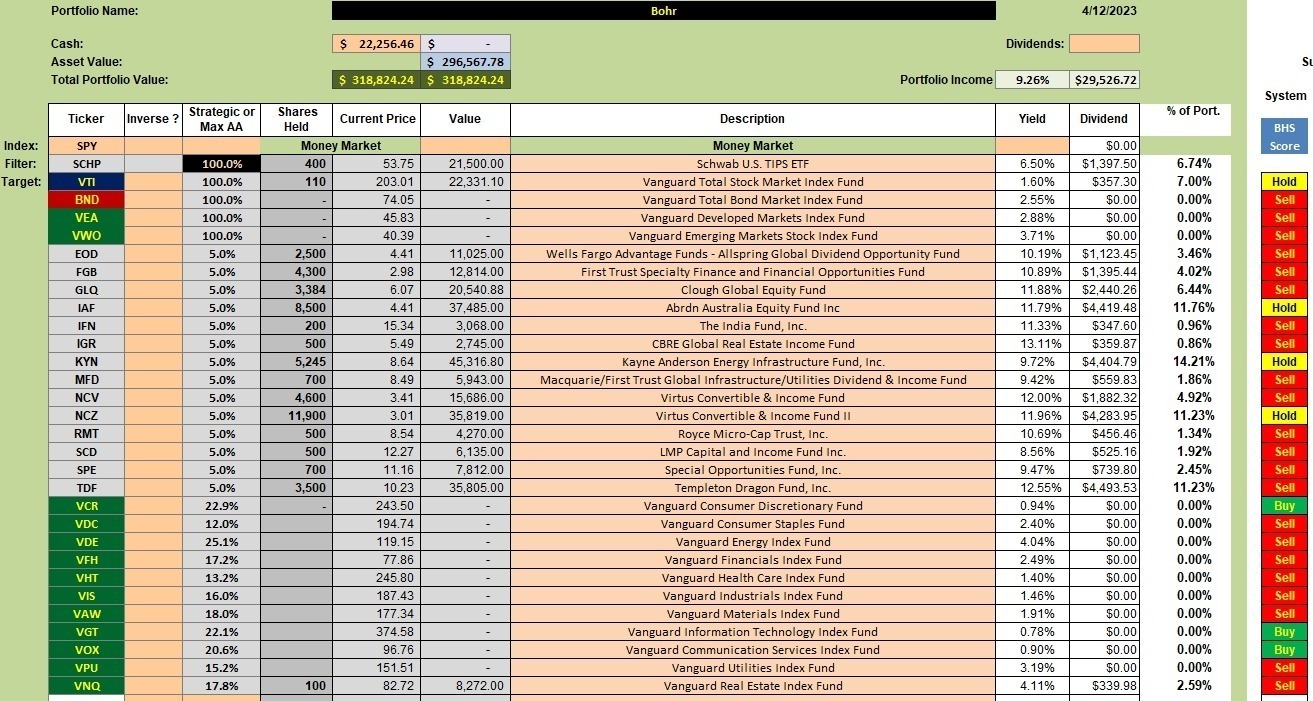
Below is the expanded version of the Bohr investment quiver. The portfolio now has the capacity to operate three ways. 1) As a Dual Momentum™ style portfolio. 2) As a Sector BPI portfolio. 3) As an income oriented portfolio.
Bohr Security Recommendations
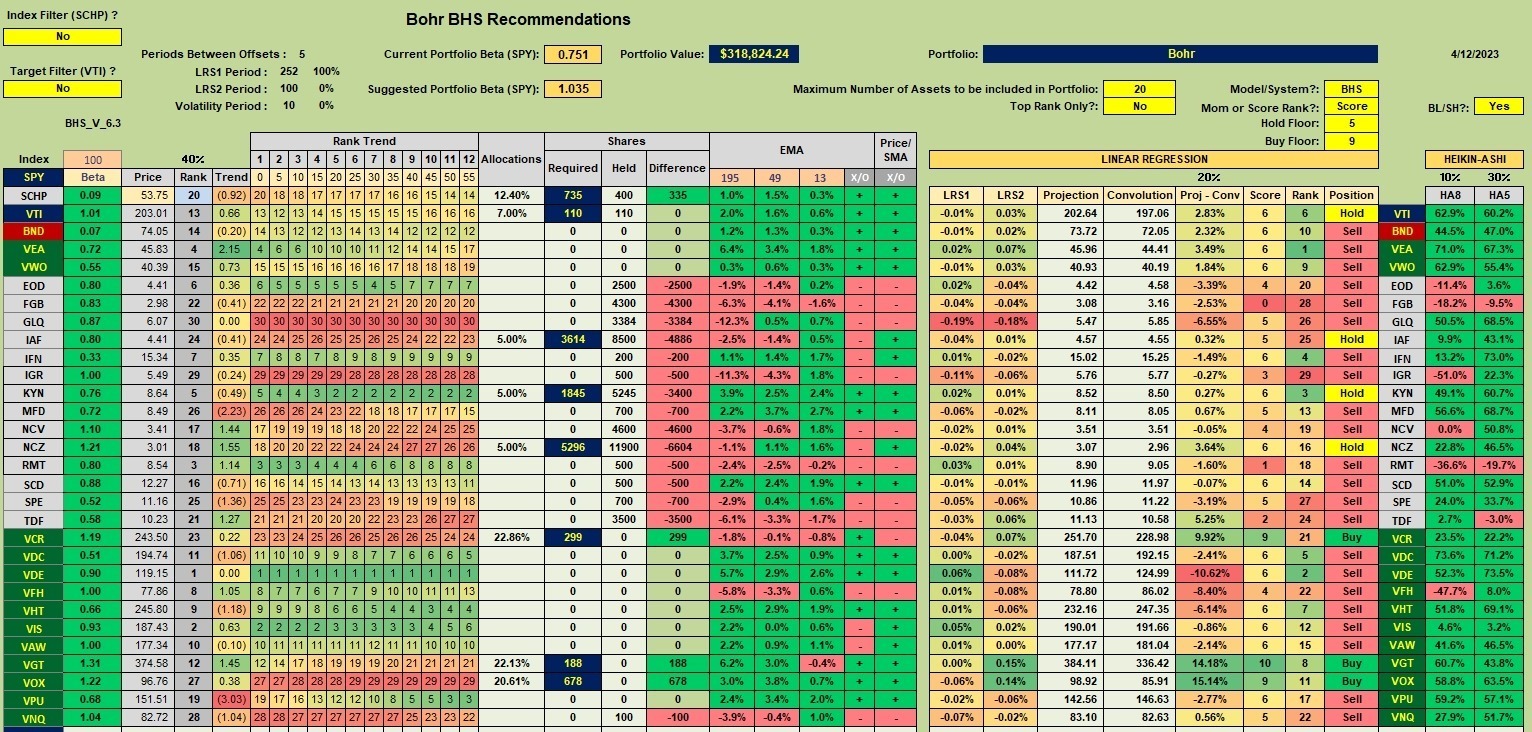
With the investing model set to BHS, look-back period adjusted to 252 trading days, and the maximum number of assets set to 20, we first find that VTI is set to Hold. The Bohr currently holds 110 shares so that position will not change.
Currently, no sectors are recommended as a Buy based on BPI recommendations. The 100 shares held in VNQ is a holdover from the past investing model so that holding will not change. Therefore, most of the portfolio is invested in income securities or Closed-End-Funds (CEFs).
Bohr Manual Risk Adjustments
How do I intend to manage the Bohr?
- If one or more of the eleven (11) sectors calls for a purchase, I will fill those requirements first. If funds are not available to fill the Sector BPI requirements I’ll sell shares of one or more of the CEFs. In other words, first priority is to implement the Sector BPI model.
- Next in hierarchy is to populate VTI, VEA, VWO, or BND based on recommendations that come out of the BHS investing model. This provides an escape valve or covers an apparent weakness to the Sector BPI model.
- Last is to hold available cash in several income oriented CEFs. I’m currently holding 14 CEFs, but plan to eventually reduce that number to 10.
Using the above logic, the current plan is the following. The Sector BPI model is not recommending any purchases so no action there. Likewise there is no call to add shares to VTI, VEA, VWO or BND. So we move to the third level or the income oriented CEFs. Available cash will be used to set limit orders to pick up additional shares of high quality CEFs.
While we wait for buy orders to show up within the Sector BPI and/or Dual Momentum models, we will collect dividends from the CEFs.

Bohr Performance Data
This is a good time to begin this fresh approach as the annualized Internal Rate of Return (IRR) for the Bohr is nearly identical to the S&P 500 (SPY). The following data includes information going back to 12/31/2021.

Bohr Risk Ratios
As a Growth-Income oriented portfolio the Bohr has been loosing ground as one can see by examining the Jensen Alpha and Information Ratio. Rather than stand still, I am moving forward with the adjustments described above. The hope and plan is for the sector ETFs to provide growth when the market moves up, but if the situation arises where the sector ETFs back off the overbought zone and the market then continues higher, the BHS investing model will have us moving back into the market through either equities such as VTI or available CEFs.

ITA Portfolios: Summarizing Investing Approaches
New Carson Launched: 4 November 2022
Readers: If you have Questions or Comments, post them in the Comment section provided.
If interested in learning more about the Sector BPI model, check out this link or do a Search for Sector BPI on this blog.
Discover more from ITA Wealth Management
Subscribe to get the latest posts sent to your email.
Hello Lowell,
Can you please share the basis for choosing the particular set of 14 CEFs that you are now using in this and other similarly managed BPI portfolios? Thanks. -Martin
Martin,
I use CEF Connect as my source of information. I’m seeking CEFs that generate a minimum of 8% yield. Many are higher than the 8% cutoff. The second criteria is to look for CEFs that are priced below their Net Asset Value.
If I have a CEF already in the portfolio and it increases in value so it might now be priced above its NAV, yet is throwing off a yield of 12% or 13%, I will likely keep it.
Lowell