
Photo made in San Luis Obispo
Bohr is a Buy and Hold style portfolio where the investment quiver is made up of a group of ETFs designed to produce growth and another group of Closed-End-Funds set up to produce income. Think of the Bohr as a blend style portfolio. The Bethe is a similar style portfolio.
Don’t miss the article referenced in the very last line of this blog post.
Here is the workflow I use when reviewing the Bohr.
- Open up the broker account and the Investment Account Manager (IAM) software.
- Record all transactions that show up in the broker account and record those transactions in the IAM database. Make sure the cash accounts match and number of shares in the various securities match. The IAM data must align with the broker statement.
- Open up the Bohr spreadsheet using the Kipling program.
- Match the cash in the Bohr spreadsheet with the cash in the broker account.
- Match the shares in the various securities match the broker account. The Bohr SS must match the broker statement.
- Update the Risk Ratios worksheet in the Bohr spreadsheet.
Bohr Investment Quiver
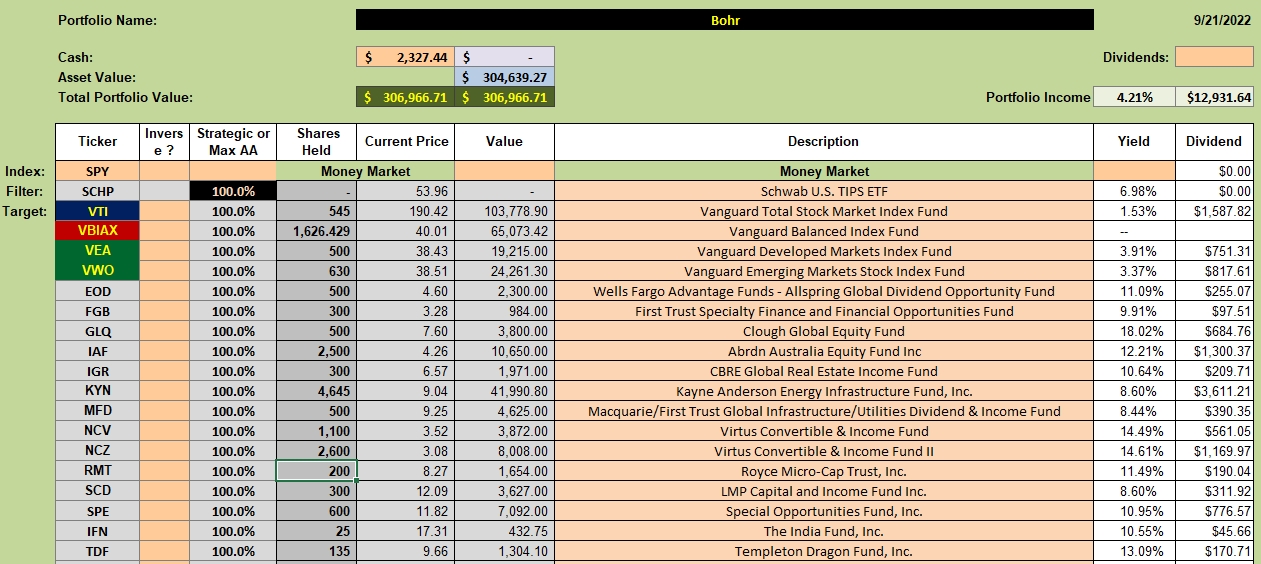
Below is the Bohr investment quiver and the shares held in the various ETFs and CEFs. Since we are near the end of the third quarter I plan no changes. After the third quarter dividends are distributed I’ll run a check on the CEFs to make sure each is yielding at least 8% and the Net Asset Value (NAV) is negative. A negative NAV is when the going price of the CEFs is below the actual value of the stocks held within the CEF.
Once more, I use CEF Connect as my CEF data source.
The current structure of the Bohr is to hold U.S. Equities (VTI), Developed International Equities (VEA), a balanced fund (VBIAX), and Emerging Market Equities (VWO). The securities with the gray background are CEFs and these investments are designed to generate income. Based on Yahoo data, all CEFs are currently yielding 8.0% or higher. Those yields can be checked or confirmed on the CEF Connect site.
Bohr Security Recommendations
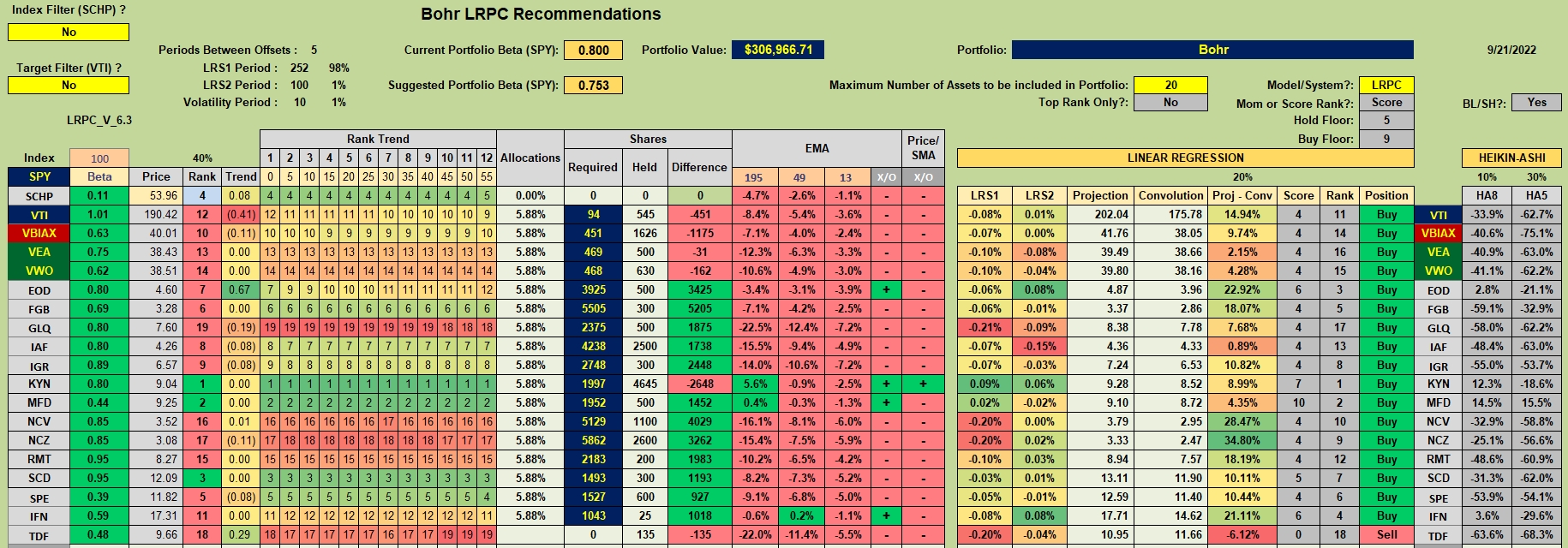
Using the LRPC model and the VTI Target Filter turned off, there are buying opportunities when the look-back period is set to one-year or 252 business days. There is an error in the spreadsheet as TDF is not recording data. I’ve asked the developer of the SS to fix this problem. Just assume TDF is also a Buy.
Bohr Manual Risk Adjustments
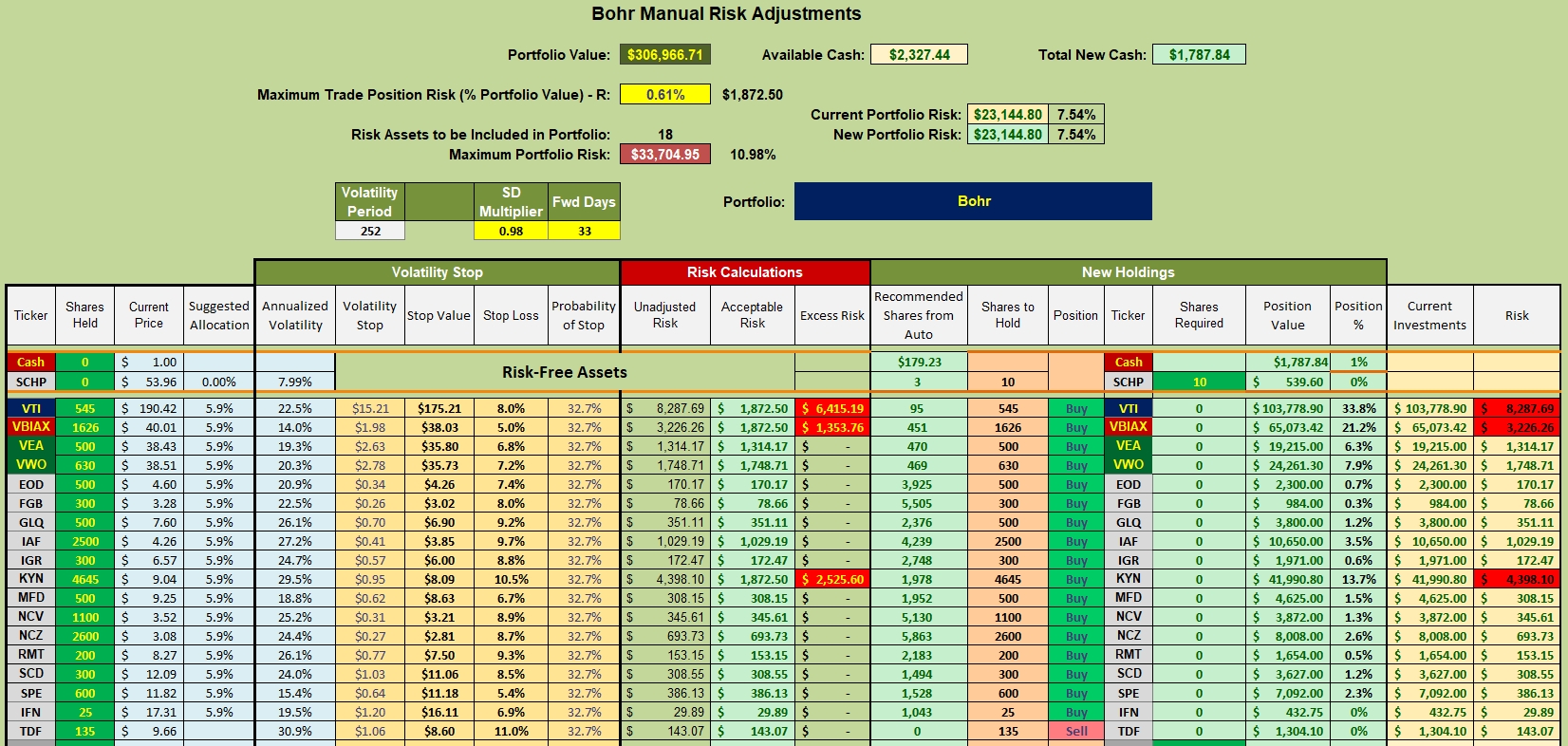
The only decision is whether or not to pick up a few shares of SCHP or leave the money in the Money Market. No other changes are planned for the Bohr this month.
A complete review of the Bohr will take place after the third quarter dividends are declared.
Bohr Performance Data
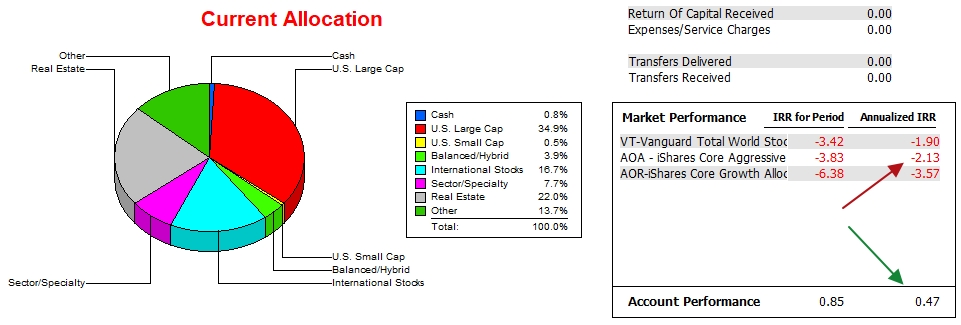
Since 11/30/2020 the Bohr is barely scraping out a positive IRR. The good news is that the Bohr is besting all the benchmarks by a significant percentage. This data shows just how hard the market has been in 2022 as 2021 was a stellar years for stocks.
Bohr Risk Ratios
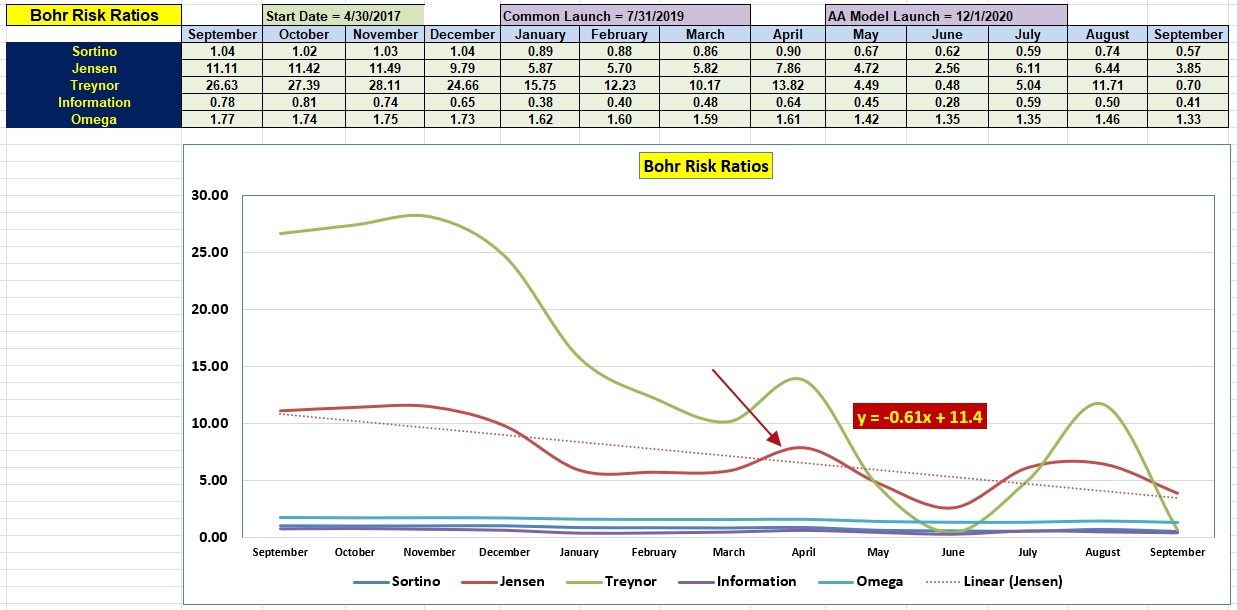
Over the past year the Jensen Alpha (frequently known as the Jensen Performance Index) declined in value. The good news is that it is still positive and a value of 3.85 is quite good. It just is not up to the same level it was back in the fall of 2021.
The Bohr will now go into “neglect” mode until the third quarter dividends become available for reinvestment.
The Argument for Self-Management
Check out this link if you are looking for a winning strategy. This is essentially the same strategy as used with the Copernicus.
Discover more from ITA Wealth Management
Subscribe to get the latest posts sent to your email.
dear Lowell
thank you for simplifying the steps for a new member from australia [oz]. was trying to read all your posts in date order. am now trying to work bottom up [inductively] to learn these mechanics. my oz 401Ks taxed and tax free accounts and their ETF restrictions to australian based analogues add a technical headache as they are not brokered. limit orders may be feasible but are another thing I ahve understand in these vehicles which are more cumbersome that using a regular or discount broker in oz. I think I need to understand all the definitions which are relevant for the kipling Spreadsheet SS first, then map the ETFs you use against pure ozzie analogues which my 401Ks [superannuation and pension accounts as they are called]] allow me to use.
then I need to learn the mechanics of your signals in my copy of your SS.
then understand each model from simplest to complex.
I believe the uncertain world macros make investment currently dangerous to get back into stocks.
not market timing but I think the macro is so uncertain on seeking alpha tea leaf readers that I wish to be conservative at 72 years.
I hope to take out a lifetime membership when I learn enough about your models to use them effectively
thank you for your kind help given freely to all who seek it.
Good Morning, Ken,
I understand your reluctance to having excessive exposure to stocks. Erratic individuals such as Putin and Individual-1 are not conducive or provide the comfort equities markets prefer. Regardless of events such as global inflation, stock markets tend to rise over the long run. Here is a possible strategy for those holding excessive cash.
1. Place a limit order for 5% of the cash at 3% to 5% below the current price of the security. For U.S. citizens one might use ETFs such as VOO, SPY, VTI, or ESGV. Each covers much of the U.S. Equities market.
2. Place a second limit order for 10% of the cash at 10% below the current price of VOO as an example.
3. Place a third limit order for 15% of the cash at 12% below the current price of the security of interest.
4. We still have 70% of the cash available so place a fourth limit order for 20% of the remaining cash at 15% below the current price.
5. We still have 50% in cash. Place a fifth limit order and invest 20% of the cash at 20% below the current price.
6. What to do with the last 30%? Place a sixth limit order and invest 1/2 or 15% at 25% below the current price of the security of interest.
7. Place a seventh limit order and invest the last 15% at 30% or 35% below the current price of the security of interest. VOO might be that ETF. While it is unlikely the market will dip much below 20% below its current price, at least one has limit orders in place to buy shares if it does dip this low.
Just a suggestion.
Lowell