
Arches National Park, Utah
In parts 2 and 3 of this series I described how we might manage our core portfolio by either rebalancing to a fixed asset allocation or by adjusting allocations based on changing volatilities. The two options are not complimentary, so we need to choose one or the other.
Which method we use should probably depend on whether we are more focused on returns or on risk.
Let’s start by looking at an equal weighted portfolio of just two assets – 50% equities (VTI) and 50% bonds (TLT) and we’ll use the Buy-And-Hold scenario as our benchmark portfolio:
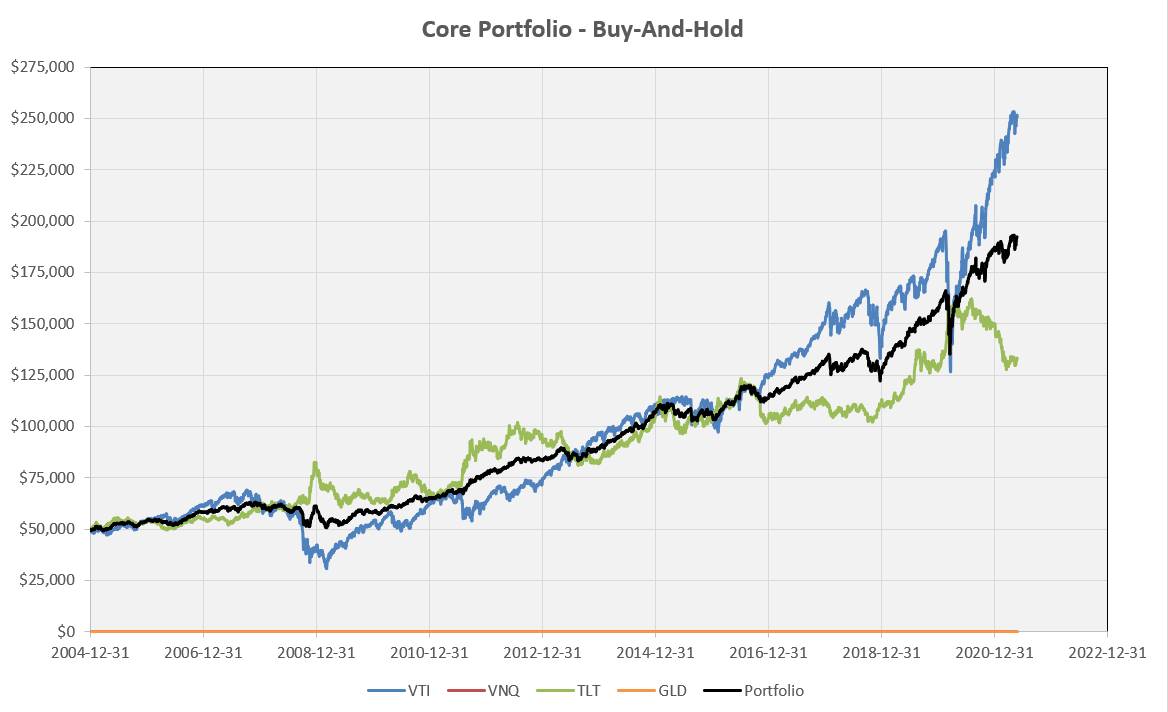
With the following characteristics:
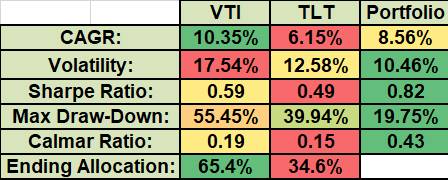
The portfolio generates an 8.56% Compounded Annual Growth Rate – CAGR – (with total returns between the returns of the assets if held individually) but with only 10.46% volatility/risk (below the volatility of each individual asset).
Now, what happens if we adjust this portfolio monthly to bring the portfolio back into a 50/50 balance:
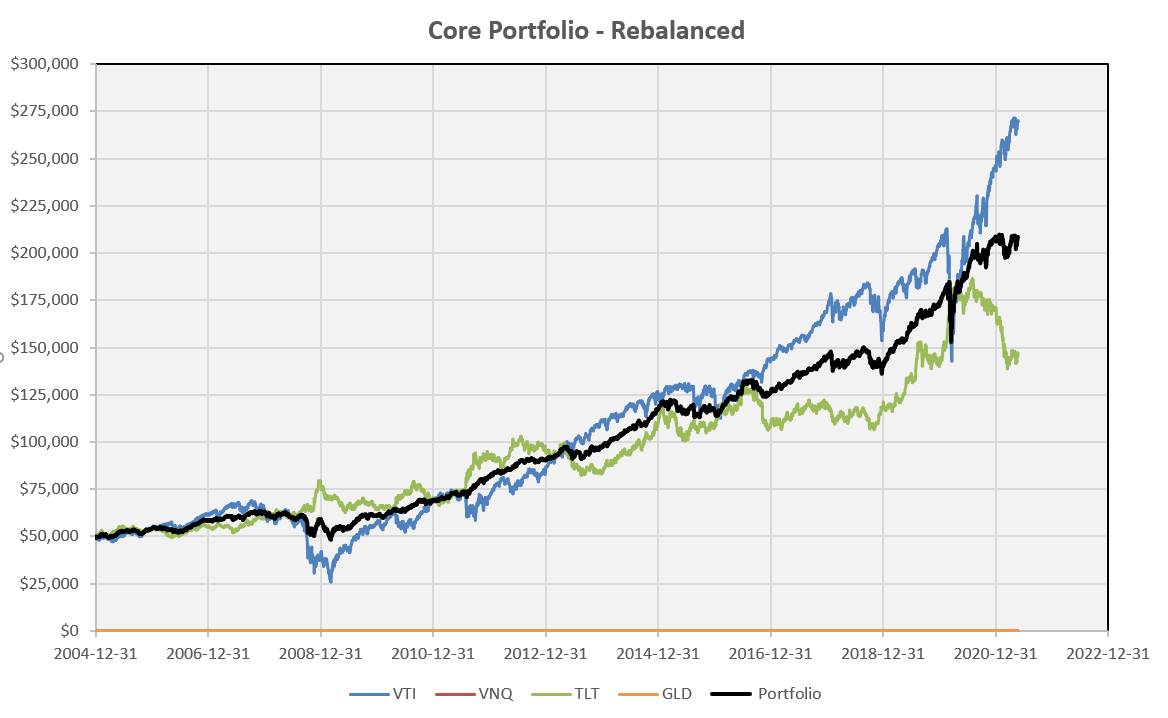
with the following characteristics:
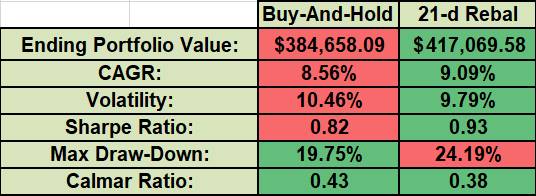
As we saw in part 2, this increases our total return and CAGR and lowers volatility even further, resulting in a higher Sharpe (reward/risk) Ratio.
But, if we were worried about the risk (at ~9.8%) we might choose to set allocations using volatility targets.
By setting 6% volatility targets for each asset, we see the following:
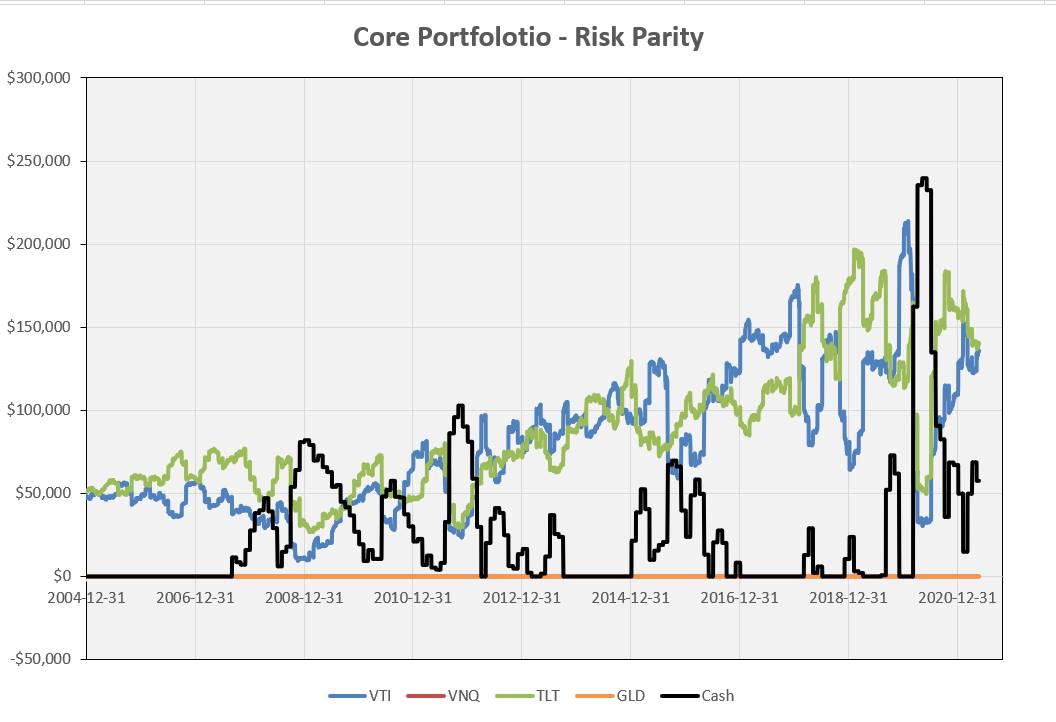
with allocations using this strategy varying between ~10%/30%/60%(Cash) and 60%/40% – with significant allocations to cash throughout the 16-year period:
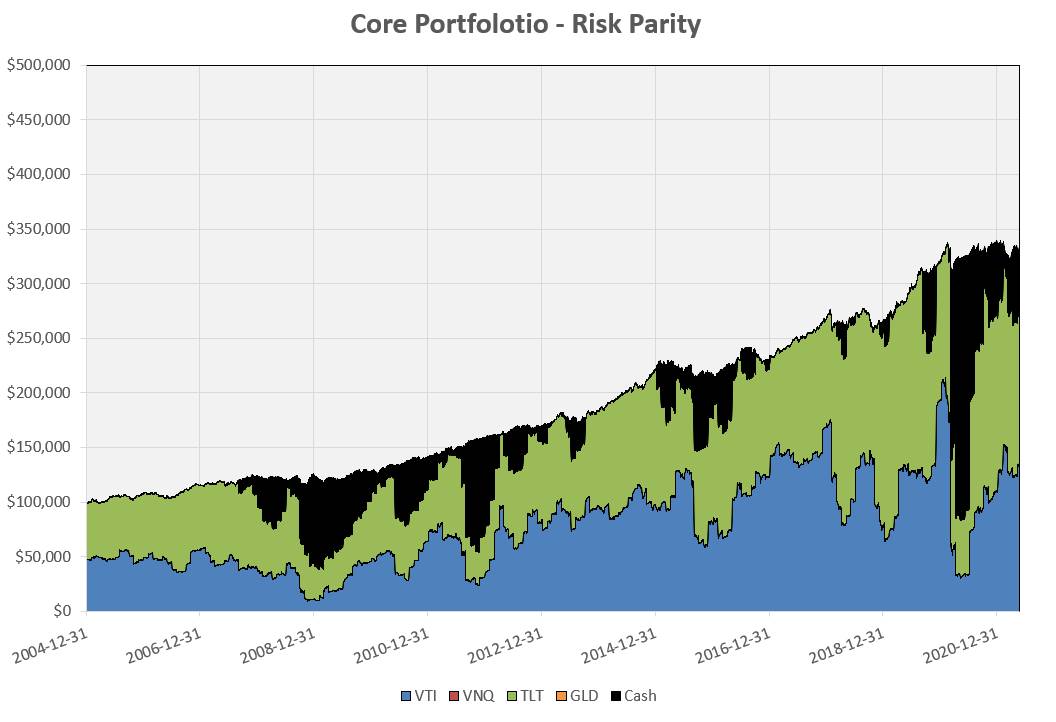
This does reduce risk/volatility:
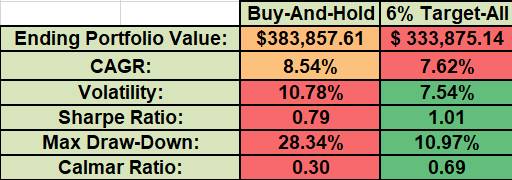
but at the expense of lower returns, even though there is an improvement in risk-adjusted returns (Sharpe Ratio) to 1.01.
So, a risk averse investor needs to balance the pros and cons here.
What about the investor who is more focused on returns and is prepared to accept more risk? Lowell (https://www.portfoliovisualizer.com/backtest-portfolio?s=y&timePeriod=4&startYear=2005&firstMonth=1&endYear=2021&lastMonth=12&calendarAligned=true&includeYTD=true&initialAmount=10000&annualOperation=0&annualAdjustment=0&inflationAdjusted=true&annualPercentage=0.0&frequency=4&rebalanceType=4&absoluteDeviation=5.0&relativeDeviation=25.0&reinvestDividends=true&showYield=false&showFactors=false&factorModel=3&benchmark=-1&benchmarkSymbol=VTHRX&portfolioNames=false&portfolioName1=Portfolio+1&portfolioName2=Portfolio+2&portfolioName3=Portfolio+3&symbol1=VTI&allocation1_1=25&allocation1_2=60&allocation1_3=70&symbol2=VNQ&allocation2_1=25&allocation2_2=15&allocation2_3=15&symbol3=TLT&allocation3_1=25&allocation3_2=20&allocation3_3=10&symbol4=GLD&allocation4_1=25&allocation4_2=5&allocation4_3=5) has suggested allocating more to US equities than to other asset classes – and this is ok if we feel that we can justify it without taking advantage of the fact that (with hindsight) we know that US equities have significantly outperformed other asset classes over the past 16 year period. This would be an example of hindsight bias that is a common weakness of some back-tests. However, if we are looking to rationalize our tilt towards higher allocations to US stocks we might cite the allocations used by Dalio, Swensen, Faber and others in their “classic” portfolios or even just the commonly referenced 60/40 portfolio as popularized by Jack Bogle.
How were these allocations derived? – I really don’t know, but, if I believed in momentum, then I might be tempted to look at historical returns and to make the assumption that this momentum (growth rate) might continue (on average) in the future. Thus with a GAGR of 10.35% for VTI and 6.15% for TLT I might combine them in a ratio of 10.35/(10.35+6.15) = 62.7% to 6.15/(10.35+6.15) = 37.3%, knowing that the low correlations would reduce volatility. Is it just co-incidence that this is close to the “classic” 60/40 portfolio?
If we apply a 60/40 Strategic Asset Allocation (SAA) model to our VTI/TLT portfolio, and rebalance monthly we would see this:
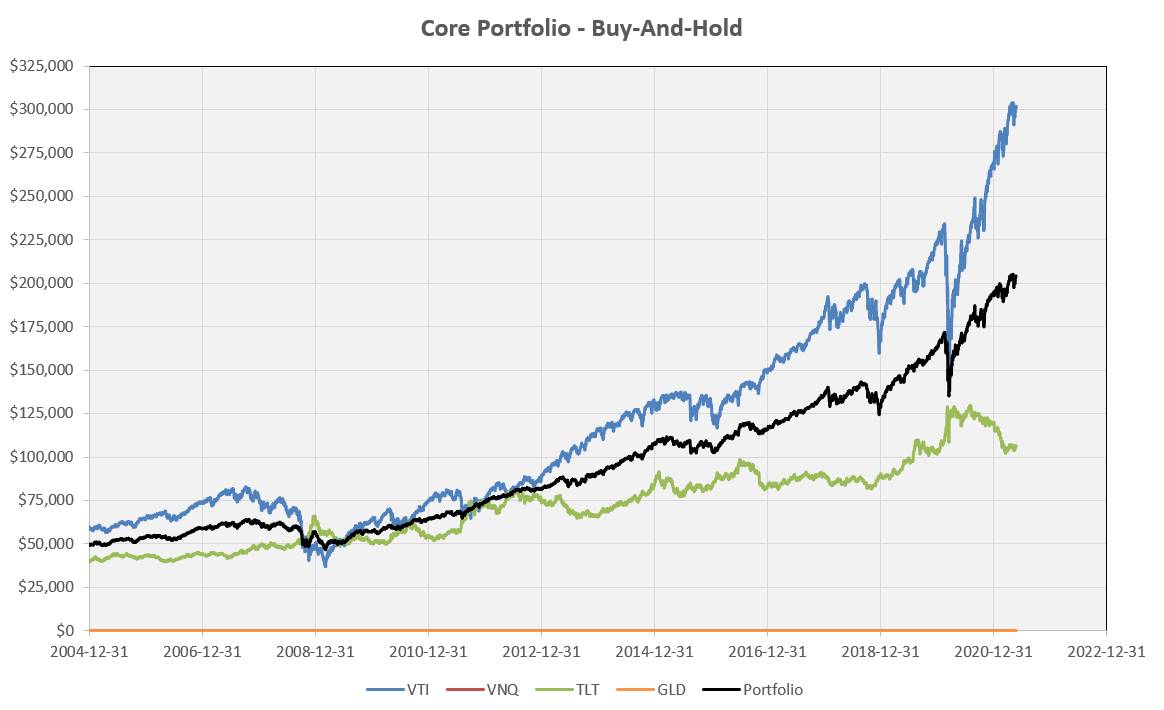
with the following characteristics:
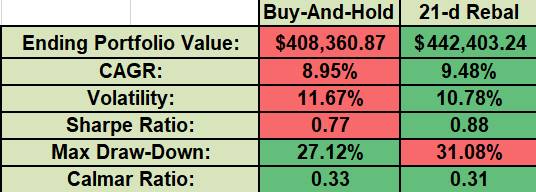
We have pushed up our return performance – but at the expense of higher volatility, lower Sharpe Ratio and larger maximum draw-down.
At the end of the day, we must adopt a management model with which we are comfortable – and this may change over time as we get older and our priorities change.
Update: Apologies, I forgot to add a link to the PDF file for this post – https://www.dropbox.com/s/ri4htusw98zpahe/Constructing%20a%20Core%20Portolio%20Pt4.pdf?dl=0
David
Discover more from ITA Wealth Management
Subscribe to get the latest posts sent to your email.
David,
Are you going to provide a DropBox link to this blog?
~jim
Jim,
Sorry, I forgot to add the link – it’s in the Update at the bottom of the post.
David
David, I have shared this series with a young friend who expressed interest in investing. I believe your effort to be a superb teaching tool for investors of any age.
Thanks,
Richard
Thanks Richard – there is more coming and it gets a little more complex – but for a young investor with a reasonable knowledge of Excel it should be no problem. For those not so comfortable with Excel it might be more of a challenge – but just an appreciation of the options available to us is also useful – at least it helps us keep our expectations realistic.
David
David, The young friend is a recent engineering grad so should have no problem with Excel. The problem he will have is finding time since he enters med school in a few weeks. He loved the series. Richard
Hi David,
I really appreciate your good work and thoughtful posts. Thank you,
Phil