
Abandoned house in Jacksonville, OR
With the U.S. Equities market either making or bumping up against new highs, it behooves investors to consider risk management. Here are a few suggestions as to how I am working to protect capital. To illustrate these suggestions, I begin with a $100,000 portfolio managed using the Kipling spreadsheet and a portfolio similar to many following the Relative Strength model.
While there are many definitions of risk, I’m thinking of protecting capital or not loosing too many dollars to market down turns.
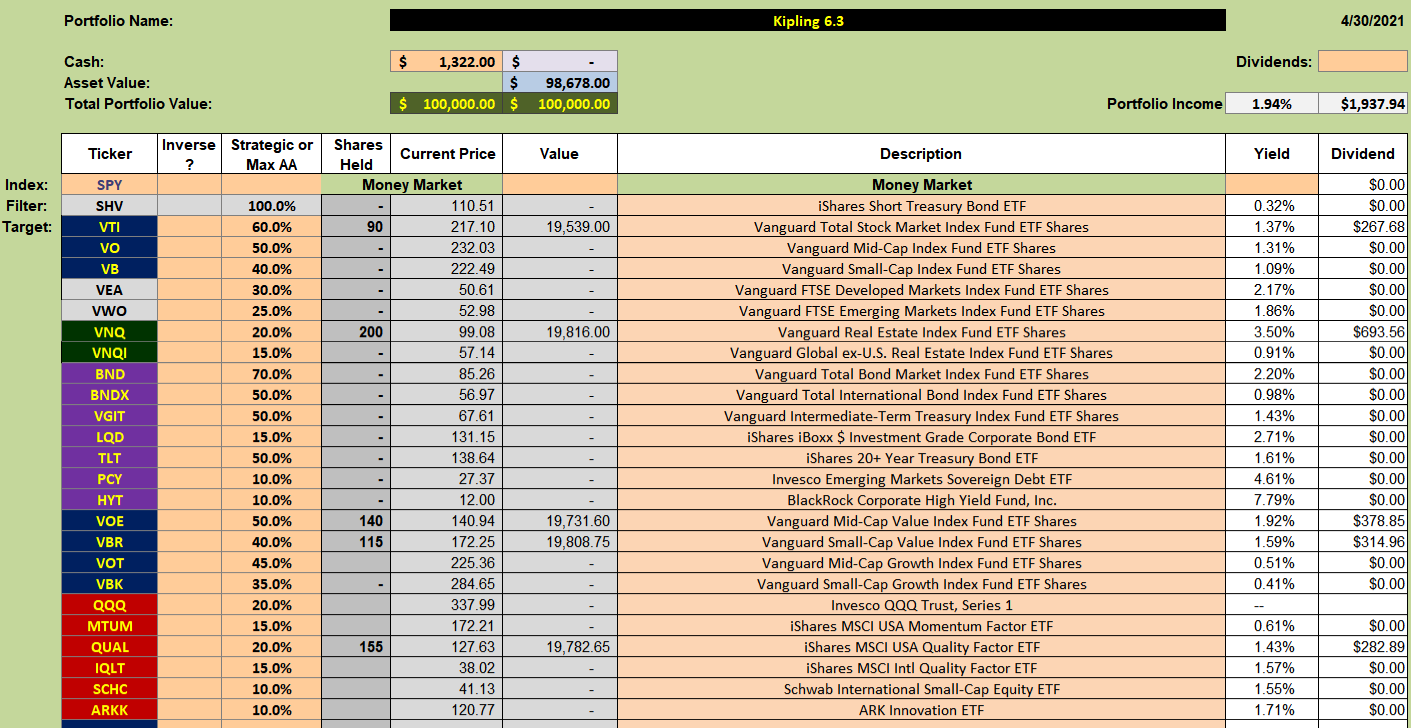
Sample Investment Quiver
The very first risk wall is how one sets up the portfolio. What ETFs are you using to construct the portfolio? By diversifying through the use of ETF and/or mutual funds, one modifies portfolio risk.
In the following portfolio the logic for what investment arrows to place in the quiver is based on the principles of asset allocation and factor modeling. The portfolio takes into consideration value, size, momentum, and quality. Those are four major factors. Bonds also play a role for periods when equities are out of favor.
With an investment quiver such as shown below, there is a high probability one will be invested in hundreds if not thousands of individual stocks. A few companies going out of business will not impact this portfolio to any significant degree.
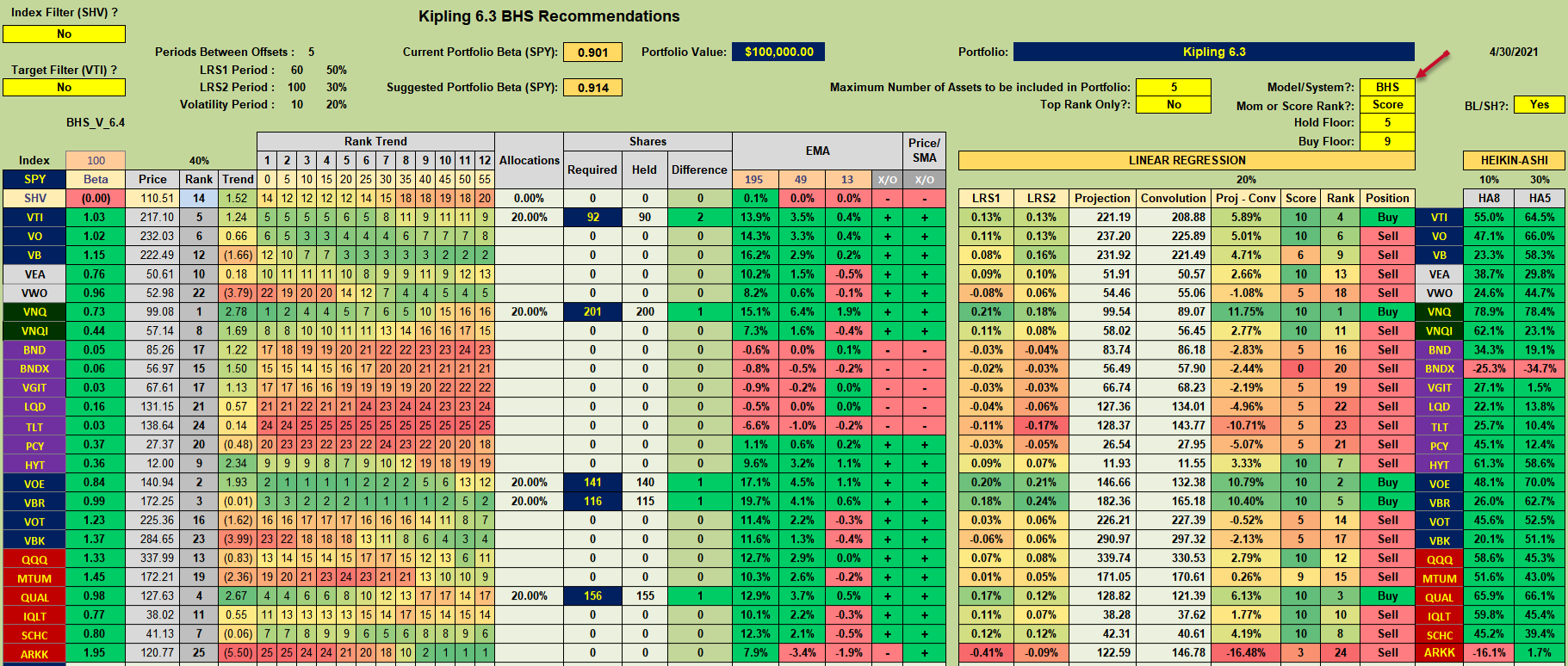
Sample Recommendations
Now we begin the second level of risk refinement by using a momentum model. In this example I select the BHS model or one that is quite familiar to ITA readers. The maximum number of assets is set to five (5). If one wants to pull down risk, just increase the number of assets.
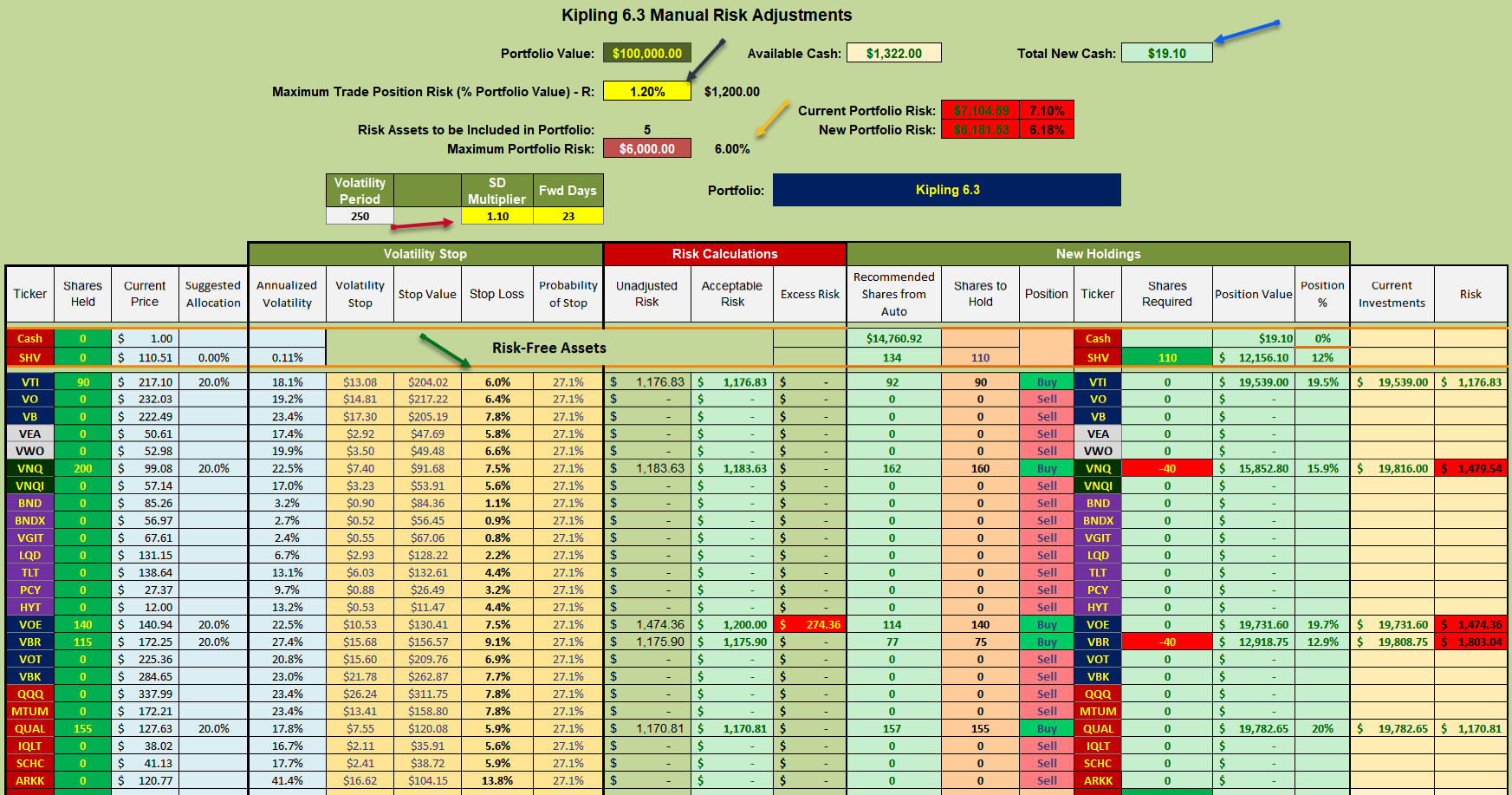
Sample Manual Risk Management Variables
The following worksheet extracted from the Kipling spreadsheet is where the money manager begins to hone risk controls.
- Adjust the SD Multiplier so the Stop Loss for VTI meets your level of risk. With this high stock market I set it to 1.1 so the Stop Loss for VTI is 6.0%. I rarely will go higher than 8.0% for the VTI Stop Loss setting.
- Move up to the Maximum Trade Position Risk – R percentage. In this example I set it to 1.2 so the Maximum Portfolio Risk is no higher than 6.0%. With these setting you will note the shares to be invested in SHV come to 110 shares. Had I increased the overall Portfolio Risk percentage, fewer shares would go to SHV and more shares to the equity recommendations such as VTI, VNQ, VOE, VBR, and QUAL.
- The last major risk control is to set stop loss orders. I prefer using Trailing Stop Loss Orders (TSLOs).
- For example, set a TSLO of 6.0% for VTI shares.
- Set a TSLO of 7.5% for all shares of VNQ. If the broker will not permit factional percentages, then round to the nearest percentage.
- Follow through with TSLOs for VOE, VBR, and QUAL.
Using these different risk controls, one is able to avoid major market draw-downs and protect capital.
Discover more from ITA Wealth Management
Subscribe to get the latest posts sent to your email.
You must be logged in to post a comment.