
Steam Train, Lake District, Northern England
Normally there is not a lot for me to say in my reviews of the Hawking Portfolio because I like to try to keep it as a low maintainance (close to Buy-And-Hold) portfolio that generates steady monthly income at a predicable 8-12% level. This is achieved through a selection of diversified Closed-End-Funds (CEFs) or ETFs. Lowell and Lee Cash are working on how we might analyze the Funds to evaluate/select for our “income” portfolios since there are many different types/styles of CEFs from Fixed Credit Funds to Equity Funds and hybrids in between – and I look forward to seeing what they suggest looking at and, maybe, how to asses/choose between the varios candidates. CEFs also offer investors access to markets that may not otherwise be available to them, such as private equity investments and Covered Call (Options – without the need to know anything about Options) markets. Some funds also use leverage to generate possible additional “alpha” to the portfolio. All these funds have pros and cons and work better/worse in certain market environments than others. Personally, I prefer to spread this risk around through diversification between the different classes of Funds.
Since we are looking for “Income” we obviously need to look at the annual distribution yield, stability, and sustainability of the distributions and the frequency of the payments (monthly being more desirable). Also, since these funds often trade at a Discount or Premium to the Net Asset Value (NAV) of the Fund it may be preferable to look for funds trading at a discount since, if a Fund were to close down, shareholders would immediatly receive the benefit of the discount as they would receive the NAV of the Fund as settlement. When I first opened my “income” account I simply calculated Yield minus Discount and picked the biggest number. But this is not necessarily the best approach and even Funds trading at premiums to NAV may still produce acceptable or better performance – the PIMCO Bond Funds immediately come to mind – these funds have performed consistently well over many years.
Since CEFs are normally “closed” to the addition of new shares (unlike Mutual or ETFs that can generate new shares based on Supply and Demand) they trade at a market price that may be above or below the current NAV of holdings within the fund – and this is one of the major differences from other types of Funds that usually trade at (or very close to) NAV. However, when a Fund decides that it would like to attract new money (and generate new shares) it will often offer existing shareholders “Rights” to purchase more shares – often/usually at a discount to NAV. The consequence of these offerings is that market prices will often drop ahead of the closing date for acceptance of the “Rights” offering in anticipation of a dilution in the value of the existing shares. This leaves existing shareholders at least 3 options – 1) ignore the offering and hold existing shares without exercising the rights to add more (and increasing their investment), 2) Accept the “rights” offering and add more shares at a discounted price so as to reduce their cost basis, or 3) Sell existing holdings at or close to the time of the offering but before the closing date (when prices will likely have dropped) and to repurchase once the offering is closed and prices show signs of recovery. Investors should probably choose option 2 or 3 for the best results. If I see these notices in a timely manner I will usually choose Option 3 – but it takes time and effort to read all the notices that are sent out from, maybe, 25+ Funds each month – and I don’t catch all of them.
Right now FSK are asking shareholders to “approve a proposal to allow the Company in future offerings to sell its shares below net asset value per share in order to provide flexibility for future sales” – this without offering the rights to new shares. This is to be voted on August 15 and the market is beginning to react:
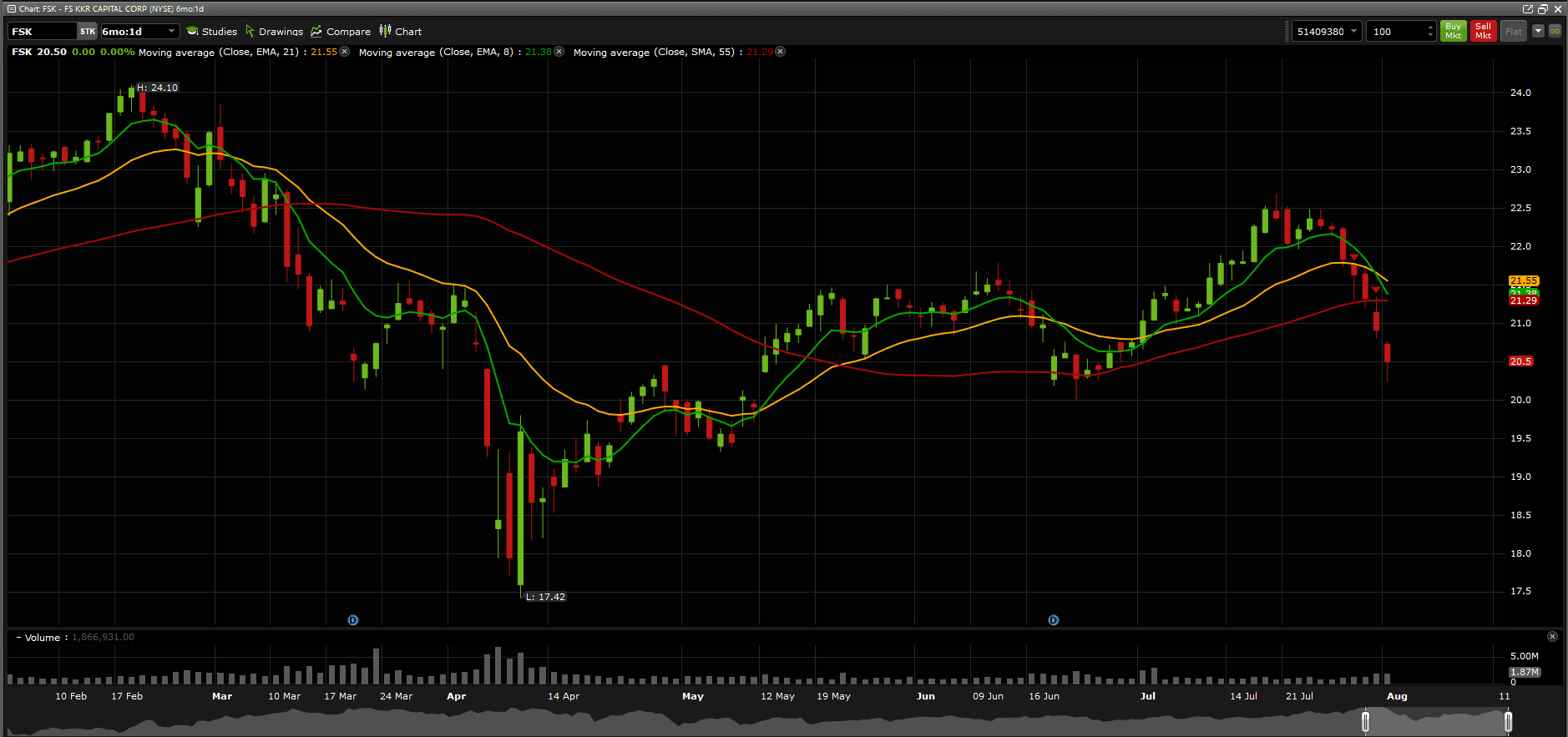 As indicated by the arrows in the above screenshot I have sold my holdings in FSK and will re-evaluate after August 15. FSK is a good Fund with solid management but it may be beneficial to let the dust settle here.
The other Funds that I have reviewed recently are those classified as Collateralized Loan Obligation (CLO) Funds. This group of funds has been hit hard over the past 12 months and I hold positions in 4 of these funds – OXLC, ECC, EIC and XFLT (usually classified as a Senior Loan fund but almost 50% of holdings are in CLOs). This is probably the most difficult class of funds to understand and evaluate for a number of reasons but particularly because “real” returns are difficult to measure. The Funds are usually characterized by high yields (often >20%) that are obviously not sustainable through simple investment. But the funds tend to use leverage to help boost returns. Banks commonly use this type of vehicle for institutional investors – and have done so very successfully for a number of years – but, unlike Banks, CLO-CEFs cannot set aside reserves for future credit losses and, by regulation, must pay out 90% or more of pre-tax income as distributions to shareholders. Since shareholders like to see a steady flow of income from month-to month these distributions tend to be over-payments of “real” income with the true value only being known when the Fund closes down. Provided that we understand what is happening we may be OK – if we receive 20% per year in distributions and capital losses are only 8% – than our net return is still 12% and well within our target return. The returns are front-end loaded and the investment works much like an annuity.
Let’s take a look at the current holdings in the Hawking Portfolio:
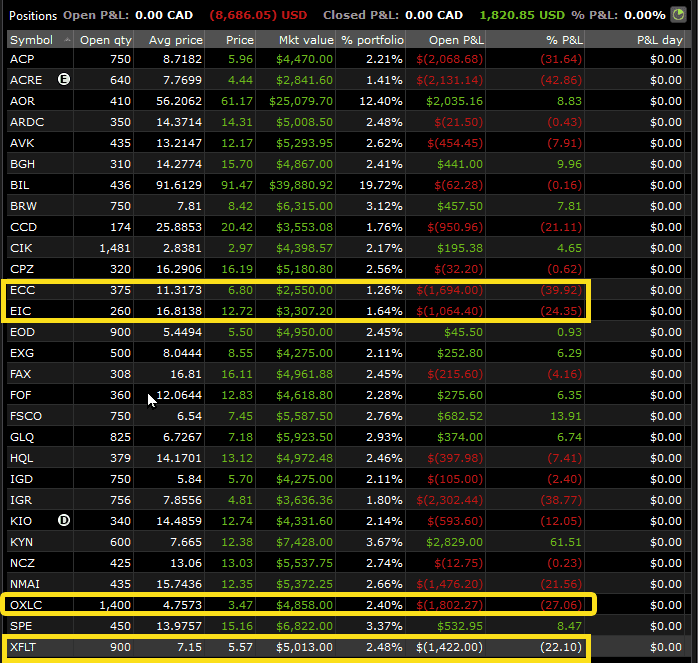
where the CLOs are identified within the yellow boxes. As can be seen, these are showing losses of 22%-40% over the ~4 year+ period that I have been managing this portfolio. This doesn’t sound too good – but let’s look at the distributions/yields:
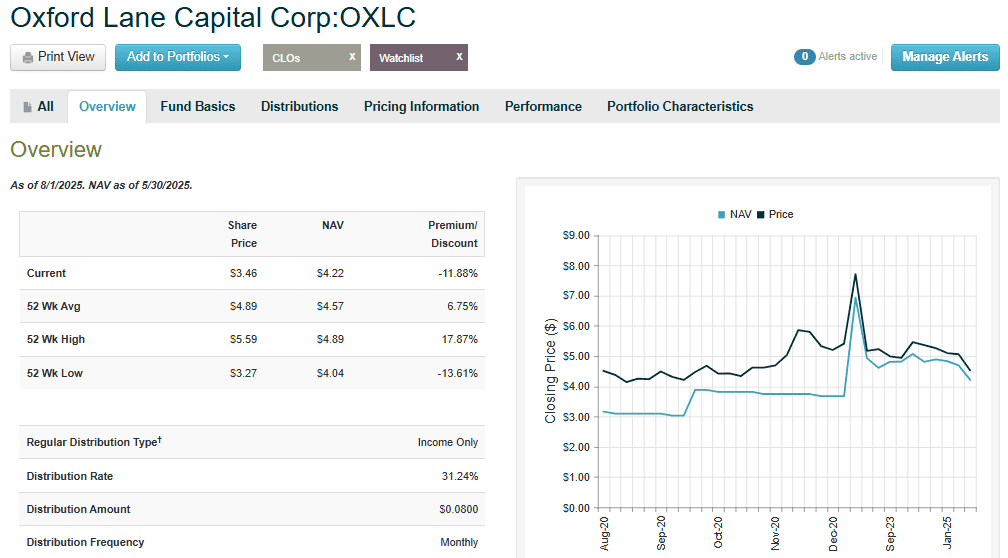
 these range from 12%-30% – so, if I do some very simple calculations, we see this:
 where the second column (2) shows the actual 4+ year losses (reduction in NAV) and the fourth column (4) shows the annual yields/distributions taken from the above screenshots. Column three (3) shows the average loss over the 4 year period (column 2/4) and Column five (5) shows the average annual difference between the total distributions received and the average loss in NAV – the “real” annual return (column 3 + column 4). Column six (6) shows the 4 Yr distribution yield where we note that our original investment in OXLC and ECC has already been returned to us. The other CLOs have returned ~50% of the original investment.
The “real” returns shown in Column 5 assume no re-investment of the distributions, but, if these returns were re-invested then we might expect to see “real” geometric returns similar to those shown in Column eight (8). The re-investment rate, column seven (7), is assumed to be Annual Yield x Annual Yield. Many CEFs have Dividend Re-Investment Plans – DRIPs – if your broker will allow you to join the plans – mine don’t 🙁
As we can see above, returns from ECC and OXLC are quite juicy.
Let’s take a closer look at OXLC as an example:
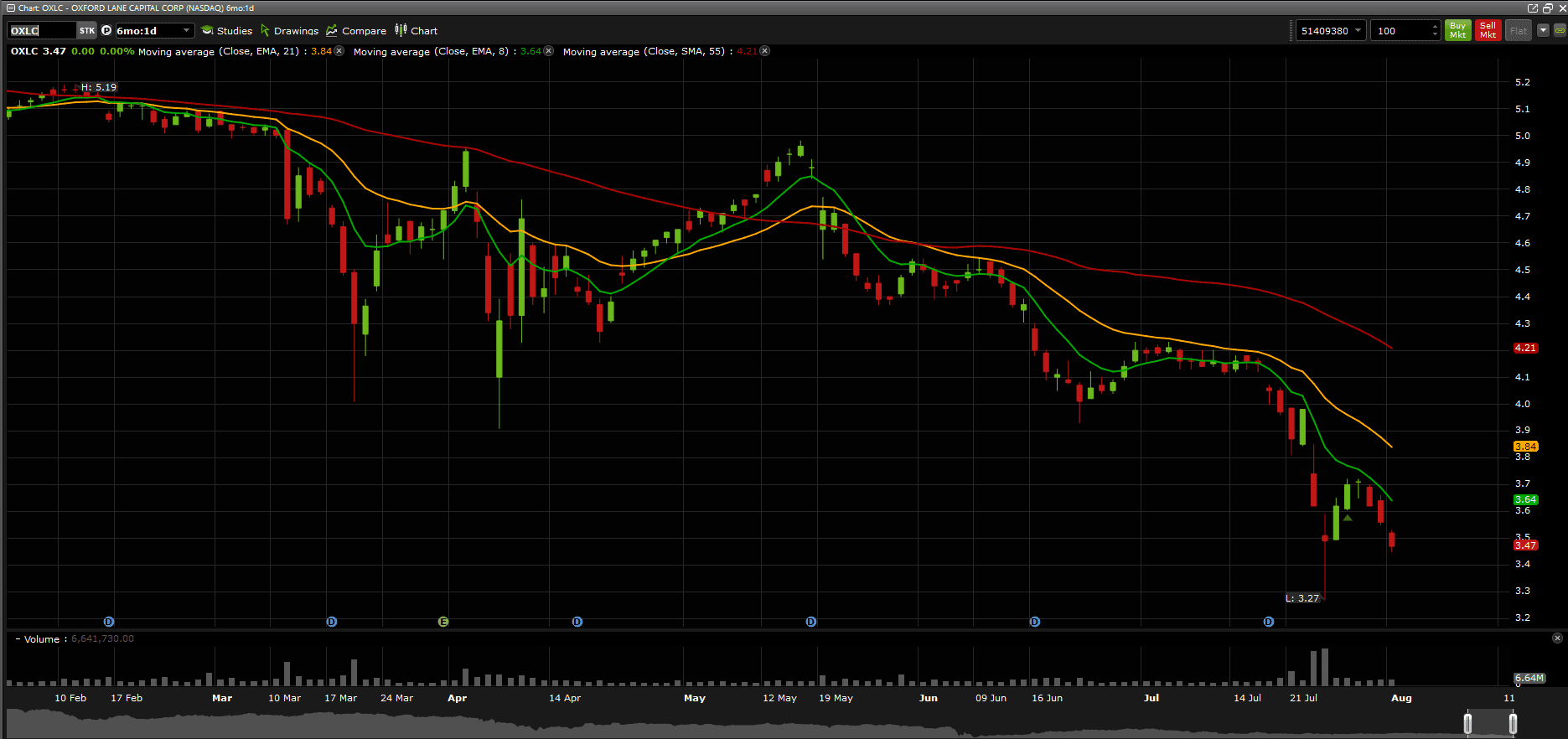
that certainly doesn’t look very appealing – and a trend/momentum system certainly wouldn’t be screaming “Buy” – but the above table shows that it has performed very well over the past 4+ years in delivering “income”. Even if the Fund were to close down tomorrow with a NAV of zero we would still have made 5% per year (120% return over 4 years) – better than many bonds.
At the moment, OXLC is trading at an 11.88% discount to NAV when, historically it has traded at a premium (probably simply because investors are chasing the “apparent” high 30% yield) – so we pay 0.88c for every $ of Value in the Fund – according to cefconnect.com with a 31% distribution rate. I added a few more shares to my portfolio on this one. However, I will likely sell my holdings in EIC as there are less risky investments out there with more secure 8+% distributions.
 At the end of the day. the Hawking Portfolio performance is looking like this:
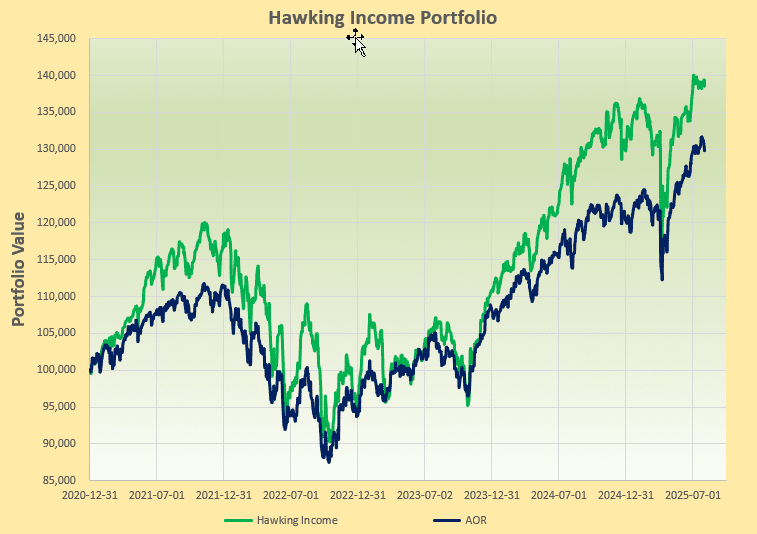 with a good lead over the benchmark AOR Fund despite the weakness in the CLO space. I am not making a strong recommendation to buy CLO funds – they are a complicated class of assets that need to be understood and evaluated carefully. I have tried to provide a little insight here as to how they work and why it is not easy to evaluate them – but there are other fish in the sea that are easier to catch. I certainly wouldn’t be buying at a premium, but at a discount they can still be a good bet for anyone willing to take a little more risk and sizing their holdings accordingly.
Discover more from ITA Wealth Management
Subscribe to get the latest posts sent to your email.
Leave a Comment or Question