
Stonehenge, England
This week saw an official “correction” in the trend of US Equities with a 10% pullback from the mid-February highs. This pullback also coincided with a test of resistance at the 61.8% Fibonacci retracement level at 5520:
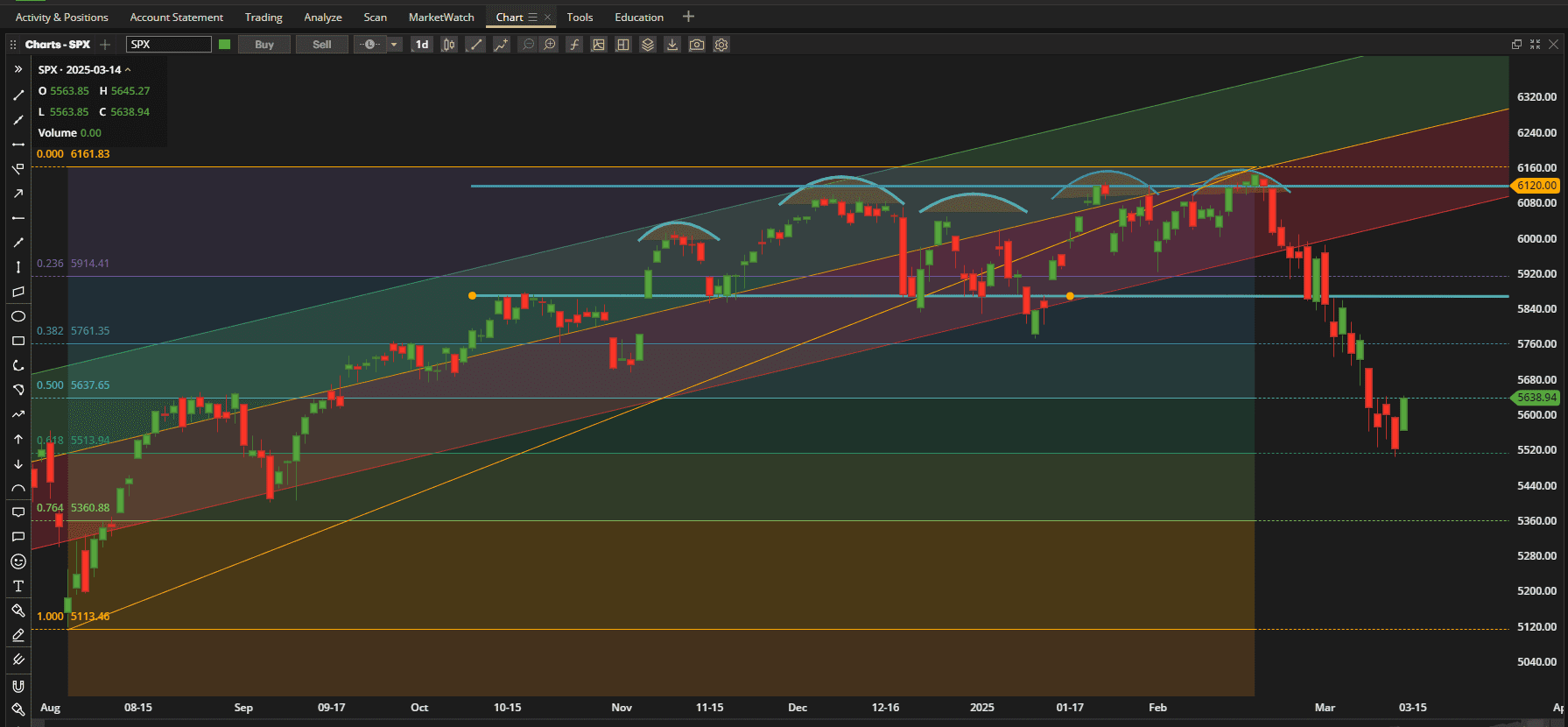
From here we might expect to see a bounce into the ~5760-5840 zone that had previously provided support and might now act as resistance. Should this area prove to provide resistance and price cannot break through this area then we will officially be in a new bearish trend with lower lows and lower highs. The next areas of support to the downside might be at ~5360 and 5120 (August 2024 low).
Relative to other major asset classes US equities were weak showing a ~2.3% loss on the week from last Friday’s close:
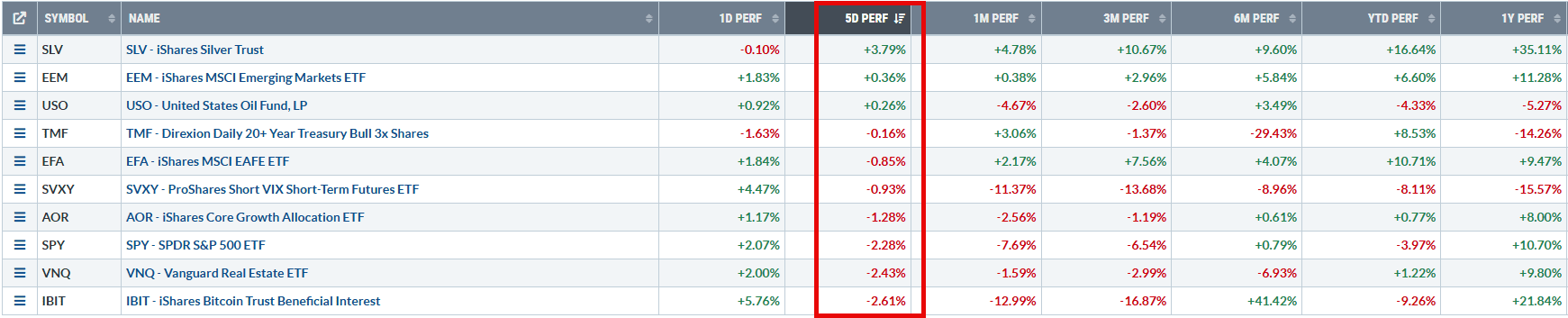
Silver (SLV) was the best performer with a 3.8% gain.
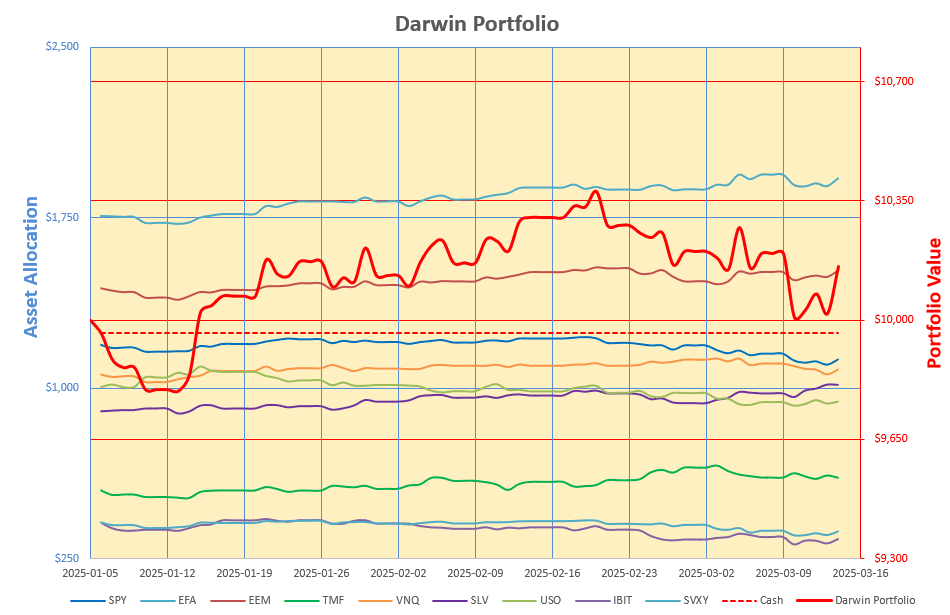
Checking on the performance of the Rutherford-Darwin Portfolio we know that $50,000 is safe in the “risk-free” BIL ETF and has added a few more dollars to the account – now at $435 since inception.
The diversified Darwin portion of the portfolio lost a little ground, ~$40, but held up relatively well with nice gains from SLV and EEM (Emerging Markets):
 and, of course, there was volatility in the Rutherford Options portion of the portfolio:
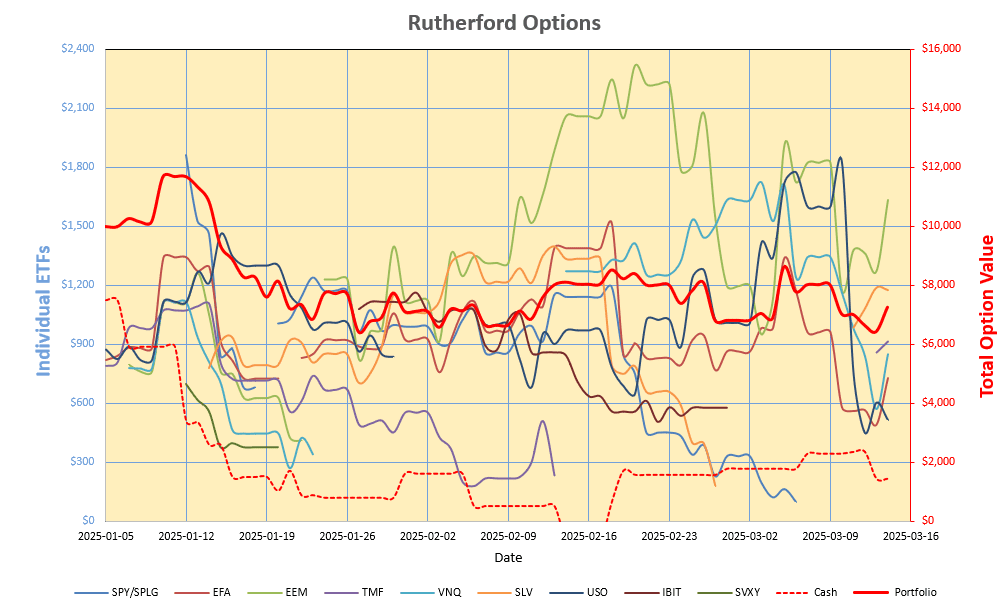 where I chose to hedge a little of the risk by selling Options against existing long (Call) positions in equities (EFA and EEM) and Real Estate (VNQ) and short (Put) position in Oil (USO). This converts the single long (Call) and short (Put) positions to vertical spreads, with known maximum risk/rewards and brings in a little time premium to lower risk.
I also chose to open 2 new positions in Silver and Bonds, both of which are vertical spreads. The position in Silver (SLV) is neutral/bullish and looks like this:
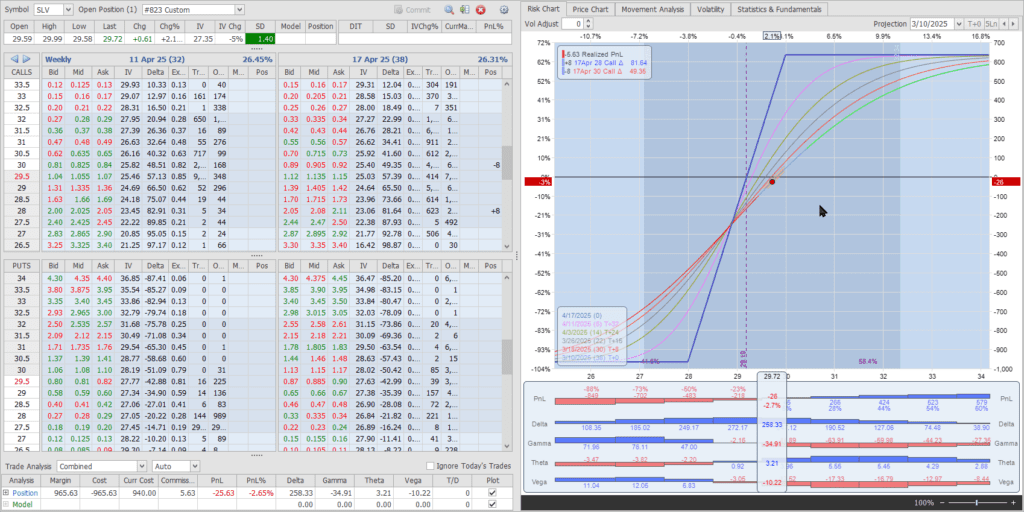 where I have bought 8 contracts of the $28 strike Call Options expiring on 17 April and Sold 8 contracts of the $30 strike Call Options, expiring on the same date, for a net debit of 8 x 100 x $1.20 = $960. This is my maximum loss on the trade (although I plan to exit with a mental stop loss at 20-30% of this). My maximum profit (without adjustments) is the width of the spread ($2) minus the net debit paid = $2 x 100 x 8 contracts = $1,600 – $960 = $640 or a reward/risk of $640/$240 (assuming 25% loss) or ~2.5:1. The probability of profit on this trade is ~58% – so the odds are good. Maximum profit on this trade would generate a $640/960 = 67% return in 38 days (~640% annualized) if held to maturity on 17 April – however I will likely exit should I see 80% of the maximum return ($512) before this date.
I also placed a neutral/bearish trade in Bonds (TLT) by buying 2 contracts of the $96 strike Put Options expiring on 17 April and Selling 2 contracts of the 90 strike Puts expiring on the same date. This was placed for a net debit of $4.55 x 100 x 2 = $910 (max risk) with a profit potential of ((96-90) x 100 x 2) = $1200 – $910 = $290. Assuming a max 25% loss this gives me a $290/$230 reward/risk (or ~1:1 with a 60% probability of profit and a maximum $290/$910 = 32% return in 38 days (~300% annualized).
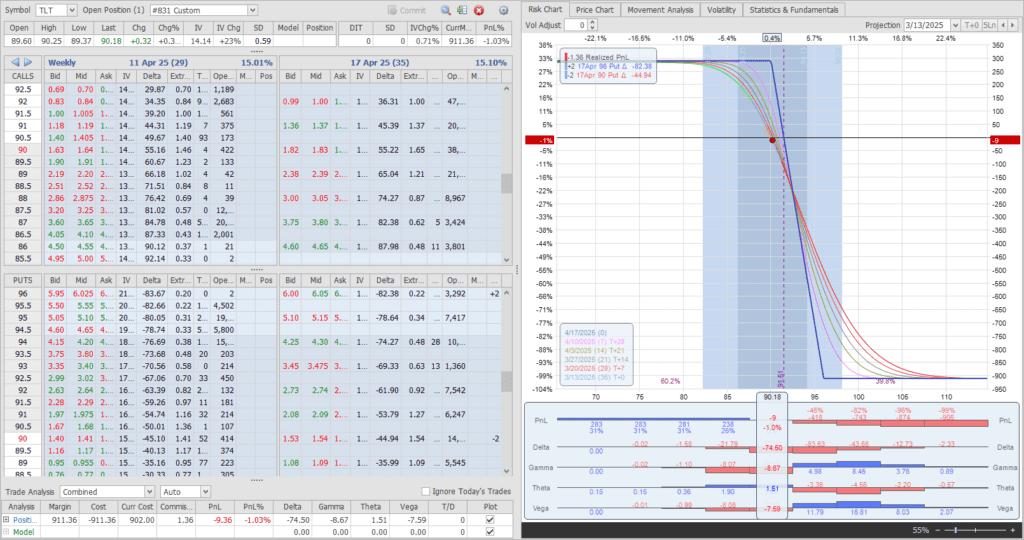
I have chosen to place my Bond trades in TLT rather than the 3x TMF Bond ETF since there is far more liquidity and tighter bid/ask spreads on these TLT Options than in the TMF Options and I can get the same reward/risk on the vertical spreads.
I wanted to try to keep these trades simple by just buying the Calls or Puts and not complicating things by using multi-leg trades but, since this is real money, I want to define my risk/reward a little better so have moved to using spreads that take advantage of time decay in the Options sold.
After all the adjustments noted above this portion of the portfolio gave up ~$700 (7%) on the week but the move to spreads rather than naked (uncovered) Options should reduce volatility going forward. Volatility presently stands at 115%.
The picture for the total portfolio still looks ok:
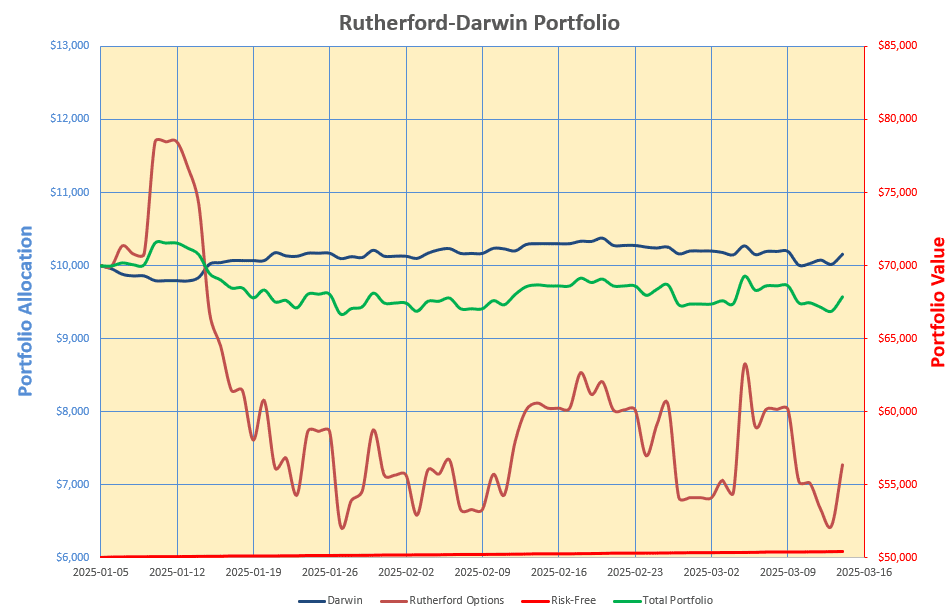 and is only showing a $2,200 (3%) loss despite our recent 10% market correction and my teething issues regarding appropriate Option positions/strategies. Volatility on the total portfolio is a very acceptable 13% and well below the volatility of US equities (SPY) that is presently closer to 20%.
Discover more from ITA Wealth Management
Subscribe to get the latest posts sent to your email.
You must be logged in to post a comment.