
Abstract Glass Art
As one of the numerous Asset Allocation portfolios, Bethe is beginning to round into shape. Or to put it another way, the various asset classes are slowly coming into balance. This morning shares of TLT and QQQ were added to the portfolio.
So as to be tax efficient, the goal of Bethe is to never or rarely sell shares. Instead, use fresh cash and dividends to bring asset classes below target into balance.
Bethe Asset Allocation Portfolio
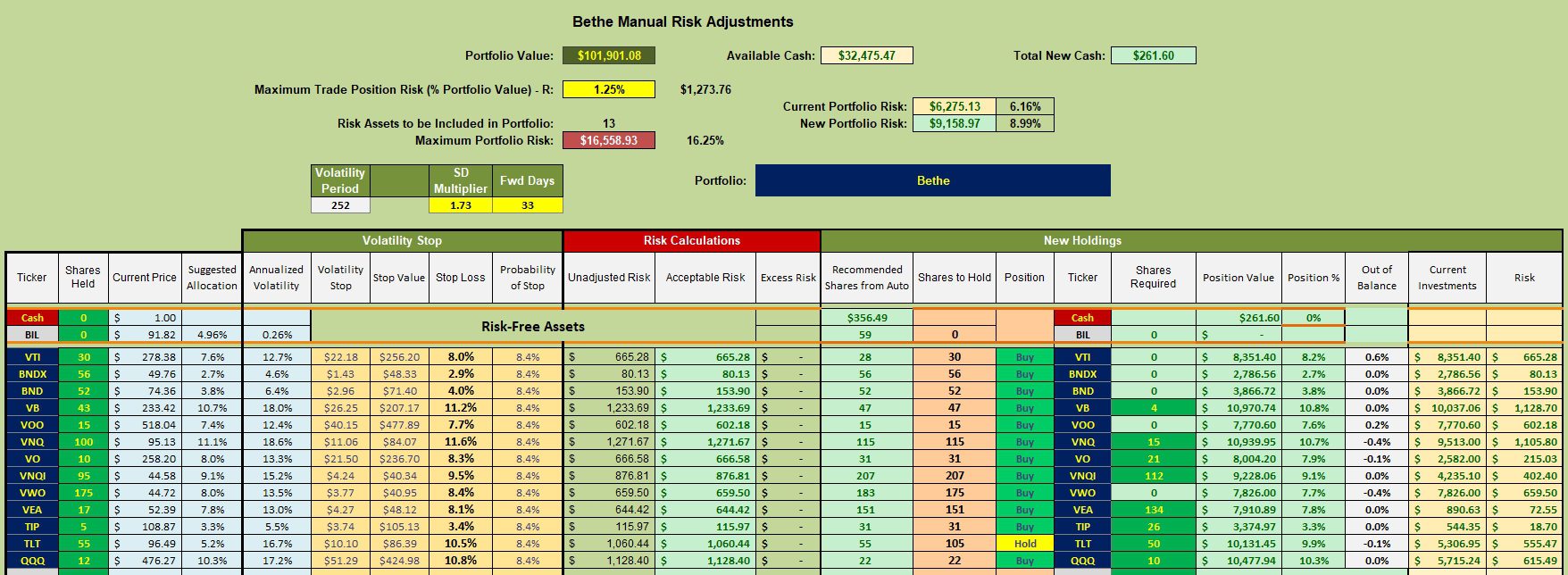
Below is the investment quiver for the Bethe. In the third column from the left we see the Maximum Asset Allocation allocated to each asset class. In the next screenshot we see how many shares of the different asset classes are required to bring the portfolio into balance.

Bethe Manual Risk Adjustments
Under Shares Required we see the number of shares required to bring asset classes currently out of balance into balance. Limit orders are in place to add shares to eight different asset classes. Due to price variations this table will need to be adjusted each time the portfolio comes up for review.
Bethe Performance Data
While the Bethe has only been using the AA model for a short period of time, since 12/31/2021 portfolio has outperformed the AOR benchmark by a little over one percentage point when annualized.

Bethe Risk Ratios
It is too early in September to pay much attention to the latest entries. Compare August of 2024 with September of 2023 and readers will see the Bethe has been performing quite well when risk enters the equation.
The current slope of the Jensen is essentially flat. Over the next few months the slope will become a valuable tool in measuring how well the Asset Allocation model is working.

Returning To Investing Roots: 5 August 2024
Discover more from ITA Wealth Management
Subscribe to get the latest posts sent to your email.
Hi Lowell,
Sorry if I’m asking a redundant question but where and how do you set the limit orders to acquire new shares?
Thanks,
Bill T
Bill,
I generally set the limit orders between 1% and down to 5% below the current price. Since there are no commissions involved, I break the limit orders into groups. For example, suppose an asset class is out of balance and 9 shares are required to bring the class back into balance. Further, assume the asset class ETF is priced at $430.25/share. My orders may look like the following.
1. Buy 4 shares at $425.90 or 1% below current price.
2. Buy 5 shares at $417.30 or 3% below current price.
Since bonds such as BND and BNDX have low volatility I will set the limit prices even closer to the current price.
I don’t use hard and fast rules so judgment enters these decisions. High priced ETFs with greater volatility will receive greater limit price spreads. Hope this is useful information.
Lowell