
Ben Nevis – Highest Mountain in Scotland
I have reset the Dirac Portfolio to an $80,000 account and made a minor adjustment to the asset list (“quiver”) in order to limit the number of assets in the quiver to a maximum of 10 for ease of management. I have also decided to move this portfolio to the new algorithm that I have outlined in my recent Darwin Portfolio post (https://itawealth.com/darwin-2026-02-january-2026/). The changes to the asset list are not too significant as only XLRE (Real Estate Sector ETF) has been removed from the list.
The Dirac Portfolio is setup to test whether an actively managed sector rotation model can outperform the broader S&P 500 Index. In the past I have not had a lot of success in doing this – but we’ll wait, watch and see what happens when I shift to the new algorithm.
Since the asset quiver comprises only sector ETFs within the US Equity markets it is appropriate to use SPY as the benchmark fund i.e. the ratio data used in the analysis is ETF Price/SPY Price.
Running the analysis this morning generated the following recommendations:
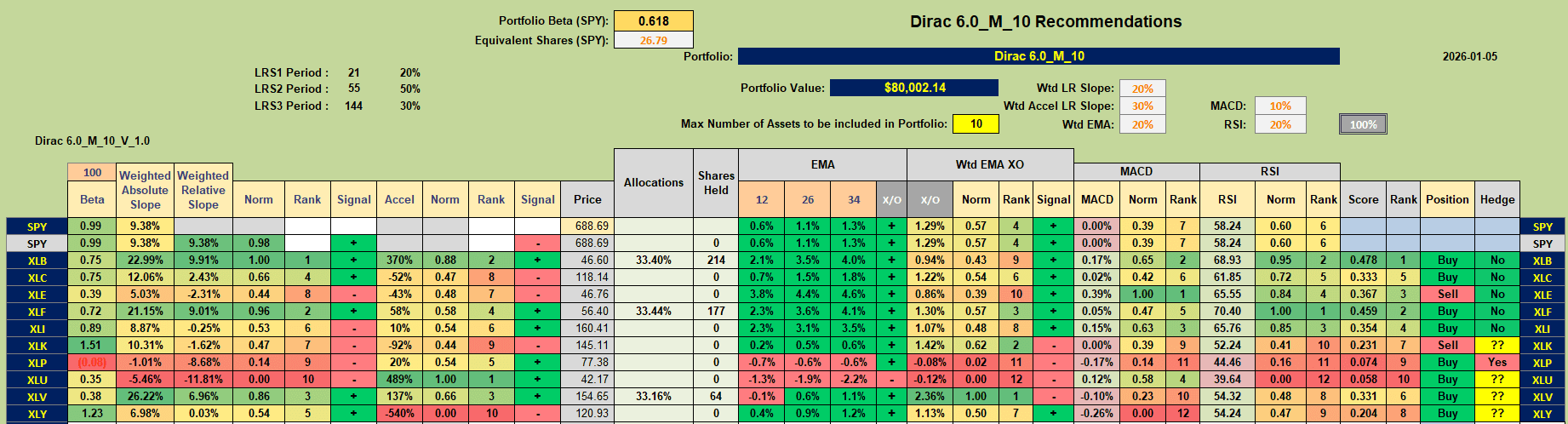 ,,,, with Buy recommendations on eight of the ten Sector ETFs. Rather than jump in and allocated all available funds to the recommended ETFs – as I did with the Darwin Portfolio – I will ease into this portfolio a little slower by first choosing only those ETFs that are generating Buy signals based on both positive momentum and positive acceleration. These ETFs are XLB (Materials sector), XLF (Financial sector) and XLV (Health sector). Maybe a little surprising is that XLK (Technology Sector), that has led the market through 2025, is generating a Sell recommendation:
 …. we will wait to see if this does reflect a true weakening of this sector or whether we see a rebound – both signals are very close to the horizontal zero cross-over axis.
Based on the allocation calculations for the eight sectors with Buy recommendations, the number of shares to be purchased (based on equal weighting of available funds – $80,000/8 = $10.000 per fund) looks like this:
 Although I am only buying 3 of these funds today, I will stick with the calculated allocations with the intent of adding more holdings to the portfolio in the days/weeks ahead. This means that I will be left with ~$50,000 in cash to allocate to new purchases:
 The portfolio sheet presently looks like this:
 I will update this post in the comment section should I add more holdings before my next review.
Discover more from ITA Wealth Management
Subscribe to get the latest posts sent to your email.
Leave a Comment or Question