
Dock Action
When I first began setting up this Asset Allocation portfolio I called it Pauling II. Now that the account is nearly established or fully populated I’m reverting back to the original name, Pauling.
The philosophy behind this portfolio is to build a retirement account using tried and true diversification methods. The Pauling is diversified across all sizes of U.S. Equities, TIPs, domestic and international bonds, domestic and international real estate, developed international equities, emerging markets, treasuries and gold. I left out commodities as I don’t like dealing with K-1 forms at tax time.
Readers will note that I use Vanguard Exchange Traded Funds (ETFs) as the investment vehicles as Vanguard runs low cost ETFs and when one purchases their ETFs you become part owner of Vanguard.
Pauling Asset Allocation Model
Below is the investment quiver and current holdings for the Pauling. Check the Out of Balance column as that provides the guiding principle as to were we need to concentrate new investments. More to be explained later in the blog post. Thirteen (13) ETFs are used with the Pauling. The tickers are VTI down through TLT. The Strategic or Maximum Asset Allocation percentages are based on volatility calculations with some proprietary adjustments. In other words, the Asset Allocation percentages are my choices.
When the portfolio is finally set I want to keep the Out of Balance percentages to + or – no more than 0.5%. Most of the asset classes are still out of balance as the latest Pauling was only launched on 4/1/2024.
VB is out of balance on the up side. Instead of selling shares I’ll leave VB alone and concentrate on adding shares to VTI, the security most out of balance with a Buy recommendation. Next on the purchase list is VEA as it is out of balance by 4.2% on the low side. ETFs out of balance on the plus side are of no consequence.

Pauling Manual Risk Adjustments
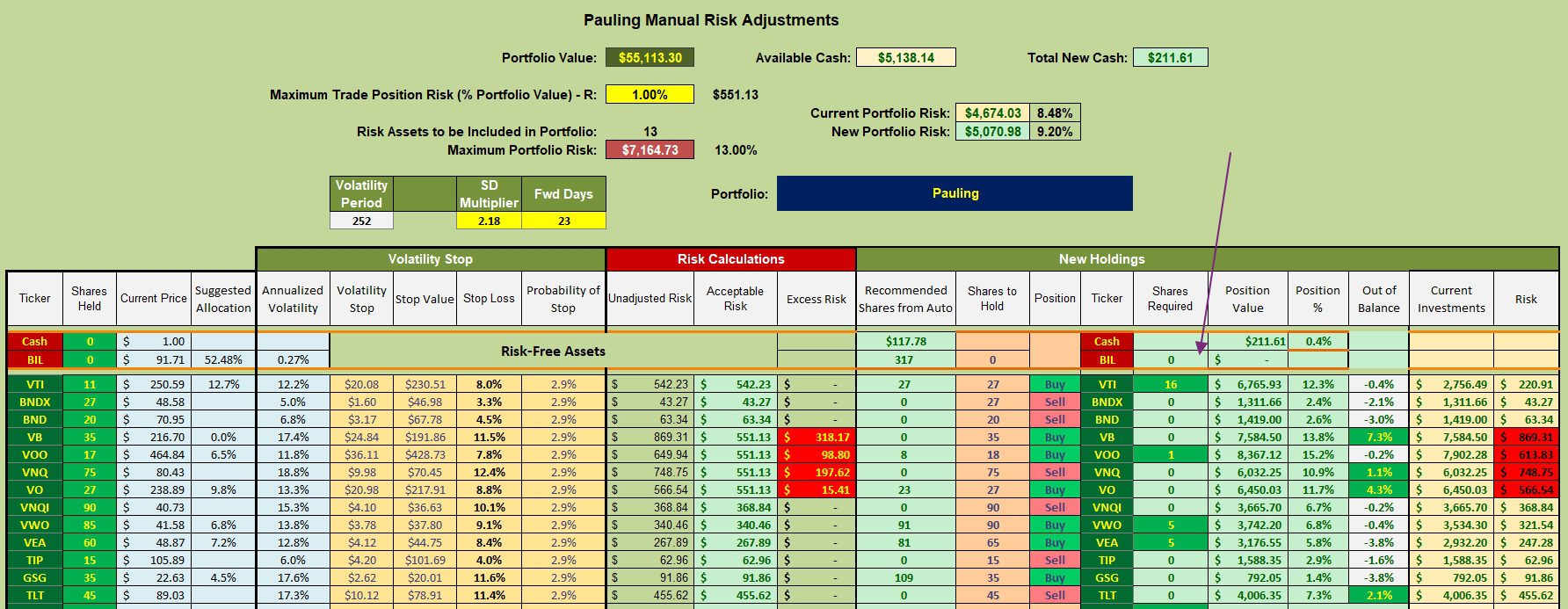
Below is where the manager begins to make decisions as to what ETFs to add and how many shares. The goal is to never sell shares unless there is an emergency. By not selling the portfolio becomes less of a tax burden.
The following worksheet comes from the Kipling spreadsheet. As an example, if I purchase 16 shares of VTI this U.S. Equity will only be out of balance by -0.4% or within the guidelines I’ve set for the Pauling.
I want to focus on those ETFs that are most out of balance and have a Buy recommendation. There is insufficient cash to bring all ETFs into balance. As new cash is add and dividends are paid, that money will be invested in assets that are most out of balance on the low side and show a Buy signal. It will likely be sometime in the fall or winter of 2024 before the Pauling is completely in balance.
Once all asset classes are within the Out of Balance percentages the portfolio will be ease to manage. The beauty of the Schrodinger is that this is all done automatically for the owner.
Pauling Performance Data
One of the reasons for moving to the Asset Allocation model is to attempt to close the gap between the current performance and the SPY benchmark. The Pauling does not have far to go before catching up to AOR, but the delta is quite large when compared with the S&P 500 (SPY) benchmark.

Pauling Risk Ratios
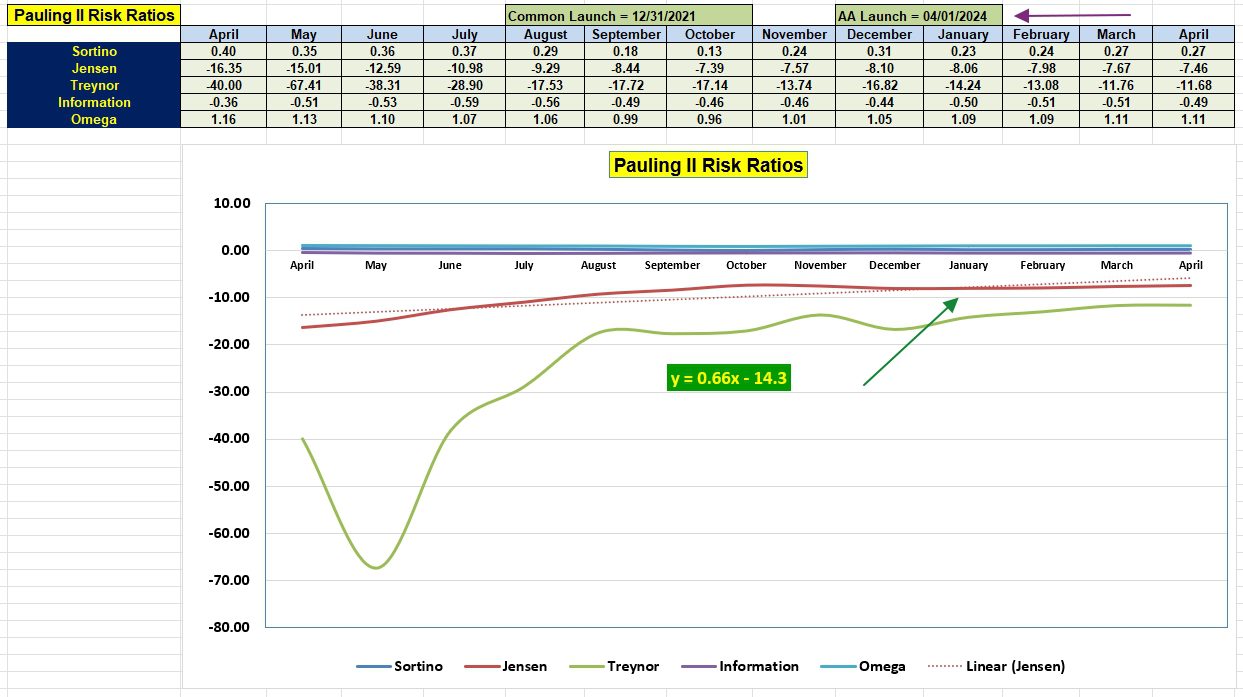
The purple arrow points to the launch date for the Pauling AA approach. Over the past two weeks the portfolio improved slightly on three of the five risk ratios. Jensen’s Alpha or Jensen’s Performance Index is the most important of the three and the slope over the past year is positive. One goal is to maintain a positive slope for the Jensen.
Tentative Asset Allocation Model
Pauling II Asset Allocation Portfolio Launch: 1 April 2024
Pauling II Update: 1 April 2024
Huygens Asset Allocation Portfolio Review: 10 April 2024
Three of the many portfolios I track here at ITA are built around the principles of asset allocation. The oldest is the Schrodinger. Huygens and Pauling are the youngest. Here is a link to the Schrodinger. Check it out as I think readers will find it of great interest.
Discover more from ITA Wealth Management
Subscribe to get the latest posts sent to your email.
You must be logged in to post a comment.