
Chesterfield, Idaho (Ghost Town) General Store.
Gauss is one of four Sector BPI portfolios currently managed here at ITA. Gauss is one of the last accounts to be shifted over to the BPI management model and thus far it is just holding its own with respect to the S&P 500 (SPY). As mentioned in prior Sector BPI portfolio reviews, I’ve tweaked this model a few times and the Gauss will show these changes as you track the following analysis.
Gauss Security Recommendations
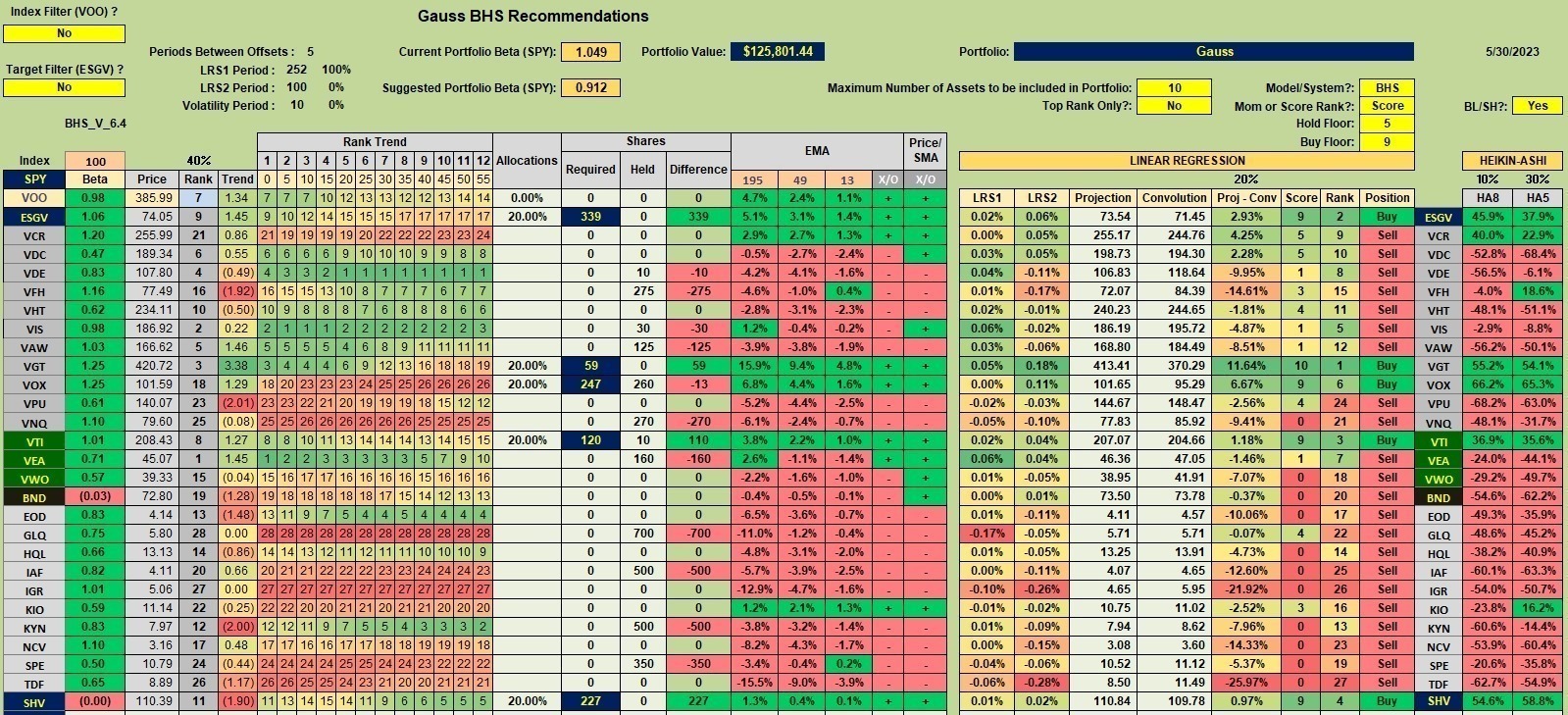
After updating the Sector BPI data this morning, Energy and Real Estate continue to be the two sectors recommended for purchase. This is the same recommendation we recorded at the end of last week.
The Gauss currently holds four Closed-End-Funds (CEFs) and here is where one of the latest “tweaks” kicks into action. Since no CEF shows up as a Buy and all are call for a Sell, I placed limit orders on the CEFs so as to raise cash to purchase more shares of Energy (VDE). I do plan to hold KYN as it pays a significant dividend at the end of the second quarter.
Gauss Risk Management Adjustments
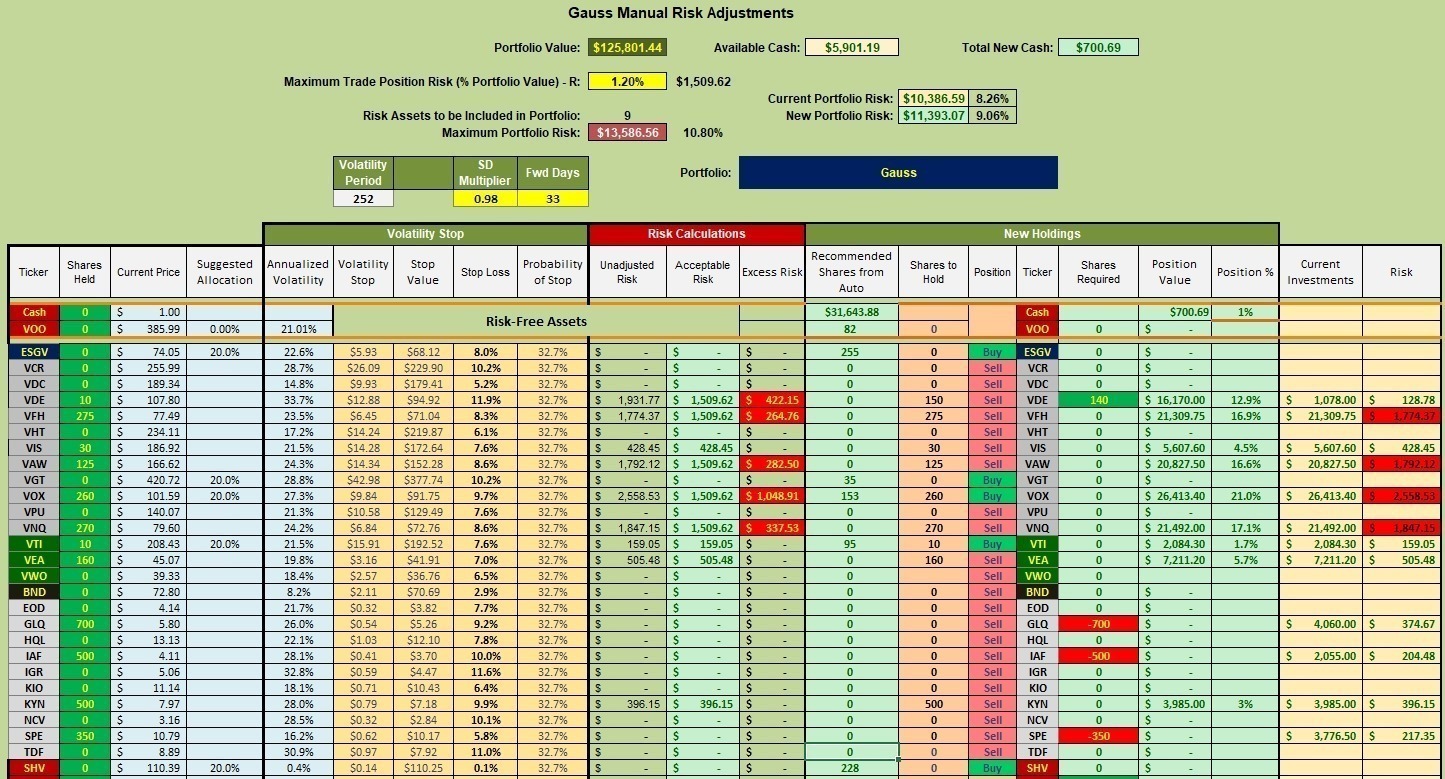
If and when GLQ, IAF, and SPE are sold I’ll have a little more cash to add to the VDE holding. Just to review the Sector BPI logic, here it is once more.
- First fill the Sector BPI recommendations. The Sector BPI recommendations override those from the Kipling spreadsheet.
- Currently that means building VDE up to 25% of the total portfolio.
- In addition we would build VNQ up to 17.9% or 18% of the portfolio.
- If cash were still available, purchase shares of VTI as it is recommended as a Buy and it is part of the Dual Momentum™ model. This addition or “tweak” of the Sector BPI model is to insure we have equity investment activity if an when a sector ETF is sold and then might move back into the oversold zone. This move leaves one hold excess cash when the market is rising and we will counter that upward move by buying shares of the ETF recommended by the Dual Momentum model.
- Since no CEFs are currently recommended I would leave any available cash in the money market or purchase a short-term treasury such as SHV.
Gauss Performance Data
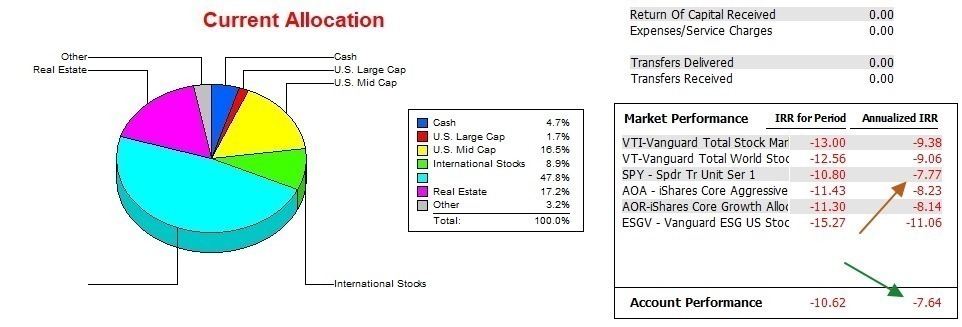
After 17 months of operation the Gauss is in a dead heat with SPY or the S&P 500. The separation is a little greater when comparing the Gauss with either AOA or AOR.
Gauss Risk Ratios
Both the Jensen Alpha and Information Ratio are positive, but not by much. The Gauss is a good Sector BPI portfolio to watch as the various ratios are quite close to zero.
The Gauss is now set to run at least another month. However, I keep a watch on the Sector BPI portfolio when a change shows up in the BPI data.

The Argument for Self-Management
Tweaking Sector BPI Plus Model: 20 May 2023
Gauss Portfolio Update: 19 March 2023
Discover more from ITA Wealth Management
Subscribe to get the latest posts sent to your email.
Lowell,
Why have you decided to use the Kipling to determine what to do with CEFs? I thought the idea was to use the yield plus discount as criteria for buying/retaining CEFs. The combined yield plus discount of many of these CEFs exceed 20 percent, so why sell just because they are not a BUY in the Kipling?
~jim
Jim,
The reasoning is related to the order of population importance in the Sector BPI Plus portfolios.
Take the Gauss as the example. Energy and Real Estate are now recommended for purchase based on BPI data. There is insufficient cash to fill Energy to 25% and Real Estate to 17.9%. None of the other sector holding call for a Sell so the first securities to be sold are CEFs. The idea is to raise cash in order to meet the Sector BPI recommendations.
There will come a time when so many sectors will be calling for a Buy that there is insufficient cash to fill all the requirements. As to which to fill first will then require a decision as to what to do. I’ll likely fill the most volatile sectors first and then work down the list until there is no more cash.
Hope this makes logical sense.
Lowell