
Church at Bodie Historic State Park – California
Schrodinger is the portfolio that answers the question, “Who Will Manage the Family Portfolio When I Die?” This portfolio is called an Intelligent Portfolio by Schwab. It is managed by computer using the principles of Asset Allocation. To set up such a portfolio an investor needs to answer a few questions so the computer can develop an asset allocation program that fits the return/risk ratio for the client. It is possible to change the stock/bond ratio after the initial set up. Once established all the investor needs to do save. The computer does all the investing. It is quite easy to move money from a checking account into the intelligent portfolio.
One change I requested on behalf of the owner of this portfolio was to concentrate on U.S. Equities and to down-play International Equities. That request has paid off thus far.
Schrodinger Portfolio
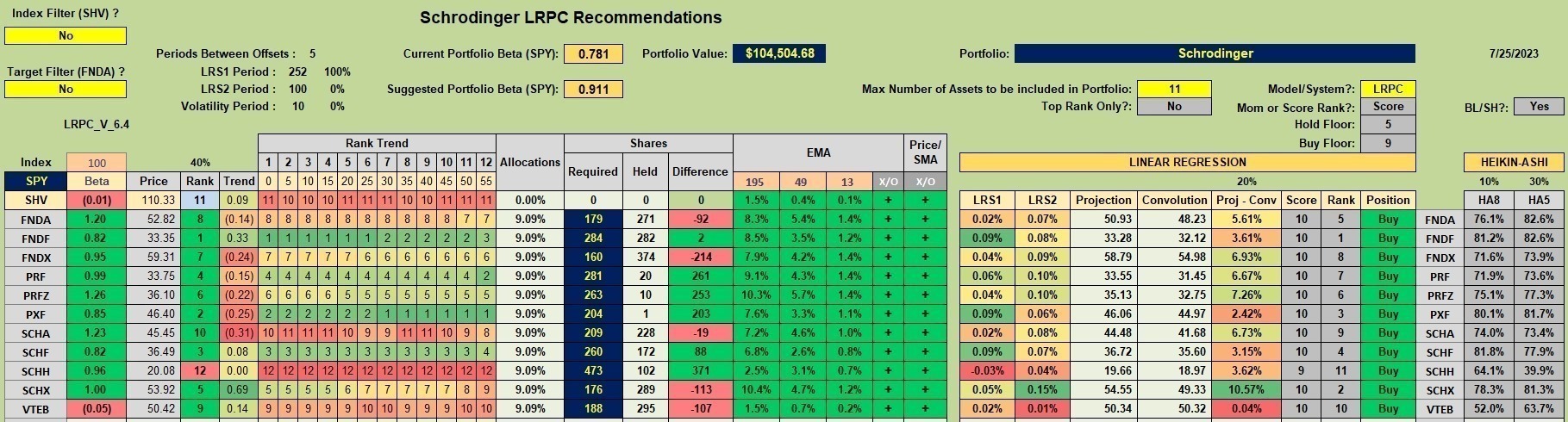
Below is the current make-up of the Schrodinger portfolio. While I don’t use the Kipling spreadsheet to manage this portfolio, I use it to see what securities are recommended for purchase. It is unusual to see all eleven (11) recommended for purchase.
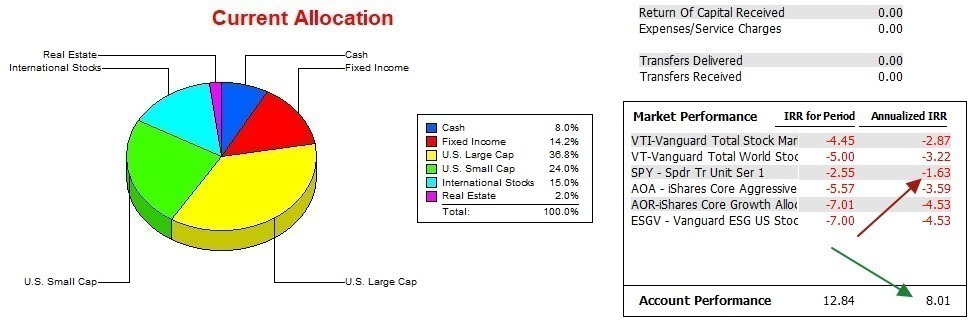
Schrodinger Performance Data
Over the past 19 months of operation the Schrodinger has outperformed the SPY benchmark as well as the other five potential references. The difference is quite remarkable and is certainly and endorsement for this style of investment. The red and green arrows point to the annualized Internal Rate of Return data while the IRR for the Period is found in the left hand column.
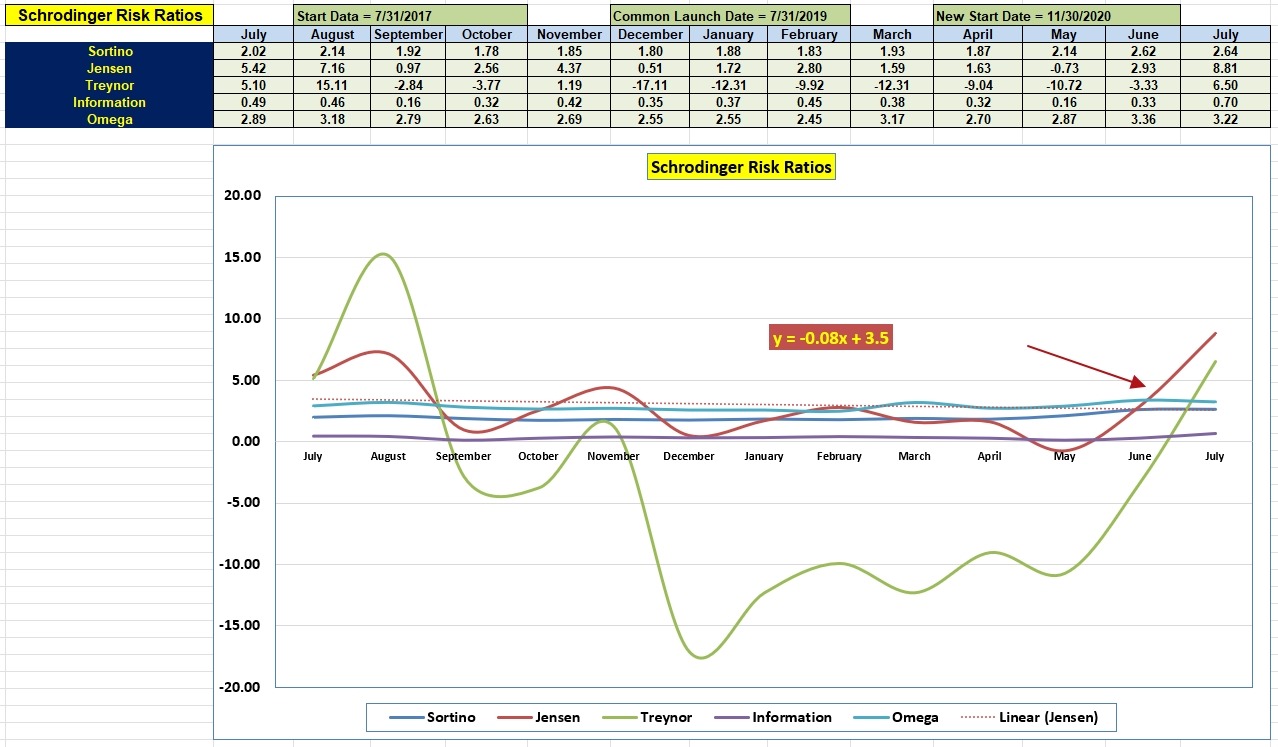
Schrodinger Risk Ratios
Each of the current risk ratios is higher than they were a year ago. Once we clear the August data the slope of the Jensen should turn positive.
Checking the Information Ratio we see the Schrodinger has outpaced the benchmark each month. That speaks well for the Intelligent Portfolio investing model.
Schrodinger Computer Manage Portfolio Update: 7 June 2023
Schrodinger Interim Update: 19 October 2022
Discover more from ITA Wealth Management
Subscribe to get the latest posts sent to your email.
In this you mention a focus on US with low weights on international equities. How is that communicated to the Schwab? Does Schwab use a chat style interface? Also, sometime back you indicated Schwab over-weighted risk avoidance, which was changed. How was that change requested? And what relative weights are currently in use? Thank you. – Lee
“In this you mention a focus on US with low weights on international equities. How is that communicated to the Schwab? Does Schwab use a chat style interface? Also, sometime back you indicated Schwab over-weighted risk avoidance, which was changed. How was that change requested? And what relative weights are currently in use? Thank you. – Lee”
Lee,
I spoke directly with a Schwab representative to lower the exposure to international equities and place the emphasis on U.S. Equities. I only learned of this possibility when another reader of this blog mentioned this possibility. While I have not made any stock/bond ratio changes in over a year, I think you can determine the ratio online. I think this is what you are referring to when mentioning “risk avoidance.”
As you can see from the pie chart in the above blog, the Schrodinger is approximately 80% equities and 20% bonds and cash. This may be too aggressive for some investors. The owner of the Schrodinger is OK with this ratio.
Anything else?
I will be away from this computer larger portions of time over the next two days due to a granddaughter’s wedding.
Lowell
Thank you very much, today is July 29th, so I hope the wedding is wonderful.
80/20, mostly US equities, makes a lot of sense, given the recent Schrodinger performance.
CONTEXT: For the past year, we have been in the “recession is a few quarters away camp,” and now have our funds coming back out of FDIC insured bank CD’s between now and February. Most are paying in the low 5% range. As these roll back in, adding to a well structured Schrodinger model with Schwabe looks inviting.
Again, thanks. – Lee
Lee,
I recently set up 2 Intelligent portfolio accounts for great-grandchildren. You can choose a domestic asset portfolio or a portfolio that includes international assets. Then you can select level of risk. These are tiny kids (early investors). I chose aggressive growth. Looks like that leaves 6-7% in cash. I didn’t find any option to customize allocation.
Bob W.
Robert,
The asset allocation is up to the Schwab computer analysts. If we were able to determine the asset allocation there would be no need for the computer managed portfolios. (g)
You were correct to go with aggressive growth.
Lowell
Lowell,
There is one glitch I have to follow up on. One child is 6 the other is 1. I setup it up as needing the money at 25. The older child’s AA is more aggressive than the younger one. Seems counter intuitive to me. I’ll let you know what I find out.
Bob W.
Bob W.,
Yes, that is counter intuitive. At those young ages I would think both portfolios would be quite close in their Asset Allocation percentages.
The computer does strange things at times. For example, with the Schrodinger I don’t understand why the computer selected one (1) share of PXF to include in the portfolio as one share in a portfolio of over $100,000 is a “shard” addition. Something similar happened about a year ago. The shard holdings were eventually sold out of the portfolio.
Lowell