
Grand Tetons in Wyoming. Road leading to Jenny Lake.
The Gauss Portfolio is one of four Sector BPI portfolios or what might be better classified as a Sector BPI Plus portfolio as I’ve added two layers of ETFs in order to patch a potential weakness in the original Sector BPI hypothesis. More on this later.
The Sector BPI portfolios are built around a contrary hypothesis or what one might call a reversion-to-the-mean theory. New readers would do well to run a search for Sector BPI. The basic idea is to take the eleven (11) sectors that make up the S&P 500 and apply Bullish Percent Indicator (BPI) analysis to each sector. Each weekend I post information on the BPI data for both broad market sectors and the eleven market sectors. When a sector is oversold or when the BPI drops to 30% or lower, we purchase shares of that sector ETF. Currently, no sectors are oversold so we have no recommended purchase orders.
When it is time to review or update a Sector BPI Plus portfolio I check the BPI data to see if there are any Sell or Buy recommendations. While there are no Buy recommendations at present, at the other end of the BPI spectrum we currently have three overbought sectors. They are: Staples, Health, and Utilities. Trailing Stop Loss Orders are in place for shares held in any of these three sectors. More on this later.
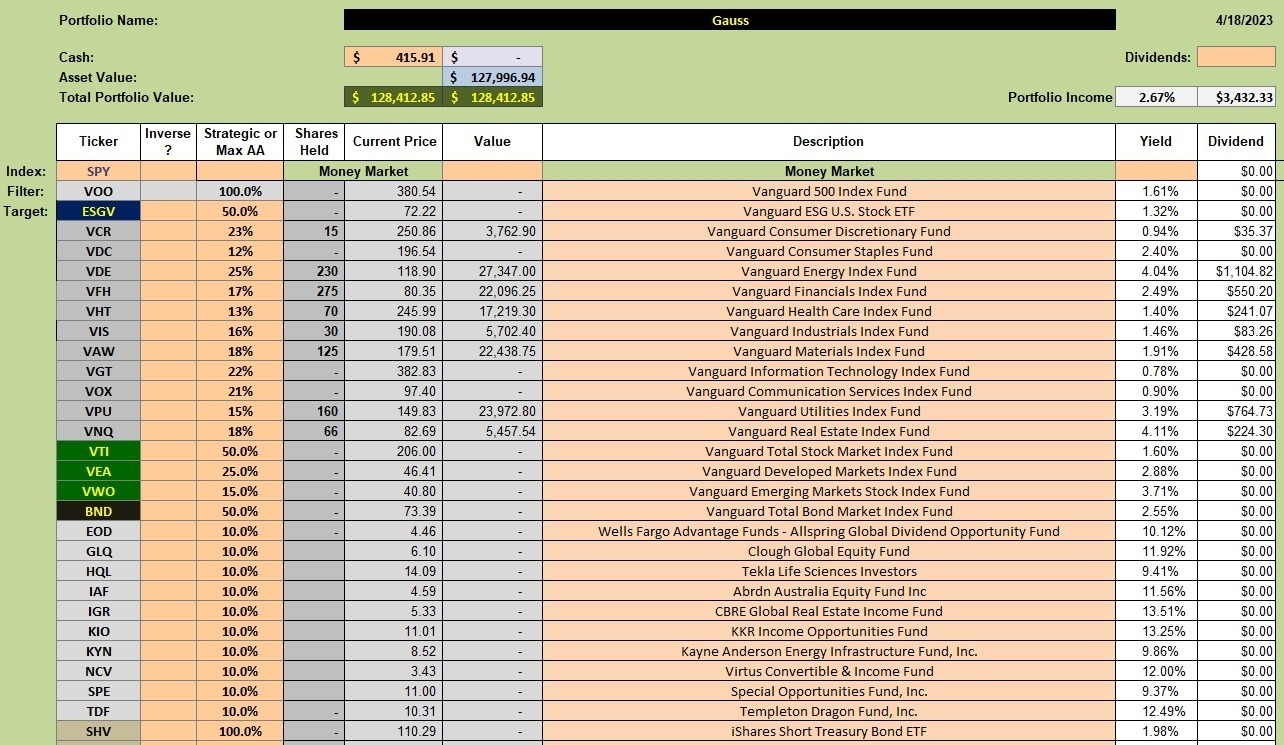
Gauss Investment Quiver
Below is the investment quiver and the current holdings for the Gauss. Since we do not hold shares of Staples (VDC), no TSLO is set for this sector. On the other hand Gauss does hold shares of Health (VHT) and Utilities (VPU) and TSLOs of 3% are in place for these two sectors.
As the Gauss now stands it is holding very little cash ($415.91). Do we want to do anything with such a small amount? Follow the next steps.
Gauss Security Recommendations
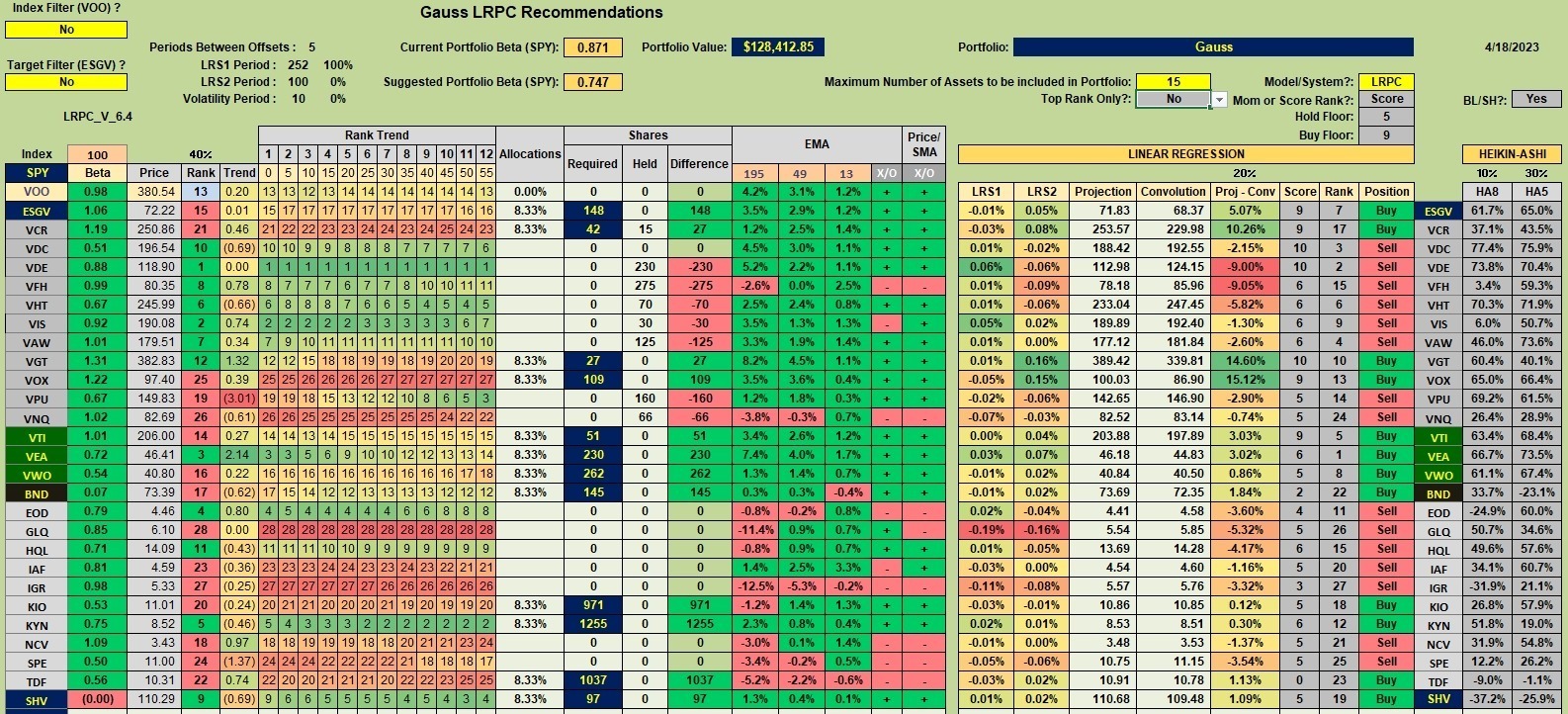
The following worksheet comes out of the Kipling spreadsheet. This worksheet is handled somewhat differently for the sector driven accounts. I set variables that impact the worksheet. For example I am using a one-year look-back period of 252 trading days. The second critical setting applies the LRPC model/system. The third critical setting is the maximum number of assets and I have this set to 15. This will include all possible sectors and the Dual Momentum™ ETFs.
- The first order of business is to follow the rules for populating the sector ETFs. As for the Gauss there are no Buy recommendations and TSLOs are in place for Health and Utilities. Nothing else needs to be done to this portfolio as it pertains to sectors.
- The second step is to move down to the four Dual Momentum™ ETFs. They are: U.S. Equities (VTI), Developed International Equities (VEA), Emerging Market Equities (VWO), and Bonds (BND). Since there is so little cash available, how do I use it effectively? Go to the Rank column or the fourth one from the right edge. VEA ranks #3 or the highest among the DM ETFs. I set a limit order to pick up shares of VEA.
- Had no DM ETFs been recommended for purchase move down into the CEFs to add shares for the purpose of increasing income. Depending in the needs of the investment manager, they might wish to pass over the DM ETFs and go right to the CEFs to generate additional income.
Why add the four DM ETFs and the 10 CEFs? The weakness pointed out in the Sector BPI model is likely to arise when an overbought sector is sold, then moves down into what I call neutral territory. But instead of dropping further into the oversold zone, the sector ETF might move from the neutral zone back into the overbought zone and rise even higher from that point. Rather than sitting on cash and watching the stock market move up, one is invested in DM ETFs or at least income generating securities. This the logic or reasoning behind adding more security options.
These nuances will become clearer when market movements arise requiring decisions.
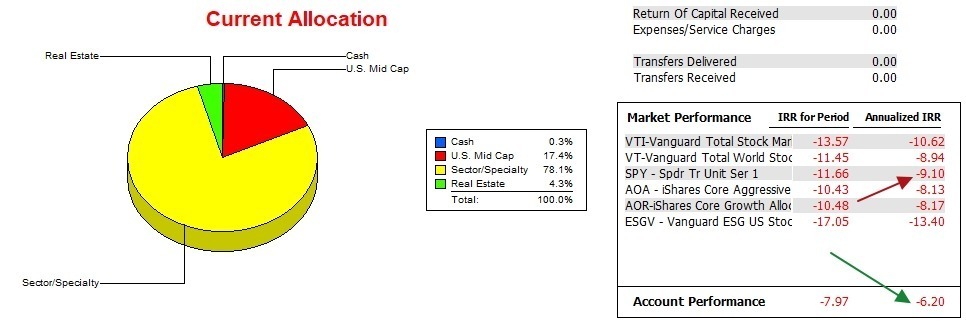
Gauss Performance Data
The Gauss was one of the last portfolios to be converted from the Dual Momentum™ model over to the Sector BPI model. While it is still too early to come up with any conclusions, the early results are positive. As we see from the following IAM portfolio tracking software, the Gauss holds a commanding lead over the SPY benchmark as well as either the AOA or AOR index funds.
The following data goes back to 12/31/2021 as the launch portfolio. This starting date takes into account the newest portfolios tracked here at ITA. A new owner was taken on at the end of 2021.
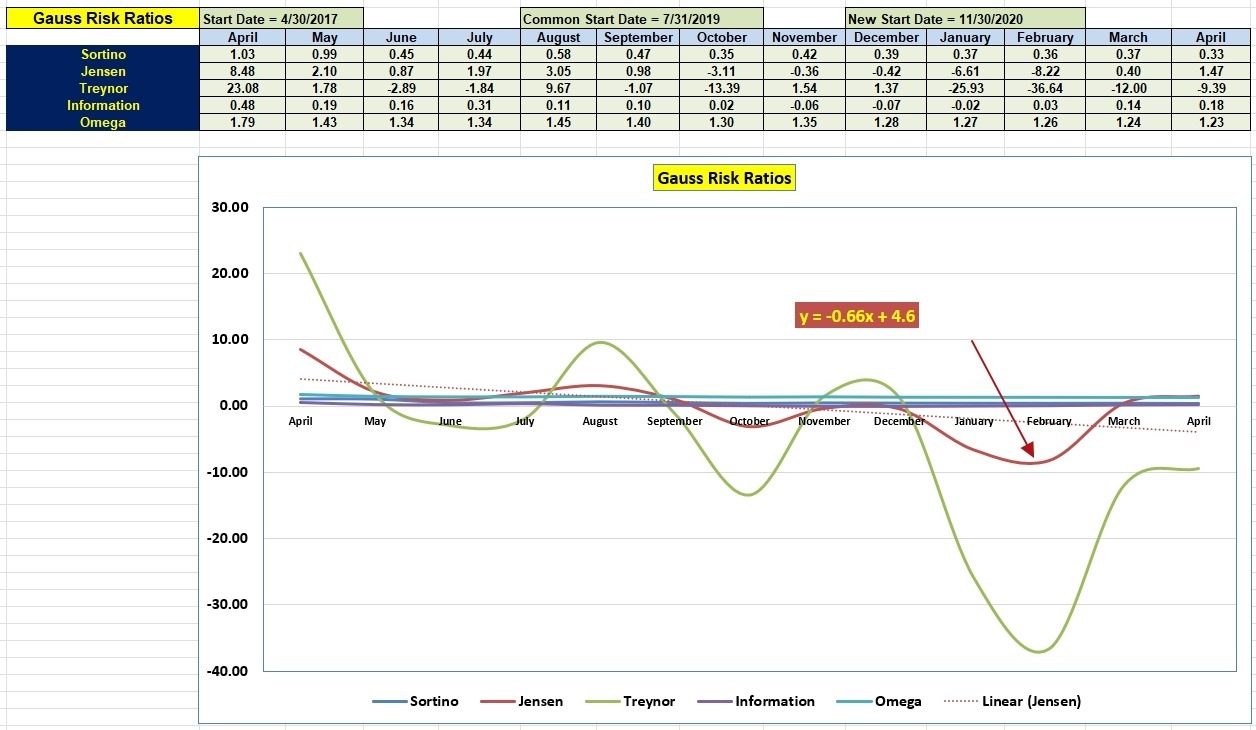
Gauss Risk Ratios
In addition to the Internal Rate of Return we also measure the risk associated with each of the ITA portfolios. Last fall I had concerns over the risks involved with the DM model and was looking for a change. Check the Jensen values and one sees recent improvement. The Information Ratio is also showing improved performance with respect to the benchmark.
As the months roll by, pay attention to the Carson, Franklin, Gauss, and Millikan portfolios as those are the four examples of this new and unique sector investing model.
Gauss Portfolio Update: 19 March 2023
Discover more from ITA Wealth Management
Subscribe to get the latest posts sent to your email.
Shortly after finishing the Gauss update 230 shares of Energy (VDE) were sold out of the Gauss as the ETF hit the 3% TSLO mark. This released a considerable amount of cash so I placed limit orders for VEA, next up on the Buy list.
I still had additional cash so I moved down into the CEF region and set additional limit orders to pick up income generating securities. Readers will see what transpired when the next Gauss review is posted.
When VDE was sold I opened up the Investment Account Manager (IAM) software to see if the sector made any money. Here is the data. IRR for the period invested is 14.5% and the annualized IRR is 54.4%. This investment was successful. The Sector BPI model worked in this instance.
Let me know if you have questions related to these two different Internal Rate of Return (IRR) values.
Lowell
Since Energy (VDE) was sold out of the Gauss this morning there is a high probability it was also sold out of the other three Sector BPI Plus portfolios so I plan to check on that tomorrow and reinvest any available cash.
Lowell