
“American Falls” on the U.S. Side of the Niagara River
US equity markets remain bullish and at new all-times highs as they test an important potential resistance level at~6450 in the SPX (S&P 500 Index):
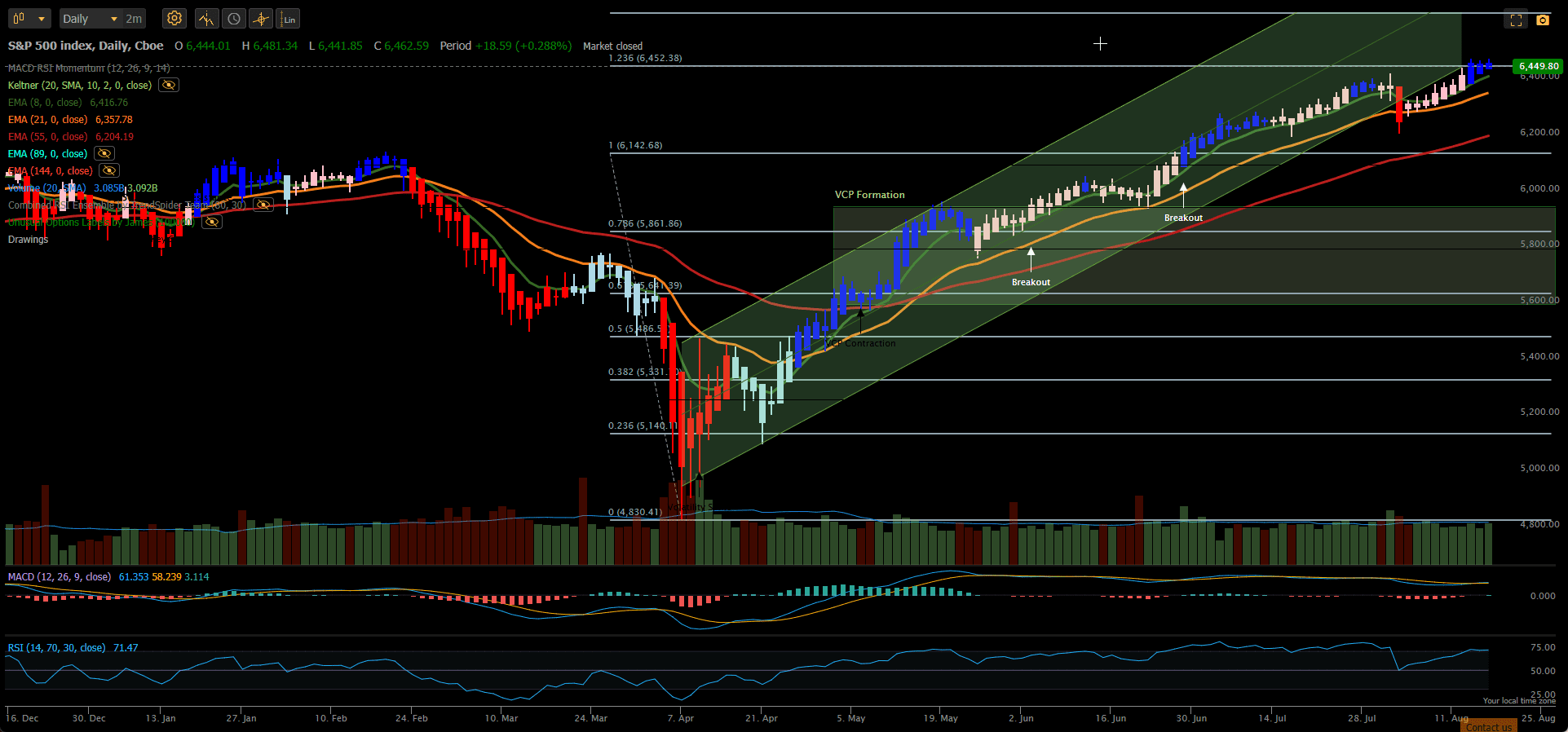
As we can see from the above chart, the 8-, 21- and 55-period Exponential Moving Averages (EMAs) are stacked bullishly one above the other and price is sitting above all of them. In addition, the MACD and RSI Indicators are all flashing confirmatory bullish signals. Now we wait to see whether momentum can take us through 6450 to the next potential resistance level at ~6650 (1.382 Fibonacci extention level). This will be interesting as we approach September – historically the weakest seasonal month of the year for US equities.
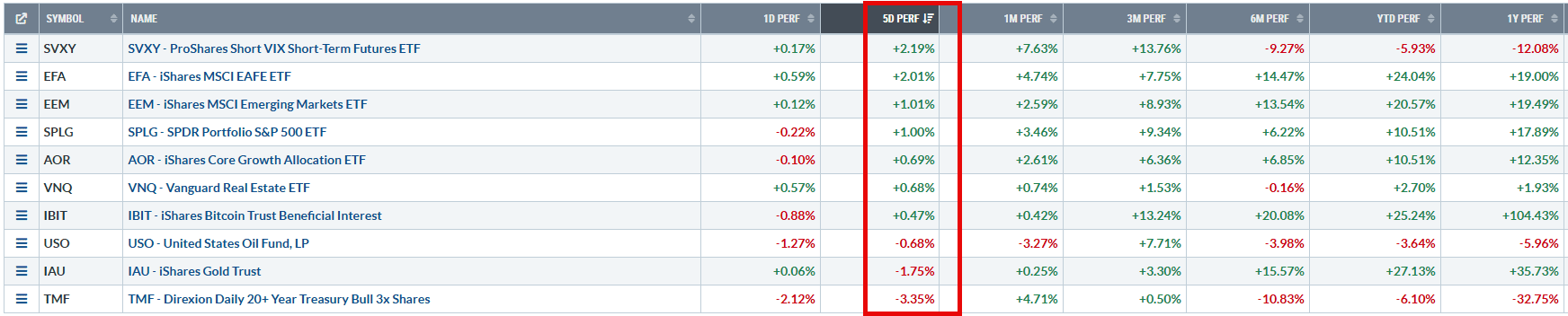
Compared to other major asset classes US equities fell in line with other equity markets, although developed markets were a little stronger:
 Rankings and recommendations for the Darwin Porfolio, from the Kipling workbook, look like this:
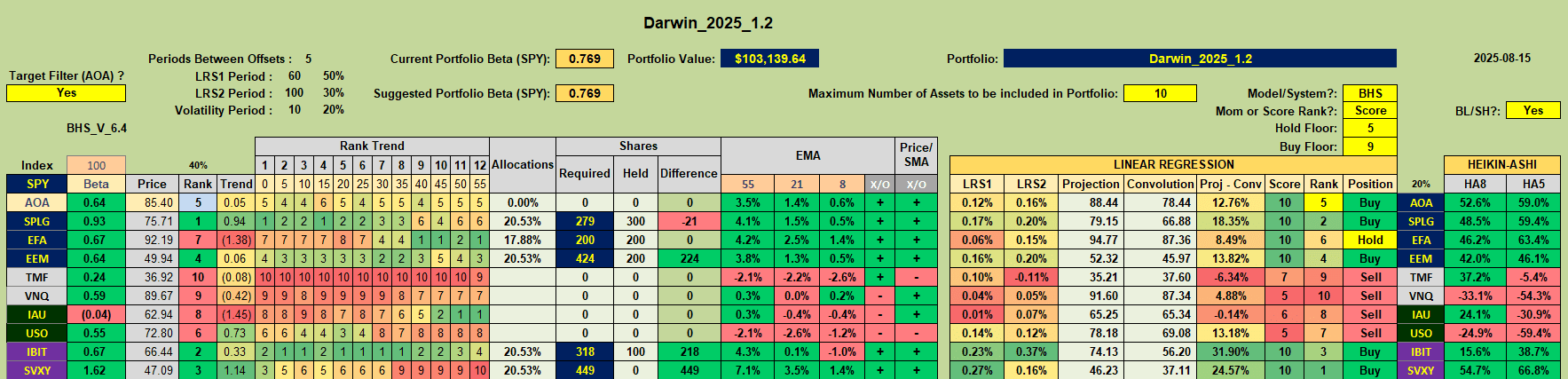 so, with weakness showing in VNQ (Real Estate) and USO (Oil) I sold out of my holdings in these 2 ETFs on Friday.
I was also holding short Call Option positions in all ETFs that were held and these expired at Friday’s close. Since the strike Price of the Call Options against holdings in VNQ and USO was above the closing market price of the underlying holdings the Options expired worthless and I got to keep the premiums received when I sold the Options. Options sold against the other holdings, IBIT (Crypto), EEM (Emerging Markets), SPLG (US Large Cap) and EFA (Developed Markets) were all trading In-The-Money (ITM) with the market price of the underlying asset trading above the strike price of the Options sold. This means that the Options would have been exercised and the shares that I was holding would have been taken away from me. However, since all these ETFs have a Buy or Hold recommendation attached to them, I chose to keep the shares and roll the short Call Options up in price and out in time (just 1 week). This resulted in losses in the Option positions, which were offset by profits from the underlying shares, but, nevertheless, limiting potential profits.
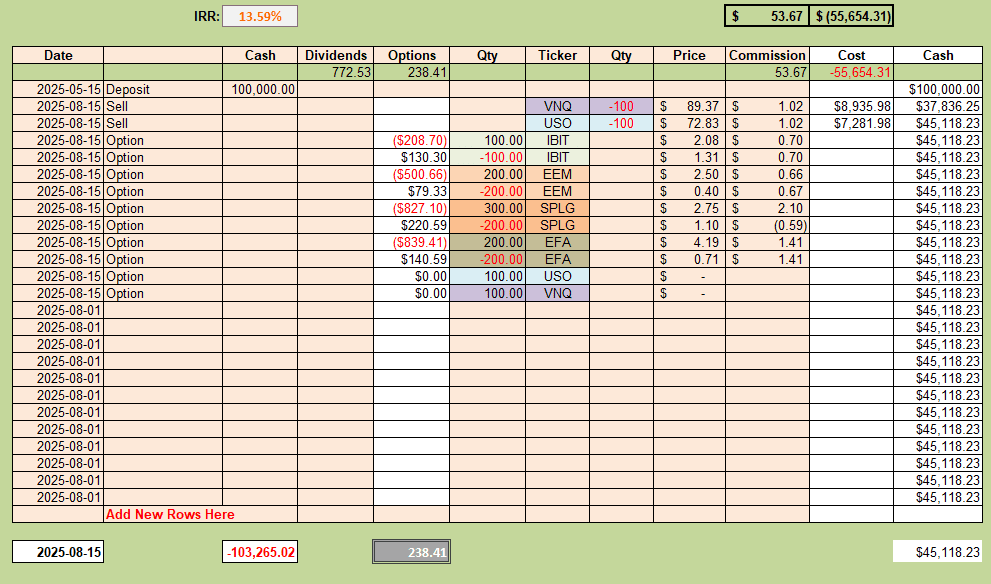
As I mentioned last week I was overhedged in these positions so I will have to rethink my hedging strategy going forward. I am working on a new algorithm for this rotational strategy although it will follow similar logic to the existing algorithms in the Kipling workbook – just a slightly different way of “scoring” the assets.
Checking on the hedging/risk management positions:
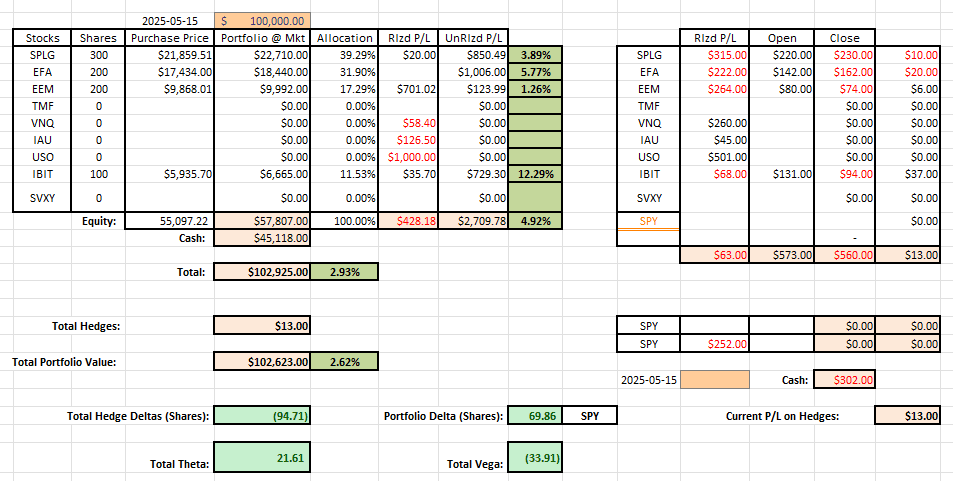 we see that I am currently showing a $302 loss on the hedge positions. It would obviously be more comforting if I were showing a profit – but we don’t normally get paid for insuring our assets, so this is ok despite the fact that I was greatly overhedged – in fact, I am still overhedged for the next week with minus 95 equivalent SPY shares in short Call Options against only plus 70 equivalent SPY shares in ETF holdings. On the brighter side we see that my timing on entry into the Oil sector (USO) was poor with a $1,000 loss on the shares purchase – but that half of this, ~$500, was recouped from the sale of Call Options. Real Estate (VNQ) went nowhere and I lost $58 from the purchase of VNQ shares but took in a profit of $260 from the sale of Call Options for a net credit of ~$200. However, overhedging the equity markets has cost me ~$800 in potential profits so I will have to try to correct this even though it reduces volatility and does not constitute a net loss:
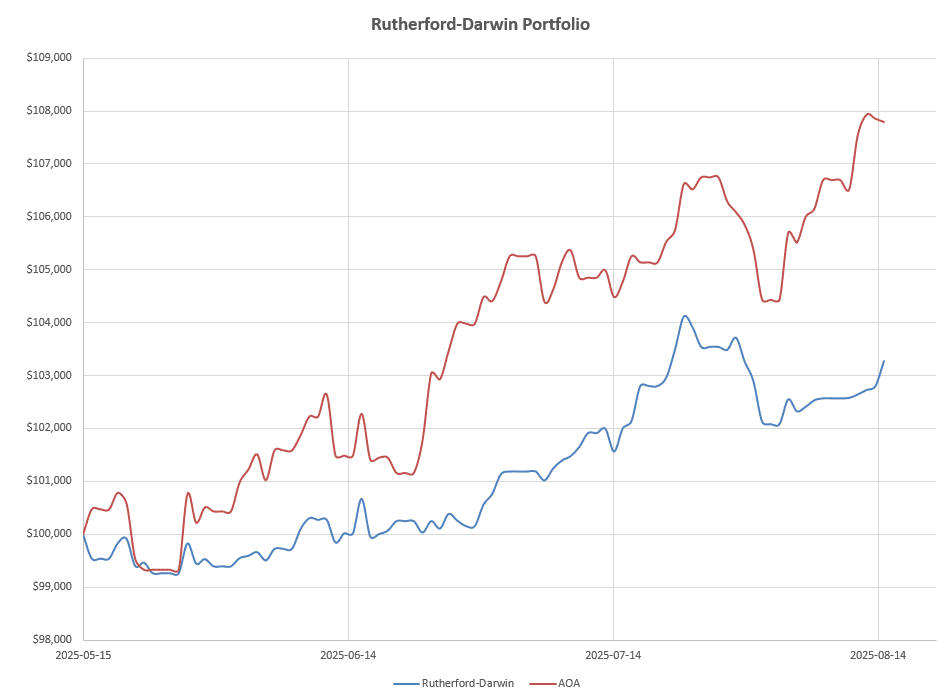 The above graph shows a comparison of the performance of the portfolio against the benchmark AOA fund and, while the returns are lower, this is impacted by the fact that I have not been 100% fully invested (at the moment I am slightly less than 60% invested) but the nice thing is that portfolio volatility is at only 4.8% versus 8.4% for the benchmark fund – i.e. risk-adjusted returns are better – and this becomes more important to us as we get older. Internal Rate of Return (IRR) on the hedged portfolio is still at a comfortable 13.6%.
Discover more from ITA Wealth Management
Subscribe to get the latest posts sent to your email.
Leave a Comment or Question